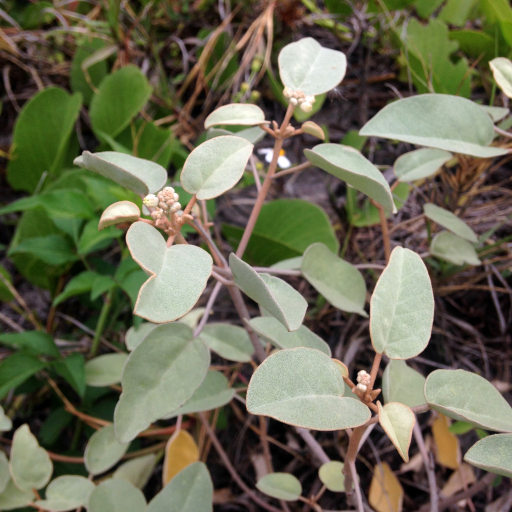
Plant Overview
Known as the Gulf Croton or Beach Croton, this resilient survivor is the "silver ghost" of the southern coastlines. Often appearing as a shimmering, metallic mist against the white sand, it acts as a natural anchor for shifting dunes. It is a plant built for the extremes, thriving in environments that would wither most other garden species.
🔍 How to Identify
- 🍃 Foliage: The leaves are the most striking feature—oval to elliptical and covered in a dense layer of silvery-gray, star-shaped hairs that give the plant a soft, felt-like texture.
- 🌼 Flowers: The blooms are tiny and inconspicuous, lacking showy petals. They appear on short spikes and are often a pale yellowish-green that blends into the foliage.
- 📏 Growth Habit: It typically forms a low, rounded mound about 1 to 3 feet tall. Its woody base helps it stay grounded even during heavy coastal winds.
🏡 In Your Garden
- 🏖️ Coastal Champion: This is the ultimate plant for "front-line" salt exposure. Because it evolved on sand dunes, it is exceptionally tolerant of salt spray and poor, sandy soils where nutrients are scarce.
- 🏜️ Xeriscaping Star: It hates "wet feet." If you plant it at home, ensure the soil is extremely well-draining (sandy or gravelly). It is a perfect choice for low-maintenance, water-wise gardens in hot climates.
⚠️ Safety & Toxicity
- 🚫 Irritant Sap: Like many members of the Euphorbiaceae (Spurge) family, Gulf Croton contains a milky sap that can cause contact dermatitis or skin irritation for some people.
- 🐾 Ingestion Warning: The plant is considered toxic to pets and humans if eaten. Ingesting the leaves or seeds can lead to significant stomach upset or vomiting. Always wear gloves when pruning.
✨ Fun Fact
The specific name punctatus is Latin for "dotted" or "spotted." If you look very closely at the silvery leaf surface with a magnifying glass, you can see tiny brownish scales or glands that look like a pattern of microscopic dots!

Detailed Care Instructions
To grow Croton Punctatus plants, follow these steps:
- Choose a location: Croton Punctatus plants require bright indirect sunlight, so choose a spot with plenty of natural light but without direct exposure to harsh sunlight.
- Soil: Croton Punctatus plants prefer well-draining soil. Use a potting mix that is rich in organic matter and has good drainage properties.
- Planting: Select a pot that is slightly larger than the current size of the plant. Fill the pot with the potting mix, leaving enough space for the plant's roots. Carefully remove the plant from its current container and place it in the new pot, making sure the roots are covered with soil.
- Watering: Water the plant thoroughly after planting and keep the soil moist but not waterlogged. Croton Punctatus plants prefer slightly moist soil, so monitor the moisture level regularly and adjust the watering accordingly.
- Humidity: Croton Punctatus plants prefer high humidity levels. You can increase the humidity around the plant by placing a tray of water near it or using a humidifier.
- Temperature: These plants prefer warm temperatures ranging from 60-85°F (15-29°C). Avoid placing them in areas with extreme temperature fluctuations or cold drafts.
- Fertilizer: Feed your Croton Punctatus plant with a balanced fertilizer during the growing season (spring and summer) every month or as directed by the brand. Reduce or stop fertilizing during the dormant period in fall and winter.
- Pruning: Prune your Croton Punctatus plant to maintain a desired shape and encourage bushier growth. Remove any yellow or damaged leaves regularly.
- Pest control: Monitor your plant for common pests like spider mites and mealybugs. If you notice any infestation, treat it with an appropriate insecticide or use organic pest control methods.
- Repotting: If your Croton Punctatus plant outgrows its current pot, or if you notice that the roots are circling the bottom, it's time to repot into a slightly larger container. Repeat the steps mentioned earlier for repotting.
Remember to research the specific requirements of the Croton Punctatus variety you have, as some may have specific care needs.

Place in a bright room that is sun drenched almost all day. Or directly in a south-facing window.

When it comes to watering this particular plant, it is important to first determine the type of soil it is growing in. It should be moist but not waterlogged, so avoid overwatering or letting the soil dry out completely.
To water it properly, you should allow the top layer of soil to dry out slightly between watering. Only water the plant when the soil feels dry to the touch, about 1-2 inches below the surface.
When watering, ensure that the water is evenly distributed throughout the soil, and avoid getting water on the leaves as this can cause them to rot or become diseased.
In general, this plant prefers to be kept evenly moist and thrives in humidity, so consider using a pebble tray or misting the leaves regularly to keep it hydrated.
Overall, remember to monitor the soil moisture levels regularly to ensure the proper watering frequency for this particular plant.
- Use a fertilizer with an NPK ratio of 3-1-2, or higher in nitrogen.
- Apply the fertilizer once a month during the growing season (spring and summer).
- Dilute the fertilizer by half the recommended dosage to prevent burning the plant.
- Apply the fertilizer to the soil around the base of the plant, not on the leaves.
- Water the plant well before and after fertilizing to prevent root burn.
- Avoid fertilizing in the winter when the plant is dormant.
Croton Punctatus plant requires a well-draining soil that is rich in organic matter and provides good aeration to the roots. The ideal soil is slightly acidic to neutral, with a pH range between 5.5 and 7.0. It should be a mixture of sand, perlite, and peat moss or coconut coir to provide good drainage, retain moisture, and promote healthy root growth. Additionally, it should be free of any harmful chemicals or toxins that may damage the plant.
Croton Punctatus plant can be propagated through stem cuttings. Select a mature and healthy stem and cut it at an angle of 45 degrees with a clean and sharp knife. Remove the leaves from the bottom 2-3 inches of the stem, and dip the cut end in rooting hormone powder. Plant the stem cutting in a pot filled with well-draining soil. Water the soil and cover the pot with a plastic bag to create a humid environment. Place the pot in a location with indirect sunlight. Keep the soil moist but not soggy, and remove the plastic bag after a few weeks when the cutting has started growing new leaves. Allow the plant to grow until it reaches a suitable size to transplant into a larger pot or directly into the garden.








