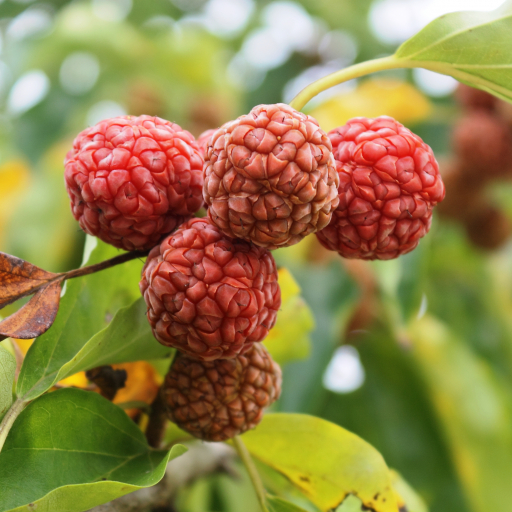
Plant Overview
Often called the Mandarin Melon Berry or Che, this fascinating tree is a rugged relative of the Mulberry and the Osage Orange. Hailing from East Asia, it has been cherished for centuries not just for its sweet, melon-flavored fruit, but also as a traditional secondary food source for silkworms. It is a hardy, eccentric survivor that brings a taste of the exotic to temperate gardens.
🔍 How to Identify
- 🍃 The Foliage: Young leaves often feature three distinct lobes (giving it the name tricuspidata), while older leaves on mature branches tend to be simple, oval, and glossy dark green.
- 🍓 The Fruit: The fruit is a "syncarp," looking like a firm, bumpy red ball or a cross between a raspberry and a brain. It turns a deep, dull red when fully ripe.
- ⚔️ The Defense: Young branches are typically armed with sharp, stout thorns. As the tree ages, it often loses these thorns on the upper growth, focusing its energy on fruit production instead.
🏡 In Your Garden
- ☀️ Sun & Ripening: While the tree is incredibly cold-hardy (surviving down to Zone 5), it requires a long, hot summer to properly ripen its fruit. Plant it in the sunniest spot available to ensure the berries develop their signature sweetness.
- 🌳 Gender Matters: This species is typically "dioecious," meaning you need both a male and a female tree to get fruit. However, many modern garden varieties are grafted to be self-fertile or are "parthenocarpic," producing fruit without a mate.
- ✂️ Vigorous Growth: It can be quite a rambunctious grower, often sending up "suckers" from the roots. Regular pruning is necessary if you want to keep it as a manageable garden tree rather than a wild thicket.
⚠️ Safety & Toxicity
- 🟢 Status: Generally safe and non-toxic.
- 🩹 Physical Hazard: The primary danger is the thorns. They are stiff and sharp, so thick gardening gloves are a must when pruning or harvesting.
- 💧 Latex Sap: Like its cousins the Fig and Mulberry, the stems contain a milky white sap. While not strictly toxic, this latex can cause mild skin irritation in sensitive individuals or those with latex allergies.
✨ Fun Fact
In its native regions of China and Korea, the Mandarin Melon Berry was historically the "Plan B" for the silk industry. If Mulberry leaves ran out, silkworms were fed Che leaves—though legend says this produced a tougher, lower-quality silk!

Detailed Care Instructions

Place in a bright room that is sun drenched almost all day. Or directly in a south-facing window.

The presence of a dry surface layer of soil does not indicate that the plant requires water. Instead, stick your finger 1-2" (3-5 cm) deep in the soil to feel dampness or moisture content. If the soil seems dry, it's time to water your greens. If the soil is still moist, however, it is better not to water your plant and instead wait a day or two. Overwatering or waterlogging raises the risk of root rot. So if the soil takes longer than a week to dry, check the light conditions because it's likely that the plant isn't getting enough light. It's fine if the upper layer of soil is dry between waterings, but the deeper soil layer should always have some moisture.








