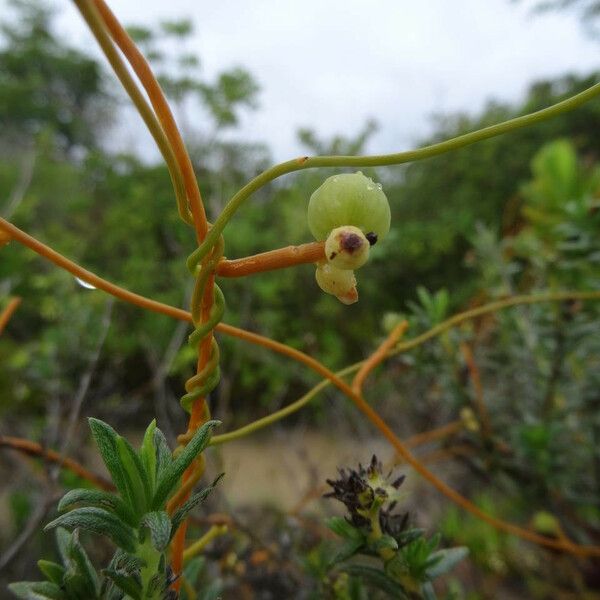
Plant Overview
Often called "Love Vine," "Witch’s Hair," or "Devil’s Gut," Cuscuta americana is nature’s ultimate botanical freeloader. This golden, stringy vine lacks chlorophyll, meaning it cannot produce its own food through photosynthesis; instead, it survives by stealing nutrients from other plants. In many cultures, its tangled, golden appearance has inspired myths of trapped spirits or a "love" that clings too tightly.
🔍 How to Identify
- 🧶 The Stems: Look for thin, leafless, spaghetti-like strands that are typically bright yellow, vibrant orange, or occasionally reddish.
- 🌸 The Flowers: Small, waxy, bell-shaped flowers that grow in tight clusters. They are usually white to creamy-tan and appear quite delicate.
- 🍃 The Foliage: You won’t find traditional leaves here. Because the plant doesn't photosynthesize, its leaves have been reduced to tiny, almost invisible scales.
🏡 In Your Garden
- 🧛 The Parasitic Habit: This plant is a "holoparasite." Once it finds a host, it wraps around it and inserts tiny feeding tubes called haustoria into the host's stem to drain its water and sugar.
- ✂️ Management Challenges: If you find this "hair" in your garden, act fast. Because it weaves itself into the vascular system of its host, you often have to prune the host plant significantly to remove the dodder. Simply pulling the "strings" off rarely works, as any small piece left behind can regrow.
⚠️ Safety & Toxicity
- 🟢 General Safety: Cuscuta americana is generally non-toxic to humans and pets if touched. It does not have stinging hairs or irritating sap.
- 🐾 Livestock Warning: While safe for most garden pets, some species of Dodder can be problematic for livestock if consumed in very large quantities, as they contain high levels of certain alkaloids.
- 🥀 Host Health: The real danger is to your other plants! It acts like a biological vampire, weakening your favorite shrubs or crops and potentially spreading plant viruses from one host to another.
✨ Fun Fact
American Dodder can actually "smell" its prey! Seedlings can sense the volatile chemicals (scents) released by nearby plants, allowing them to "hunt" and grow specifically toward a preferred host, like a tomato plant, rather than just growing at random.

Detailed Care Instructions
To grow Cuscuta Americana, also known as American dodder, follow these steps:
- Select a suitable location: Cuscuta Americana is a parasitic plant that requires a host plant to grow. Choose an area where suitable host plants are present or can be planted alongside Cuscuta Americana.
- Prepare the soil: The soil should be well-draining and rich in organic matter. Clear any weeds or debris from the area.
- Obtain seeds or young plants: Cuscuta Americana can be grown from seeds or young plants. Seeds can be purchased from a reputable nursery or collected from mature plants.
- Choose appropriate host plants: Cuscuta Americana typically prefers perennial hosts such as sunflowers, tomatoes, and morning glories. Select suitable host plants and plant them in the chosen location.
- Plant the Cuscuta Americana: The best time to plant Cuscuta Americana is in early spring. Sow the seeds or transplant young plants near the chosen host plants.
- Water regularly: Keep the soil moist but not waterlogged. Cuscuta Americana requires sufficient moisture for growth.
- Monitor growth and control the spread: Cuscuta Americana can be invasive, so it's important to monitor its growth and prevent it from spreading too far. Prune or remove any excessive growth to maintain control.
- Be patient: Cuscuta Americana takes time to establish and grow. It may take several weeks or even months for significant growth to occur.
- Provide support for host plants: As Cuscuta Americana is a twining vine, it may require support to climb and wrap around the host plants. Install trellises, stakes, or other structures to aid the plants' growth.
- Maintain suitable growing conditions: Ensure the host plants are healthy and well-maintained by providing adequate sunlight, water, and nutrients. This will support the growth of both the host plants and Cuscuta Americana.
Remember to check local regulations and restrictions regarding the cultivation of Cuscuta Americana, as it may be considered invasive in some areas.
To properly water this plant, it is important to use a watering can or hose with a fine nozzle to ensure that the water reaches the soil without disturbing the plant's delicate roots. The frequency and amount of water required will vary depending on a number of factors, including the plant's age, size, and environmental conditions. In general, however, it is important to avoid over-watering, as this can lead to root rot and other diseases. To determine when the plant needs water, it is a good idea to check the soil moisture level regularly by sticking your finger into the soil up to the first joint. If the soil feels dry, it is time to water. It is also important to water the plant in the morning or early evening to avoid evaporation and to give the plant time to absorb the moisture before the heat of the day sets in.
To promote healthy growth of this plant, apply a balanced fertilizer with a ratio of 10-10-10. Mix the fertilizer with water according to the package instructions and apply it to the soil around the base of the plant. Avoid getting the fertilizer on the leaves or stems of the plant, as it may cause damage. Fertilize the plant every two weeks during the growing season, which typically lasts from spring to fall. Adjust the frequency and amount of fertilizer based on the plant's response and growth rate.
In order to grow the plant that is commonly known as Cuscuta Americana, it is important to use a specific type of soil. This plant requires soil that is well-draining and nutrient-rich, as it is a parasitic plant that relies on its host for nutrients. It is recommended to mix the soil with organic matter, such as compost or leaf mold, to provide additional nutrients and improve soil structure. The soil should also have a neutral to slightly acidic pH level. Additionally, it is important to ensure that the soil is moist but not saturated, as excess water can harm the plant.
There are several ways to propagate this plant. One method is to collect the seeds from the mature plant and sow them in a suitable soil mix. The germination period can vary, but it is typically within a few weeks to a month. Another method is to take stem cuttings and root them in a moist soil mix. To do this, select a healthy stem and make a clean cut just below a node. Remove any leaves or twigs from the bottom half of the stem, leaving a few leaves at the top. Dip the cut end of the stem in rooting hormone and plant it in a pot with well-draining soil. Keep the soil moist and warm, and in a few weeks, the cutting should begin to take root and grow. Lastly, this plant can also propagate through layering. To do this, select a healthy stem and bend it down to the ground, where it can make contact with the soil. You can either pin the stem down with a small stake or cover it with soil. Over time, the stem will root and a new plant will develop.








