Plant Overview
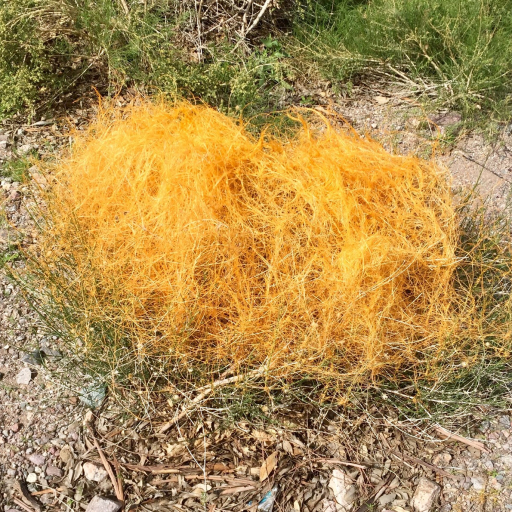
Often referred to as "Desert Dodder" or "Witch’s Hair," Cuscuta denticulata is a fascinating botanical outlaw. Looking more like a bundle of tangled orange spaghetti than a traditional plant, this parasitic vine has completely abandoned the color green. Instead of making its own food through photosynthesis, it lives a "vampiric" lifestyle, wrapping itself around desert shrubs to steal the nutrients it needs to survive.
🔍 How to Identify
- 🧶 The Stems: Look for thin, leafless, wiry threads that range in color from pale yellow to a vibrant, sun-baked orange.
- 🔔 The Flowers: It produces tiny, bell-shaped white or cream flowers that grow in small, dense clusters along the stems.
- 🦷 The "Teeth": The name denticulata refers to the microscopic, tooth-like scales found inside the tiny flowers—a detail usually only visible with a magnifying glass.
- 🔗 The Grip: Unlike climbing vines that use tendrils, Dodder uses "haustoria"—specialized sucking organs that pierce the bark of the host plant to tap into its internal plumbing.
🌵 Habitat & Ecology
- 🏜️ Desert Specialist: You will primarily find this plant in the arid regions of the Southwestern United States and Northern Mexico, draped over host plants like Creosote bushes, Saltbush, or Buckwheat.
- 💧 A Resource Thief: Because it doesn't have a traditional root system in the soil, it is entirely dependent on its host for water. In the heat of the desert, it is a master at staying hydrated by taking what it needs from hardier plants.
- 🌾 Ecological Balance: While it looks like it’s "strangling" the host, in the wild, it acts as a natural regulator, preventing certain fast-growing shrubs from completely dominating the landscape.
⚠️ Safety & Toxicity
- ✅ Status: Non-toxic to humans and pets.
- 🛡️ Garden Threat: While safe to touch, it is a major "safety" concern for your other plants. If it hitches a ride into your garden, it can quickly weaken and kill ornamental shrubs. It is difficult to eradicate because even a tiny fragment of the vine left on a host can regrow.
✨ Fun Fact
- 👃 Sniffing Out Prey: Dodder seedlings don't just grow randomly; they can actually "smell" their host plants. They sense volatile chemicals (scents) released by nearby vegetation and will grow specifically in the direction of the "tastiest" host!

Detailed Care Instructions
To grow Cuscuta denticulata, also known as the large-toothed dodder or toothed dodder, you can follow these steps:
- Obtain the plant: You can find seeds or young plants at local nurseries, botanical gardens, or online seed stores.
- Select a suitable location: Cuscuta denticulata is a parasitic plant that grows on other plants, so it requires a host plant to survive. Choose a location where there are suitable host plants nearby.
- Identify host plants: Cuscuta denticulata prefers to grow on woody plant species like shrubs or trees. Some commonly used host plants include acacias, citrus trees, and forest trees. Identify suitable host plants in your area.
- Prepare the host plant: Ensure that the host plant is healthy and well-established. Trim any dead or weak branches to promote better growth for both the host plant and the Cuscuta denticulata.
- Planting the dodder: Sow the dodder seeds or plant the young dodder plant at the base of the host plant. Gently press the seeds or roots into the soil, making sure they have good contact with the ground.
- Provide support: As the dodder grows, it will twine and climb up the host plant. You may need to guide its growth initially, gently training it onto the preferred direction.
- Maintain suitable conditions: Ensure the host plant receives adequate sunlight, water, and nutrients to support both its growth and the Cuscuta denticulata. Regularly monitor the health of both plants and make any necessary adjustments.
- Monitor and control growth: Dodder is a parasitic plant, and its growth can be rapid and invasive. Regularly check for any signs of excessive growth or potential harm to the host plant. If needed, you can manually remove or prune the dodder to control its spread.
Note: Dodder is a parasitic plant that can negatively impact other plants if allowed to grow unchecked. Make sure to choose suitable host plants and monitor its growth to prevent it from overpowering or damaging them.

To water this plant, it is important to first understand its specific watering needs. One should consider the amount of sunlight and temperature the plant receives, as well as the type of soil it is planted in.
When watering, it is important not to overwater the plant, as it is susceptible to root rot. The soil should be moist to the touch, but not soaking wet. It is recommended to water the plant once or twice a week, depending on its individual needs.
When watering, one should water at the base of the plant, avoiding getting water on the leaves or stems. This can help prevent fungus or mold growth. The plant should also be allowed to drain properly, ensuring that there is no excess water sitting in the pot or container.
Overall, it is important to monitor the plant's watering needs and adjust as necessary. With proper care, the plant can thrive and grow to its full potential.
To fertilize this plant, apply a balanced fertilizer, such as a 10-10-10 or 20-20-20 formula, during the growing season. Mix the fertilizer with water according to the package instructions and apply it to the soil around the plant. Avoid getting fertilizer on the leaves, as this can cause burning. Water the plant after fertilizing to help the nutrients soak into the soil. Apply fertilizer every four to six weeks during the growing season, or as needed based on the plant's growth and health.
The type of soil that is suitable for the Cuscuta Denticulata plant should have a pH level between 6.0 to 7.5 and be well-draining. The plant can thrive in soil that is light, sandy, or loamy and should not be too compact or heavy. To ensure proper growth and development, the soil should also be rich in nutrients and organic matter. Adequate moisture should be provided, but the soil should not be waterlogged, as it may lead to root rot. Additionally, the plant should not be planted in soil that has been previously used to grow its host plants, as it may cause the spread of disease.
Cuscuta Denticulata is a parasitic plant that can be propagated through its seeds. To propagate this plant, you need to follow the below steps:
- Collect the seeds from a mature Cuscuta Denticulata plant. You can identify a mature plant by looking for its yellow or orange stem.
- Clean the seeds by removing any debris, dirt or dust from them using a small brush.
- Prepare a soil mix consisting of peat, sand, and vermiculite in equal parts.
- Fill a seedling tray or a small pot with soil mix.
- Sprinkle the cleaned seeds on top of the soil mix. Be careful not to bury them, as they need light to germinate.
- Water the soil mix lightly to keep it damp.
- Place the seedling tray or pot in a warm and bright location, but not in direct sunlight.
- Keep the soil mix damp but not waterlogged. The germination time may take up to two weeks.
- Once the seedlings have emerged, water them regularly and fertilize them with a balanced fertilizer every two weeks.
- Transplant the seedlings into larger pots or to a suitable location in the garden once they have grown to a suitable size.
- Take care not to disturb the roots when transplanting, as Cuscuta Denticulata has fragile roots.
By following these steps, you can propagate Cuscuta Denticulata successfully.








