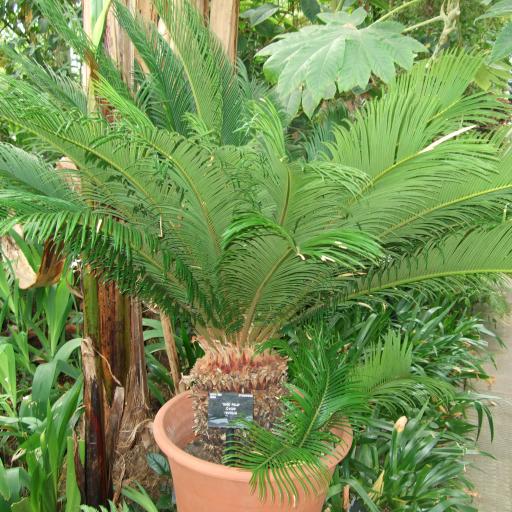
Plant Overview
Often called the "Sago Palm," this architectural marvel isn't a palm at all—it’s a cycad, a lineage of plants that has survived since the time of the dinosaurs. With its symmetrical crown of stiff, glossy fronds, it adds a prehistoric elegance to any room or garden. It is a slow-growing "living fossil" that rewards patient gardeners with a lifetime of companionship.
🔍 How to Identify
- 🌿 The Fronds: Deep green, stiff, and feather-like, curving slightly outward from a central point. Each leaflet ends in a sharp, needle-like tip.
- 🪵 The Trunk: Thick, shaggy, and dark brown, resembling a rough pineapple or a woody stump as the plant matures.
- 🕯️ The "Flowers": It doesn't produce true flowers; instead, mature plants grow large, cone-like structures (strobili) in the very center of the leaf crown.
🏡 In Your Garden
- ⏳ Patience is Key: This plant is an exceptionally slow grower, often only producing one "flush" of new leaves per year. Don't be alarmed if it seems "stuck" for months at a time.
- 🏜️ Drainage is Vital: Because it evolved in rocky, coastal environments, it absolutely hates "wet feet." Using a sandy or perlite-heavy mix is essential to prevent the dreaded root rot.
- 🌤️ Light Nuance: While it loves bright, indirect light, moving it from a dim indoor corner to direct summer sun too quickly can scorch the leaves, leaving permanent yellow or white spots.
⚠️ Safety & Toxicity
- 🚫 High Toxicity: Every part of the Sago Palm is highly toxic if ingested, but the seeds (often called "nuts") contain the highest concentration of the toxin cycasin.
- 🐾 Pet Warning: This is one of the most dangerous plants for dogs and cats. Ingestion can lead to permanent liver damage or death. Keep it on a high pedestal or in a restricted area if you have curious pets or toddlers.
✨ Fun Fact
🦕 Dinosaur Food: Cycads like the Cycas revoluta were a primary food source for herbivorous dinosaurs during the Jurassic period. When you look at a Sago Palm, you are looking at a plant design that hasn't changed much in over 200 million years!

Detailed Care Instructions
| Soil Ph | 5.5 To 6.5 |
| Humidity | Normal |
| Lighting | Part Sun |
| Toxicity | Poisonous |
| Soil Type | Sandy, Humusy, Medium Moisture, Well-Draining |
| Difficulty | Medium |
| Plant Type | Perennial Shrub |
| Mature Size | 3 To 10 Feet Tall And Wide |
| Native Area | Japan |
| Temperature | 18°C - 24°C |
| Sun Exposure | Full Sun To Part Shade |
| Hardiness Zones | 9-10 |
To grow a Cycas Revoluta plant, also known as a Sago palm, you can follow these steps:
- Choose a suitable location: Sago palms thrive in indirect sunlight, so select a spot near a window with bright, filtered light. Avoid placing them in direct sunlight as it can scorch the leaves.
- Prepare the pot: Use a well-draining pot with drainage holes to avoid waterlogging. Fill it with a mixture of well-draining soil, such as a combination of cactus mix and perlite.
- Watering: Sago palms prefer drier conditions, so water the plant thoroughly when the top inch of soil is dry. Avoid overwatering, as this can lead to root rot.
- Fertilization: Feed your Cycas Revoluta with a slow-release balanced fertilizer formulated for palm plants. Apply it during the growing season, usually from spring to early fall, following the package instructions.
- Temperature and humidity: Sago palms prefer temperatures between 65-80°F (18-27°C). They can tolerate lower temperatures briefly, but prolonged exposure to frost can damage or kill the plant. Maintain average room humidity levels.
- Pruning: Remove any dead or damaged fronds by cutting them off at the base. Pruning helps maintain the plant's appearance and health.
- Repotting: As the plant grows, it may require repotting. Wait until the roots begin to grow out of the drainage holes or the plant becomes top-heavy before transferring it to a slightly larger pot with fresh soil.
- Pest control: Monitor your plant for common pests like mealybugs or scale insects. Treat them by wiping the affected areas with a damp cloth dipped in insecticidal soap or use horticultural oil.
- Propagation: Cycas Revoluta can be propagated by seeds or by removing offsets (baby plants) that grow at the base of mature plants. It is a slow-growing plant, so be patient when waiting for new growth.
Remember that Sago palms are toxic to pets and humans if ingested, so keep them out of reach.

Place in a window with dappled sun or a spot in the middle of a room. Or directly in a window facing west or east.

Cycas Revoluta is a perennial shrub that belongs to the Cycadaceae family. The plant is typically grown for its ornamental value and is well-suited to indoor and outdoor environments. Proper watering is important for the health and growth of this plant.
When watering Cycas Revoluta, it is important to ensure that the soil is moist but not waterlogged. Overwatering can lead to root rot and other fungal diseases. To determine when to water the plant, check the soil at a depth of 2-3 inches. If it is dry to the touch, then it is time to water the plant.
When watering, add water slowly and allow it to soak into the soil. Avoid pouring water over the foliage or onto the trunk of the plant, as this can lead to fungal growth or other damage. The plant also benefits from occasional misting, especially in dry or low-humidity environments.
In general, Cycas Revoluta should be watered more frequently during the growing season and less often during the dormant season. Adjust the watering schedule based on the environment and the needs of the plant, taking into account factors such as temperature, humidity, and amount of sunlight.
In summary, when watering Cycas Revoluta, it is important to:
- Check the soil to determine when to water
- Avoid overwatering to prevent fungal growth
- Water slowly and allow the water to soak in
- Avoid getting water on the foliage or trunk of the plant
- Adjust the watering schedule based on the season and environment.
To fertilize this plant, you should use a slow-release granular fertilizer with a balanced N-P-K ratio. Apply it in the spring or early summer by sprinkling it around the base of the plant, then water thoroughly. Avoid over-fertilizing, as this can damage the plant's roots. Additionally, you can supplement with liquid fertilizer during the growing season, following the manufacturer's instructions for dilution and frequency of application.
To successfully grow Cycas Revoluta plants, it is important to choose the right type of soil. The best soil for this type of plant is well-draining and slightly acidic. The soil should also be rich in nutrients, especially if the plant is being grown in a container. Some recommended types of soil for Cycas Revoluta include a mix of sand, peat moss, and perlite or a mix of composted pine bark, peat moss, and perlite. It is important to avoid using heavy soils that retain too much moisture, as this can lead to root rot. Additionally, make sure to avoid soils that are too alkaline, as this can cause nutrient deficiencies.
To propagate this plant, one will need to carefully remove the offsets or suckers from the parent plant. This can be done by gently digging around the base of the plant and separating the smaller offsets from the main root ball. Once removed, the offsets should be rinsed with water and allowed to dry for a few days before planting.
To plant the offsets, one should use a well-draining soil mixture that contains perlite or sand. Place the offsets in the soil and cover the roots with the mixture, leaving the top of the plant exposed. Water the soil thoroughly but ensure that the water is not allowed to stand around the base of the plant.
The newly planted offsets should be placed in a bright and warm location and protected from direct sunlight. The plant can take several months to establish itself, and during this time, it is essential to keep the soil moist but not wet.
With proper care and attention, the newly propagated plants will develop into mature plants within a few years.
Common pests of the sago palm include Scale insect, mealybugs. Make a habit of checking your sago palm frequently for pests so that any infestations can be caught and managed early.








