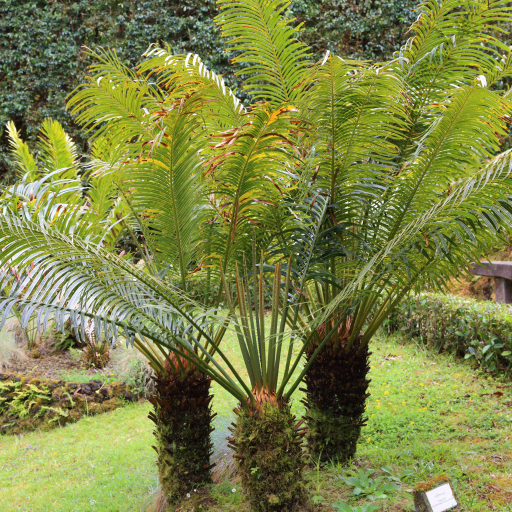
Plant Overview
Often referred to as the Queen Sago, Cycas rumphii is a living link to the prehistoric era. Despite its palm-like appearance, it is actually a cycad, a lineage of plants that flourished alongside the dinosaurs. Named after the Dutch botanist Georg Eberhard Rumphius, this elegant giant brings a touch of ancient tropical majesty to any landscape or spacious indoor collection.
🔍 How to Identify
- 🌿 The Fronds: Deep green, glossy leaflets emerge from a central crown. Unlike the King Sago, the Queen’s leaflets are wider, softer to the touch, and can reach impressive lengths of up to 7 feet.
- 🪵 The Trunk: As it matures, it develops a thick, woody, and scarred trunk that resembles a pineapple's skin, providing a sturdy base for its umbrella-like canopy.
- 🍍 The "Flowers": Since it’s a gymnosperm, it doesn't produce true flowers. Instead, it grows large, cone-like structures. Female plants produce woolly, leaf-like scales that hold large, orange-colored seeds.
🏡 In Your Garden
- 🌱 Patience is Key: The Queen Sago is a slow grower. Because it takes years to reach its full height, it is best treated as a long-term architectural focal point. Avoid transplanting once established, as its root system is sensitive to disturbance.
- ☀️ Sun & Humidity: While it craves bright, filtered light, the delicate new "flushes" of leaves can scorch in harsh, direct afternoon sun. It thrives in humid environments, making it a perfect companion for poolside gardens or misted indoor conservatories.
⚠️ Safety & Toxicity
- 🚫 Highly Toxic: All parts of the Cycas rumphii are poisonous if ingested. It contains cycasin, which can cause severe liver failure in mammals.
- 🐾 Pet & Child Alert: The seeds (nuts) are particularly dangerous because they are small and can look attractive to dogs or curious children. Additionally, the tips of the leaves can be quite sharp, potentially causing skin pricks or eye injuries.
✨ Fun Fact
Cycads like the Queen Sago are so ancient that they existed before the evolution of bees. In the wild, they rely on specialized beetles for pollination—a biological partnership that has remained largely unchanged for millions of years!

Detailed Care Instructions
To successfully grow a Cycas Rumphii plant, also known as the Queen Sago Palm, you can follow the below steps:
- Climate and Location: Cycas Rumphii thrives in warm and subtropical climates with temperatures ranging between 60-85°F (15-29°C). Ensure that you select a location that receives bright, indirect sunlight for a significant part of the day.
- Soil: The Queen Sago Palm prefers well-draining soil with good water retention. A mixture of peat moss, organic compost, and sand can create an ideal growing medium.
- Watering: Water your Cycas Rumphii plant regularly, making sure the soil is moist but not waterlogged. Avoid letting the plant sit in standing water, as it can lead to root rot. Allow the top inch of soil to dry out between watering.
- Fertilizer: Use a balanced slow-release fertilizer designed for palms or cycads during the growing season (spring and summer). Follow the package instructions for dosage and frequency. Avoid over-fertilizing, as it can harm the plant.
- Mulching: Apply a layer of organic mulch around the base of the plant to help retain moisture, regulate soil temperature, and suppress weed growth.
- Pruning: Every few years, remove any dead or yellowing fronds to encourage new growth and maintain a tidy appearance. Be cautious while pruning, as the Queen Sago Palm has sharp, needle-like spines along its foliage.
- Pests and Diseases: Monitor for pests like scale insects and mealybugs, which can infest the plant. If detected, use an appropriate insecticidal soap to treat the affected areas. Additionally, ensure good air circulation around the plant to prevent fungal diseases.
- Propagation: Cycas Rumphii can be propagated through either seeds or offsets. Seeds are typically soaked in water overnight, scarified (nicked or scratched on the surface) with sandpaper, and then planted in a well-draining mixture. Offsets, or small new plants that form around the base of the main plant, can be removed with care and repotted to grow on their own.
Remember, Cycas Rumphii is a slow-growing plant, so be patient while waiting for new growth and maturity.

Place in a bright room that is sun drenched almost all day. Or directly in a south-facing window.

To properly water this type of plant, it is important to first check the soil moisture level by gently inserting your finger a few inches into the soil. If the soil feels dry, it is time to water. When watering, slowly pour water onto the soil until it starts to drain out of the bottom of the pot. Wait until the soil has absorbed the water before placing it back in the saucer. Depending on factors such as the plant's size and environment, this type of plant may require watering every 1-2 weeks or when the soil becomes dry to the touch.
To fertilize the Cycas Rumphii plant, use a balanced fertilizer with equal parts nitrogen, phosphorus, and potassium, with additional micronutrients such as iron and magnesium. Apply the fertilizer sparingly during the growing season, from spring to fall every four to six weeks. Avoid applying fertilizer during the winter months when the plant is dormant. Be careful not to overfertilize as this can lead to burning or damaging the plant's roots.
Cycas Rumphii plant requires a well-draining soil mix that can retain some moisture. It prefers slightly acidic to neutral soil pH and requires a mix that is rich in organic matter. The soil should be loose and airy, allowing enough space for the plant roots to spread and absorb nutrients effectively.
A soil mix that includes a combination of peat moss, perlite, sand, and loam would be ideal for Cycas Rumphii plant. These components will ensure that the soil is well-drained, aerated, and has a good structure to support the plant. It is also recommended to add some fertilizers to the soil mix, such as slow-release granular fertilizers or well-decomposed organic matter, to provide essential nutrients to the plant.
Overall, the soil should be nutrient-rich, well-draining, and have a pH between 5.5 to 7.5 for optimal growth and health of Cycas Rumphii plant.
There are several ways to propagate Cycas rumphii plants, but the most common method is through seed propagation. To do this, collect mature seeds from the female plant once they have ripened and turned a reddish color. Remove the seed coat and spongy layer around the seed, and then soak the seeds in water for 24 hours to help soften the outer layer. Plant the seeds in a well-draining soil mix and keep them in a warm, humid environment with indirect sunlight. Keep the soil moist but not too wet, and in a few months, the seeds should begin to germinate.
Another method of propagation is through division. This requires an already established and mature plant. Carefully dig up the plant and remove the offsets or pups from the base of the main plant. Each pup should have some roots and a healthy shoot. Plant the pups in a well-draining soil mix and keep them in a warm, humid environment with indirect sunlight. Keep the soil moist but not too wet and the pups should begin to grow and establish themselves in the new pot.
One more method of propagation is through stem cuttings. This is a bit more difficult and less reliable than the other two methods. Cut a portion of the stem with a sharp and sterile knife, making sure to include a few leaves on the top. Dip the cut end of the stem in rooting hormone and plant it in a well-draining soil mix. Keep the soil moist but not too wet and cover the pot with a plastic bag to maintain humidity. In a few weeks, the stem may or may not start producing roots, but if it does, it will eventually grow into a new plant.








