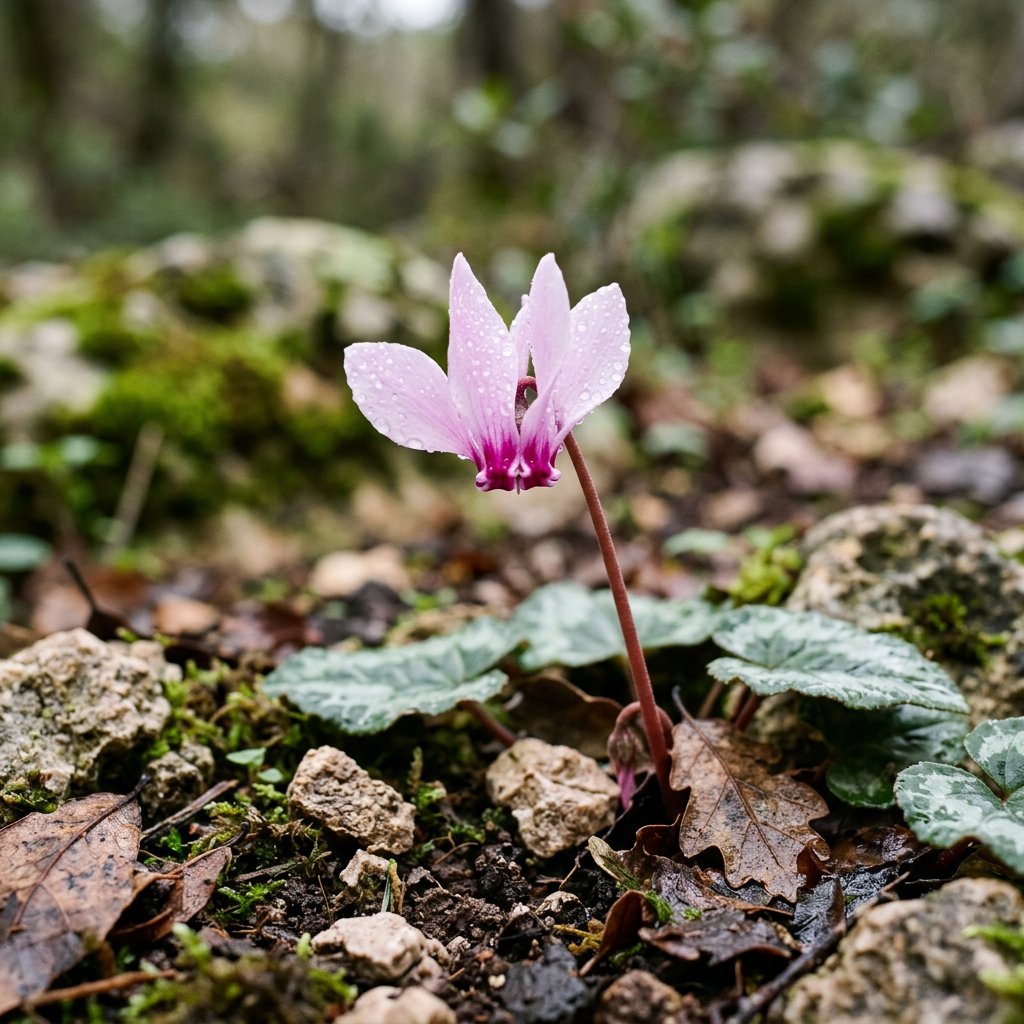
Plant Overview
Known as the "Persian Violet" or the "Indoor Butterfly," Cyclamen persicum is a winter-blooming favorite that brings vibrant color to homes when the outside world is gray. Native to the rocky hillsides of the Mediterranean, these plants are famous for their unique "upside-down" flowers and their mysterious habit of disappearing entirely during the summer months.
🔍 How to Identify
- 🦋 The Bloom: The flowers feature five petals that reflex backward, reaching toward the sky rather than hanging down, giving them the appearance of a butterfly in flight.
- 🌿 The Foliage: Thick, heart-shaped leaves that are almost as beautiful as the flowers, featuring intricate silver "halos" or marbled patterns against a dark green backdrop.
- 🌰 The Base: All growth emerges from a flattened, woody tuber called a corm, which typically sits partially exposed on the soil surface.
🏡 In Your Garden
- ❄️ The Chill Factor: Unlike most tropical houseplants, Cyclamen hates the heat. It prefers a cool, drafty windowsill and will actually stop blooming if your home is kept too toasty (above 65°F/18°C).
- 💧 Bottom-Up Drinking: These plants are highly susceptible to "crown rot." To keep them happy, never pour water into the center of the leaves; instead, let the pot sit in a saucer of water for 20 minutes so the roots can drink from the bottom.
- 😴 Summer Slumber: Do not throw the plant away when the leaves turn yellow in late spring! This is a natural dormancy period. The plant is simply taking a "summer nap" and will regrow once the weather cools down in autumn.
⚠️ Safety & Toxicity
- 🐾 Toxic to Pets: Cyclamen contains saponins that are toxic to both dogs and cats.
- 🚫 The Tuber Danger: While the leaves can cause mild stomach upset, the tubers (the potato-like base) are the most dangerous part. If a pet digs them up and eats them, it can lead to severe vomiting or even heart rhythm issues. Keep these on high shelves away from curious paws.
✨ Fun Fact
In the wild, Cyclamen seeds are coated in a sweet, sticky substance called an elaiosome. This attracts ants, who carry the seeds back to their nests to eat the coating, effectively "planting" the seeds in nutrient-rich underground tunnels where they can safely sprout!

Detailed Care Instructions
Yes, a cyclamen houseplant is easy to care for as long as it's not overwatered.
What is the difference between florist's cyclamen and hardy cyclamen?
Florist's cyclamen is tender and can typically only be grown indoors as a houseplant. Hardy cyclamen can be grown outdoors in cooler areas. When buying cyclamen at a garden center, be sure to check which one you are buying.
How long can cyclamen live?
Since cyclamen is a perennial, it can live indoors and outdoors (with the right conditions) for dozens and dozens of years.
| Color | Pink, White, And Red |
| Soil Ph | Slightly Acidic |
| Humidity | High |
| Lighting | Full Sun |
| Toxicity | Poisonous |
| Soil Type | Rich, Well-Draining |
| Bloom Time | Fall And Winter |
| Difficulty | Hard |
| Plant Type | Houseplant Or Perennial |
| Hibernation | Warm Period |
| Mature Size | 8 Inches Tall |
| Native Area | Europe, Northern Africa, And Western Asia |
| Temperature | 7°C - 15°C |
| Sun Exposure | Full Sun In Winter, Part Sun In Summer |
| Hardiness Zones | 7-8 |
To grow Cyclamen Persicum plant, you can follow these steps:
- Choose a suitable location: Cyclamen Persicum plants thrive in bright but indirect light. Place them near a north-facing window or in a spot that receives filtered sunlight. They prefer cool temperatures between 50-65°F (10-18°C) and are often grown indoors.
- Prepare the soil: Use a well-draining soil mixture that is slightly acidic to neutral. You can mix equal parts of potting soil, peat moss, and perlite or sand. This will ensure good drainage and prevent waterlogged roots.
- Planting the bulbs: Cyclamen Persicum plants are typically sold as dormant bulbs or tubers. Plant the bulbs with the pointed side up and the top exposed just at or slightly above the soil surface. Make sure the bulbs are potted shallowly to prevent rotting.
- Watering: Cyclamen Persicum plants prefer moist but not soggy soil. Water thoroughly whenever the top inch of soil feels dry to the touch. Excess water should be allowed to drain out of the pot to avoid waterlogging.
- Temperature and humidity: Maintain cool temperatures between 50-65°F (10-18°C) and provide moderate humidity levels. Misting the leaves regularly or placing the pot on a tray with water and pebbles can help increase humidity around the plant.
- Fertilization: During the active growth period, from fall to spring, you can feed the plant with a balanced, water-soluble fertilizer once a month. Follow the instructions on the fertilizer packaging for proper dilution and application.
- Pruning and care: Remove any dead or yellowing leaves regularly to prevent disease and encourage new growth. Avoid getting water on the leaves to prevent rot. After the plant blooms, you can trim back the spent flowers and stem to allow the plant to conserve energy for future growth.
- Dormancy: Cyclamen Persicum plants have a natural dormancy period during the summer months. Reduce watering and allow the plant to rest. As the foliage dies back, you can stop watering altogether but keep the plant in a cool and dry location. Resume regular care in the fall when new growth appears.
By following these instructions, you should be able to successfully grow and care for your Cyclamen Persicum plant.

Place in a window with dappled sun or a spot in the middle of a room. Or directly in a window facing west or east.

Sure, here are some details on how to water this plant without using its common names:
This plant requires moist soil, but not soggy soil. Overwatering can lead to root rot and other issues. It is important to check the soil moisture regularly by inserting your finger into the soil up to the second knuckle. If the soil feels dry at this depth, it is time to water.
When watering, water the base of the plant and avoid getting water on the leaves or flowers. It is best to use room temperature water and to avoid using hard or softened water as it may damage the plant.
In terms of frequency, it is important to water regularly, but not too often. Depending on the growing conditions, the plant may require water every 5-7 days. However, in cooler temperatures, watering may only be necessary once every 10-14 days.
During the growth period, which is typically in the fall and winter, the plant may require more frequent watering. It is important to monitor the soil moisture and adjust watering accordingly.
Overall, it is important to maintain consistent moisture levels for this plant without overwatering or underwatering.
- Use a balanced fertilizer with equal parts nitrogen, phosphorus, and potassium.
- Apply the fertilizer once every two weeks during the growing season (fall to spring).
- Dilute the fertilizer to half strength before application.
- Water the plant thoroughly before and after fertilizing to prevent fertilizer burn.
- Consider using a slow-release fertilizer if you prefer fewer applications. Apply according to package instructions.
- Avoid over-fertilizing as this can lead to salt buildup in the soil, which can harm the roots.
- It is best to stop fertilizing during the summer when the plant is dormant.
For Cyclamen Persicum plants, it is important to use soil that is well-draining and rich in organic matter. The soil should be able to retain moisture without becoming waterlogged, as this can lead to rot. A mixture of sand, peat moss, and perlite or vermiculite is a good option. It is also important to ensure that the pH of the soil is slightly acidic, between 5.5 and 6.5, as this is the optimal range for Cyclamen Persicum to thrive. Avoid using soils that are heavy in clay or have a high proportion of compost, as these can lead to drainage issues and nutrient imbalances. It is also important to ensure that the soil is free from any pathogens or pests that could harm the plant.
To propagate this plant, you will need to collect its seeds or take stem cuttings. If you choose to collect the seeds, wait until the plant has finished flowering and the seed pods have developed. Once the seed pods have turned brown and split open, remove the seeds and let them dry.
To propagate using stem cuttings, wait until the plant has finished flowering and select a healthy stem, cutting it at the base of the plant. Remove the leaves from the lower half of the stem and dip the cut end in rooting hormone. Plant the cutting in a pot filled with well-draining potting soil and place it in a warm, bright location with indirect sunlight. Keep the soil slightly moist, but not saturated.
Whether you choose to propagate using seeds or stem cuttings, it is important to keep the soil consistently moist and warm to encourage growth. With proper care, new plants should start to grow within a few weeks.
Common pests of the florist's cyclamen include Mealybugs, spider mites, fungus gnats, aphids. Make a habit of checking your florist's cyclamen frequently for pests so that any infestations can be caught and managed early.








