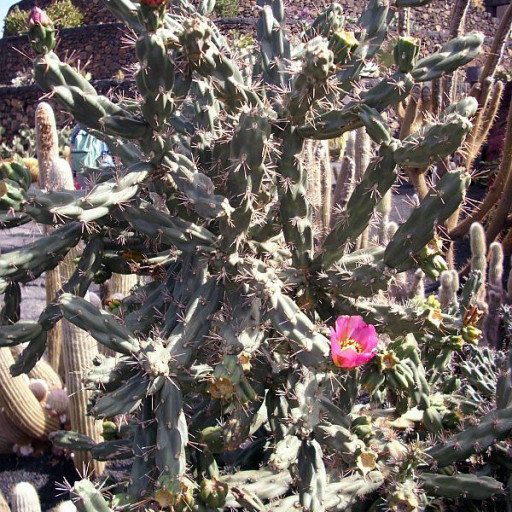
Plant Overview
Often called the Cane Cholla or Walkingstick Cholla, this desert giant is famous for its intricate, woody skeleton that resembles a hand-carved staff. Native to the American Southwest and Northern Mexico, it brings a dramatic, structural presence to any landscape. Unlike many tropical cacti, this hardy survivor is a master of extremes, shrugging off both scorching heat and freezing mountain snow.
🔍 How to Identify
- 🌵 The Segments: Look for thick, cylindrical, rope-like branches covered in prominent, diamond-shaped bumps called tubercles that give the surface a "braided" appearance.
- 🌸 Neon Blooms: In early summer, the plant is crowned with stunning, waxy flowers in vibrant shades of magenta or deep purple that are magnets for local pollinators.
- 🍋 Persistent Fruit: It produces lumpy, bright yellow fruits that are often spineless; these "yellow candles" typically stay on the plant all through the winter, providing a splash of color.
🏡 In Your Garden
- 🏜️ Drainage is King: The Cane Cholla is nearly indestructible unless it sits in "wet feet." It requires extremely porous soil (gravel or sandy loam) to prevent root rot, especially in climates with high rainfall.
- ❄️ Cold Warrior: This is one of the most cold-hardy cacti in existence, often surviving temperatures well below 0°F (-18°C). Its branches may droop or turn a purplish hue in winter, but this is a natural "anti-freeze" response.
- 🌬️ Air Circulation: Because it grows into a dense, shrubby tree, it needs plenty of space and airflow to prevent pests like cochineal scale from hiding in its inner branches.
⚠️ Safety & Toxicity
- 🌵 Physical Hazard: While not chemically poisonous, it is physically aggressive. The spines are microscopically barbed like fishhooks, meaning they "grab" the skin and are painful to remove.
- 🐾 Pets & Kids: This plant should be placed far from walkways or play areas. Curious dogs or children can easily get "hitched" by a segment, as the joints are designed to break off easily to hitchhike on passing animals for propagation.
✨ Fun Fact
When the Cane Cholla dies and its soft tissue decays, it leaves behind a hollow, latticed wooden cylinder. These beautiful, naturally "lace-patterned" skeletons are highly prized by desert artisans for making unique lamps, birdhouses, and the famous walking sticks that give the plant its nickname.

Detailed Care Instructions
| Humidity | Dry |
| Lighting | Full Sun |
| Difficulty | Medium |
| Hibernation | Cold Period |
| Hardiness Zones | 4A - 11B |
To grow Cylindropuntia imbricata, also known as the cane cholla or tree cholla, you can follow the below steps:
- Obtain a Cylindropuntia imbricata clipping or pad from an established plant. You can find these at plant nurseries, garden centers, or from fellow gardeners.
- Select a well-draining container or an area in your garden with sandy or well-draining soil. Cylindropuntia imbricata prefers full sun exposure.
- If planting in a container, fill it with a cactus or succulent-specific potting mix. If planting in the ground, amend the soil with sand or gravel to improve drainage.
- Allow the Cylindropuntia imbricata pad to dry and callous over for a few days. This step helps prevent rot.
- Gently plant the pad into the soil, burying it about 1/3 to 1/2 of its length. Ensure that the pad is securely planted and will not easily topple over.
- Water the plant thoroughly, but do not overwater. Cylindropuntia imbricata is highly drought-tolerant and prefers infrequent waterings. However, provide water occasionally during the growing season.
- Protect the newly planted pad from direct sunlight for the first few days to prevent scorching. Gradually expose the plant to longer periods of sunlight once it has acclimatized.
- Prune or trim the plant as needed to shape it or remove any damaged or dead growth. Use gloves or tongs as the plant has spiky spines.
- Cylindropuntia imbricata is hardy in USDA zones 6-10. If you live in a colder climate, consider growing it in a container that can be brought inside during winter to protect it from frost.
- Monitor the plant regularly for signs of pests or diseases. Common problems may include scale insects, mealybugs, or fungal diseases. Treat any issues promptly.
Remember, Cylindropuntia imbricata is a desert plant and is well-suited to arid conditions. Therefore, it is essential not to overwater and provide adequate sunlight for healthy growth.

Place in a bright room that is sun drenched almost all day. Or directly in a south-facing window.

To water this type of plant, it is important to understand its specific water requirements. This can depend on a variety of factors, such as the age and size of the plant, the season, and the overall climate of its environment.
In general, it is recommended to water Cylindropuntia Imbricata sparingly, as it is a desert plant with a natural tolerance for dry conditions. This means that it can often go several weeks without needing water, especially during cooler months or periods of lower humidity.
When watering, it is important to avoid over-watering or allowing standing water to collect around the base of the plant, as this can lead to root rot or other issues. Instead, it is typically best to water deeply and infrequently, allowing the soil to dry out between waterings.
One method for watering Cylindropuntia Imbricata is to apply water directly to the soil around the base of the plant, using a watering can or hose. It may also be helpful to add a layer of mulch around the plant to help retain moisture and prevent evaporation.
Overall, the key to successfully watering Cylindropuntia Imbricata is to pay close attention to its individual needs and adjust your watering schedule accordingly. With proper care and attention, this unique and resilient plant can thrive in a variety of environments.
To promote optimal growth of this plant, apply a balanced fertilizer with equal parts nitrogen, phosphorus, and potassium every two months during the growing season. Be sure to dilute the fertilizer by half before applying it to the soil around the plant's base. Avoid applying fertilizer during the dormant season. Additionally, ensure the plant is adequately watered before and after fertilization.
The best type of soil to use for this plant is one that is well-draining and has good drainage capacity. It should be moderately rich in nutrients and also have good water retention capacity. The soil should be a mix of sand, grit, and vermiculite or perlite in equal parts to ensure optimal drainage. You can also add some organic material like compost or peat moss to improve soil quality and fertility. It is best to avoid heavy, clayey soils as they can hold onto water and cause root rot. Likewise, soils that are too sandy can drain too quickly and fail to retain moisture. Overall, a soil pH between 6 and 7.5 is ideal for this plant.
To propagate this particular plant, you would need to use cuttings from its stem. First, select a healthy, mature stem that is free from any signs of disease or damage. Use a clean, sharp pair of pruning shears to make a clean cut, measuring about four inches from the tip of the stem.
Next, you will need to let the cutting dry out and callus over for a few days to prevent rot from setting in. Place the cutting in a warm, dry spot with good airflow, such as a windowsill or outdoor patio.
Once the cutting has formed a callus, you can then plant it in a well-draining potting mix that is suited for cacti and succulents. Be sure to water sparingly, and avoid getting any water on the stem, which can cause rot.
With proper care and attention, the cutting should begin to root and form new growth within a few weeks to months.
Common pests of the tree cholla include Scale insect, mealybugs, spider mites. Make a habit of checking your tree cholla frequently for pests so that any infestations can be caught and managed early.








