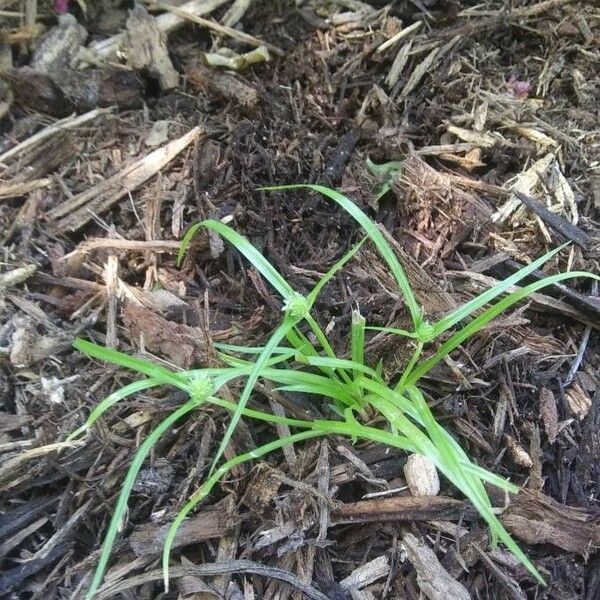
Plant Overview
Often called the "Shortleaf Spikesedge" or "Green Kyllinga," this vibrant, grass-like perennial is a master of the damp spot. While it might look like a common lawn grass at first glance, its star-shaped flower heads and preference for "wet feet" reveal its true identity as a sedge. In many parts of the world, it is considered a persistent garden visitor that loves to colonize areas where the soil stays moist and the mower can't quite reach.
🔍 How to Identify
- 📐 Triangular Stems: Like most sedges, this plant follows the "Sedges have edges" rule; if you roll the stem between your fingers, you’ll feel three distinct flat sides forming a triangle.
- 🟢 The Flower Head: It produces a single, pea-sized, globe-shaped flower head that is pale green to yellowish, looking like a tiny spiked ball.
- 🌿 Star-Shaped Bracts: Directly beneath the round flower head, three long, leaf-like bracts spread outwards, giving the top of the plant a distinct "green star" appearance.
🏡 In Your Garden
- 💧 Moisture Indicator: If this plant is thriving in your lawn, it’s a biological sign that your soil is compacted or holds too much water. It acts as nature’s way of signaling a drainage issue.
- 🏃 The Creeping Habit: It spreads through slender, reddish-brown underground runners (rhizomes). This means pulling it by hand is often difficult, as any small piece of the root left behind can sprout a brand-new plant.
⚠️ Safety & Toxicity
- ✅ Safe Status: Cyperus brevifolius is generally considered non-toxic to humans and common household pets like cats and dogs.
- 🚜 Mechanical Irritation: While not poisonous, the stems and leaves are quite fibrous and "sharp" on a microscopic level. If a pet grazes on it heavily, it may cause minor mouth irritation or an upset stomach simply due to the tough texture.
✨ Fun Fact
There is a famous botanical rhyme used by students to tell plants apart: "Sedges have edges, rushes are round, grasses are hollow right up from the ground." The "edges" of the Shortleaf Spikesedge are one of the best examples of this rule in the wild!

Detailed Care Instructions
To grow Cyperus Brevifolius (also known as dwarf papyrus), follow these steps:
- Choose a suitable location: Dwarf papyrus prefers full sun to partial shade. Select a site that receives at least 6 hours of direct sunlight per day.
- Select a container: Since Cyperus Brevifolius can be invasive if planted directly in the ground, it is best to grow it in a container. Choose a pot with drainage holes to prevent waterlogging.
- Prepare the soil: Use a well-draining potting mix, such as a mixture of peat moss, perlite, and sand. This will provide the necessary drainage while retaining some moisture.
- Planting: Place the dwarf papyrus plant in the pot, ensuring that the crown of the plant is slightly above the soil level. Gently firm the soil around the plant to provide stability.
- Watering: Keep the soil consistently moist but not waterlogged. Dwarf papyrus enjoys consistently wet conditions, so it is best to keep the pot in a saucer filled with water. This allows the plant to take up water as needed through its roots.
- Fertilization: Feed the plant with a balanced liquid fertilizer every two to three weeks during the growing season (spring to fall). This will provide the necessary nutrients for healthy growth.
- Pruning: Trim any dead or yellowing leaves to keep the plant looking tidy. Additionally, if the plant becomes too large for its container, you can divide it in early spring by removing it from the pot and splitting the root clump into smaller sections, each with leaves and roots.
- Overwintering: In regions with cold winters, bring the plant indoors before the first frost. It can be kept as a houseplant in a sunny location throughout the winter. Reduce watering frequency during this dormant period.
By following these steps, you should be able to successfully grow and enjoy your Cyperus Brevifolius plant.

Place in a bright room that is sun drenched almost all day. Or directly in a south-facing window.

To water this plant, you should first check the soil moisture level by sticking your finger about an inch deep into the soil. If the soil is dry, then it is time to water the plant. When watering, aim to give the plant a good soak, allowing the water to penetrate deep into the soil. However, be careful not to overwater as this can cause the roots to rot. It is best to water less frequently but make sure to thoroughly saturate the soil each time. It is also important to ensure that the pot has proper drainage to prevent waterlogging.
- Choose a balanced, water-soluble fertilizer with equal amounts of nitrogen, phosphorus, and potassium (such as 10-10-10).
- Dilute the fertilizer according to the manufacturer's instructions, usually 1 tablespoon per gallon of water.
- Water the plant thoroughly before fertilizing.
- Apply the fertilizer solution to the soil around the base of the plant, avoiding foliage and stems.
- Repeat every 4-6 weeks during the growing season (spring and summer).
- Avoid over-fertilizing, which can cause burn or toxicity and harm the plant.
It is recommended to use a rich, well-draining soil when cultivating this plant. The soil should be watered regularly to keep it moist but not waterlogged. Additionally, it is important to ensure that the soil contains sufficient nutrients for the plant to thrive. While organic fertilizers may enhance growth, it is important to avoid using chemical fertilizers and pesticides, as they may damage the plant and harm the environment. Overall, a good-quality soil that supports healthy growth is essential for cultivating this plant successfully.
Cyperus Brevifolius plant can be propagated by dividing the root ball. First, carefully remove the plant from its pot or soil, being careful not to damage the roots. Gently remove the soil and untangle the roots. Look for natural sections or clumps to divide the plant into smaller sections. Use a sharp, clean knife to carefully cut through the roots and separate the sections. Each section should have its own roots and a healthy shoot or two. Plant each section in a well-draining soil mixture, water thoroughly, and keep it in a bright, warm location. With proper care and maintenance, the divided sections should grow into healthy new plants.








