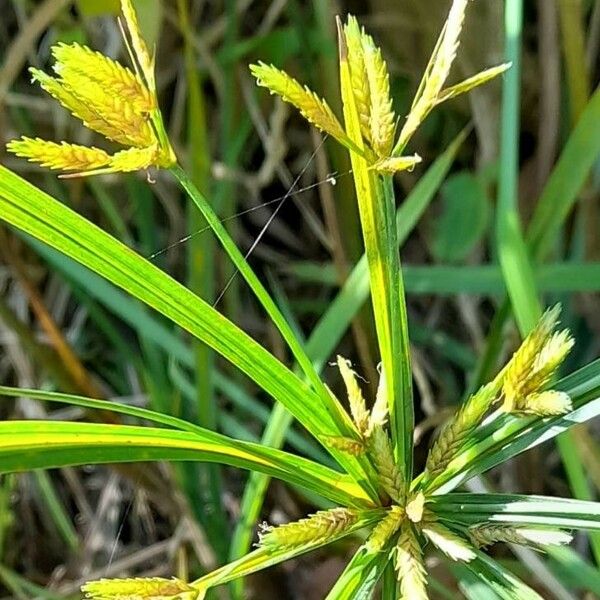
Plant Overview
Often called the Shingle Flatsedge, Cyperus imbricatus looks like a miniature, wild umbrella lost among the reeds. This hardy perennial is a cosmopolitan traveler, naturally adorning the banks of rivers and marshes across Africa, Asia, and the Americas. Its name "imbricatus" is a nod to its architectural beauty, referring to the way its floral parts overlap like shingles on a roof.
🔍 How to Identify
- 📐 Triangular Stems: True to the "Sedges have edges" rule, the stems are sharply three-angled, providing a sturdy, upright structure that resists wind.
- 🏗️ Shingled Spikelets: The flower head features dense, golden-to-reddish-brown spikes. If you look closely, the tiny scales overlap perfectly, resembling a tiled roof or fish scales.
- 🍃 Radiating Bracts: At the top of the stem, several long, leaf-like bracts spread out horizontally, creating the "umbrella" silhouette typical of the Cyperus family.
🏡 In Your Garden
- 💧 The Wetland Specialist: This isn't a plant for a dry rockery. It thrives in "wet feet" conditions, making it an ideal choice for the margins of a backyard pond, a rain garden, or a consistently boggy patch where other plants struggle.
- 🌱 Erosion Control: Because of its dense, tufted root system, it acts as a natural engineer. It is often used to stabilize muddy banks and prevent soil from washing away during heavy summer rains.
⚠️ Safety & Toxicity
- ✅ Non-Toxic Status: Cyperus imbricatus is generally considered non-toxic to humans, cats, and dogs. It is a safe choice for families with curious pets.
- 🔪 Mechanical Injury: While not poisonous, the leaf edges and stem angles can be quite sharp. Use gardening gloves when pruning to avoid "grass cuts" or skin irritation from the friction.
✨ Fun Fact
📜 Ancient Cousins: While the Shingle Flatsedge is mostly appreciated for its ecology today, it belongs to the same genus as the famous Cyperus papyrus—the plant ancient Egyptians used to create the world’s first paper over 5,000 years ago!

Detailed Care Instructions
To grow Cyperus Imbricatus, also known as umbrella sedge or umbrella palm, you can follow these steps:
- Obtain seeds or a mature plant: You can purchase seeds from a nursery or order them online. Alternatively, you can find a mature plant and propagate it through division.
- Choose a suitable location: Cyperus Imbricatus thrives in moist, swampy conditions. If you live in a region with a warm and tropical climate, you can plant it outdoors in a garden or pond. If you have a cold climate, you can grow it indoors in a container or in a greenhouse.
- Prepare the growing medium: Cyperus Imbricatus prefers soil that is constantly moist but not waterlogged. Use a mix of equal parts potting soil, peat moss, and sand to create a well-draining medium.
- Plant the seeds or division: If you have seeds, sow them on the surface of the soil and gently press them down. If you have a mature plant, carefully divide it into smaller clumps and plant them in the prepared soil.
- Provide enough water: Keep the soil consistently moist by watering regularly. However, avoid overwatering, as it can cause root rot. Ensure that water can drain freely from the container or garden bed to prevent waterlogging.
- Provide the right lighting: Place your Cyperus Imbricatus plant in a location that receives bright, indirect light or partial shade. If grown indoors, place it near a window with filtered sunlight.
- Fertilize occasionally: Use a balanced liquid fertilizer diluted to half-strength every two to three weeks during the growing season (spring and summer). This will provide the plant with necessary nutrients.
- Prune and divide: As your umbrella sedge grows, remove any dead or yellowing leaves to maintain its appearance. If the plant becomes overcrowded or too large, you can divide it every few years to promote healthier growth.
- Monitor for pests and diseases: Cyperus Imbricatus is generally resistant to pests and diseases, but occasional infestations by spider mites, aphids, or mealybugs can occur. Check the plant regularly and take appropriate measures if you notice any issues.
By following these steps, you should be able to successfully grow Cyperus Imbricatus and enjoy its lush, umbrella-like foliage.

Place in a bright room that is sun drenched almost all day. Or directly in a south-facing window.

Cyperus Imbricatus plant is a species that requires a specific approach to watering in order to thrive. Here are some detailed guidelines to follow when watering this plant:
1. Watering Frequency: The watering frequency for Cyperus Imbricatus depends on various factors such as temperature, humidity, and soil conditions. Generally, the plant prefers to be moist, so it is important to establish a regular watering schedule. Monitor the top inch of the soil regularly and water whenever it starts to feel slightly dry.
2. Soil Moisture: It is essential to maintain consistent soil moisture for Cyperus Imbricatus. However, ensure that the soil does not become waterlogged as this can lead to root rot. Aim to keep the soil evenly moist but not overly saturated.
3. Watering Method: To avoid overwatering, use a watering can or a hose with a gentle spray nozzle to water the plant. Apply water directly to the soil around the base of the plant, allowing it to soak into the roots. Avoid wetting the foliage as it can create a moist environment that promotes fungal diseases.
4. Water Quality: The quality of water used for irrigation is also crucial. Cyperus Imbricatus prefers slightly acidic water, so if your tap water is alkaline, consider using rainwater or filtered water. Additionally, avoid using water that has been treated with water softeners as it may contain high levels of salt, which can harm the plant.
5. Drainage: Good drainage is vital for the health of Cyperus Imbricatus. Ensure that the plant is potted in a container with drainage holes, allowing excess water to escape. If planted outdoors, ensure that the planting area has well-draining soil.
6. Seasonal Adjustments: During the growing season, typically in spring and summer, Cyperus Imbricatus may require more frequent watering due to increased evaporation. Adjust your watering schedule accordingly to maintain the desired soil moisture level.
7. Environmental Conditions: Consider the surrounding environmental conditions that can affect the plant's water requirement. For instance, if the plant is exposed to intense sunlight or strong winds, it may dry out faster, requiring more frequent watering.
Remember, it's important to observe the plant closely and monitor its response to watering practices. Adjust your watering routine accordingly based on the plant's needs and the environmental conditions to ensure its optimal growth and health.
To fertilize your Cyperus Imbricatus plant, follow these instructions:
- Choose a balanced, water-soluble fertilizer formulated for indoor or ornamental plants.
- Dilute the fertilizer according to the manufacturer's instructions. Typically, a ratio of 1 teaspoon of fertilizer per gallon of water is suitable.
- Fill a watering can or spray bottle with the prepared fertilizer solution.
- Water the Cyperus Imbricatus plant thoroughly with the fertilizer solution, ensuring that the soil is evenly moistened.
- Make sure to avoid over-fertilization, as this can lead to nutrient burn or other plant health issues.
- Repeat the fertilization process every four to six weeks during the growing season, which typically spans from spring to early fall.
- Monitor the plant's response to the fertilizer, such as improved growth or vibrant foliage. Adjust the frequency or strength of fertilization accordingly.
Remember, it's essential to follow the specific fertilizer instructions and consider the unique needs of your Cyperus Imbricatus plant.
Cyperus Imbricatus is a plant that thrives in specific soil conditions. It requires a well-draining soil mixture to ensure proper growth and development. The ideal soil for this plant should be rich in organic matter and have a slightly acidic to neutral pH level.
The soil mixture should consist of a combination of peat moss, perlite or vermiculite, and garden soil or loam. Peat moss helps retain moisture in the soil while improving aeration, allowing the roots to breathe. Perlite or vermiculite enhances drainage by preventing the soil from becoming compacted. Garden soil or loam provides essential nutrients for the plant's growth.
Avoid using heavy clay soil as it retains excessive moisture, leading to root rot. Similarly, sandy soil should be amended with organic matter to improve water retention.
It is crucial to maintain a consistently moist soil for Cyperus Imbricatus, although it should not be waterlogged. Overwatering can cause the roots to rot, while underwatering can lead to stunted growth. You can achieve the appropriate moisture level by watering the plant thoroughly whenever the top inch of soil feels dry to the touch.
Regularly monitoring the moisture level, adjusting watering frequency, and providing well-draining soil will help ensure the ideal growing conditions for Cyperus Imbricatus plant.
Propagation of Cyperus Imbricatus plants can be achieved through different methods such as division, root cuttings, and seed sowing. Here are the details:
- Division: This is the most common and easiest method of propagating Cyperus Imbricatus. Follow these steps:
a. Choose a healthy and mature plant with multiple stems.
b. Gently remove the plant from its pot or dig it out from the ground.
c. Locate the natural division points where the stems separate.
d. Carefully separate the roots and stems into individual sections, ensuring each section has its own roots and shoots.
e. Plant each divided section into a well-draining pot or directly into the garden soil, making sure the roots are covered, and the shoots are exposed.
f. Water thoroughly and keep the soil consistently moist until new growth appears.
- Root cuttings: This method can be employed when the plant is dormant or during the early spring. Here's how:
a. Start by digging out the plant from the soil.
b. Cut several healthy, thick roots into pieces, each about 2-3 inches long.
c. Prepare a pot or seed tray with well-draining soil mix.
d. Place the root cuttings horizontally, burying them about halfway into the soil at regular intervals.
e. Ensure the soil remains consistently moist but not waterlogged.
f. After a few weeks, new shoots should emerge from the cuttings, indicating successful propagation.
- Seed sowing: Propagation through seeds is another option, though it may take longer to establish mature plants. Here's what to do:
a. Collect mature seeds from the plant by removing the seed heads or spikes.
b. Prepare a seed-starting tray or pots filled with a well-draining soil mix.
c. Scatter the seeds on top of the soil and lightly press them down.
d. Cover the seeds with a thin layer of soil and mist the surface to provide moisture.
e. Place the tray or pots in a warm location with indirect light.
f. Keep the soil consistently moist but not waterlogged.
g. Germination may occur within a few weeks, but it can take several months for the plants to reach transplant size.
Regardless of the propagation method chosen, it is important to provide the new plants with appropriate care, including regular watering, adequate sunlight, and protection from extreme temperatures, until they become established.








