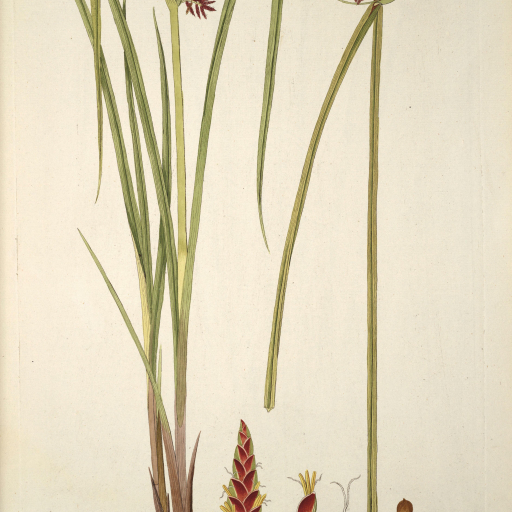
Plant Overview
Often called the Late-flowering Sedge or Tidal Marsh Flatsedge, Cyperus serotinus is a striking, moisture-loving perennial that brings architectural elegance to the edges of ponds and wetlands. While many garden plants begin to fade as summer wanes, this hardy sedge waits for the "serotinal" (late summer) period to showcase its complex, reddish-brown flower clusters. It is a master of the shoreline, thriving in mud where other plants would simply rot.
🔍 How to Identify
- 📐 Triangular Stems: Like most members of its family, it follows the rule "sedges have edges." If you roll the stem between your fingers, you’ll feel three distinct, sharp corners.
- 🌿 Radiating Bracts: At the top of the tall stems, several long, leaf-like structures (bracts) fan out horizontally, cradling the flower cluster like a natural green crown.
- 🌾 Burgundy Spikelets: The flowers appear as flattened, reddish-brown to dark purple scales. These dense clusters provide a moody, rustic contrast to the bright green foliage.
🏡 In Your Garden
- 💧 The "Wet Feet" Specialist: This plant is perfect for those "problem areas" in a yard that stay soggy or flood frequently. It is an excellent choice for rain gardens or the shallow margins of a backyard pond.
- 🌱 Rhizome Runner: Be mindful that this sedge spreads via underground runners (rhizomes). While it isn't as aggressive as some of its cousins, it can form dense colonies over time, making it great for erosion control but potentially a space-hog in small decorative pots.
⚠️ Safety & Toxicity
- ✅ Safe Status: Cyperus serotinus is generally considered non-toxic to humans, cats, and dogs. It lacks the irritating saps or alkaloids found in more dangerous garden plants.
- ✂️ Physical Caution: The leaf edges can be quite stiff and occasionally sharp. When pruning or clearing dead foliage in the winter, wearing gardening gloves is recommended to avoid minor "paper cut" style nicks on your fingers.
✨ Fun Fact
The species name serotinus comes from the Latin word for "late." In the world of botany, "serotinal" refers to the specific season between summer and autumn—the exact time this plant reaches its peak beauty while the rest of the meadow is going to seed!

Detailed Care Instructions

Place in a bright room that is sun drenched almost all day. Or directly in a south-facing window.

Some plants require more regular watering than others, which should be done every few days. It's critical to maintain the soil moist all of the time. The water requirements of the same plant placed in pots with varying sizes will differ. Because the water in the smaller pot evaporates faster than the water in the larger pot, it will require more watering. Regardless of pot size, the surface should constantly be maintained moist.








