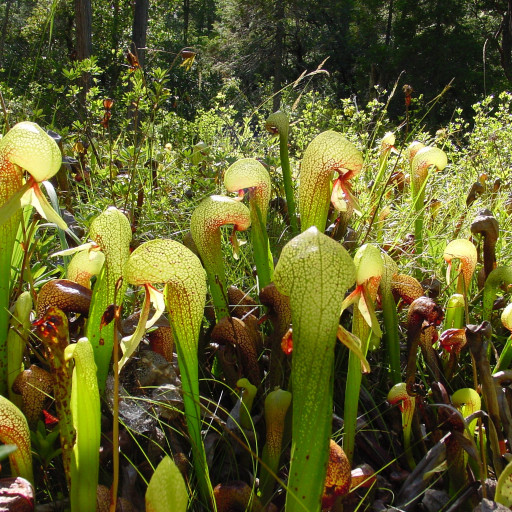
Plant Overview
Known as the Cobra Lily, this botanical wonder looks like it’s ready to strike from the marshy fens of Oregon and Northern California. Its hooded leaves and forked "tongue" give it a menacingly beautiful silhouette that mimics a rearing serpent. Unlike most pitcher plants, it is a master of trickery, using light and architecture rather than just scent to capture its prey.
🔍 How to Identify
- 🐍 The Cobra Hood: The top of the tubular leaf is rounded and bulbous, mimicking the flared hood of a cobra.
- 👅 The Forked Tongue: A prominent, two-lobed leaf extension (an appendage) hangs from the pitcher opening, looking exactly like a snake’s forked tongue.
- 🪟 False Windows: The hood is covered in translucent, "clear" patches called fenestrations. These act like skylights, tricking trapped insects into flying toward the light and exhausting themselves until they fall.
🏡 In Your Garden
- 🏔️ The Cold Root Rule: In the wild, these plants grow near chilly mountain springs. They are notoriously finicky because they require their roots to stay significantly cooler than the air temperature. Many enthusiasts use white pots to reflect heat or water them with chilled, distilled water.
- 💧 Mineral Sensitivity: Because they evolved in nutrient-poor bogs, they have no defense against chemicals. They must only be watered with rainwater, distilled water, or reverse osmosis water, as tap water minerals will burn their sensitive root systems.
⚠️ Safety & Toxicity
- 🐾 Non-Toxic: The Cobra Lily is generally considered safe and non-toxic to cats, dogs, and humans.
- 🧤 Fragile Traps: While it isn't poisonous to touch, the pitchers are structurally delicate. Avoid "feeding" it manually or sticking fingers inside, as this can introduce oils or bacteria that may cause the pitcher to rot prematurely.
✨ Fun Fact
Unlike almost every other pitcher plant, the Cobra Lily does not collect rainwater in its traps. Instead, it regulates the water level inside the pitcher by pumping it up from its roots! Furthermore, it doesn't produce its own digestive enzymes; it relies on a specific "soup" of symbiotic bacteria to break down its insect meals.

Detailed Care Instructions
| Color | Flowers Are Yellow To Purplish Green |
| Soil Ph | 6-8 |
| Humidity | Normal |
| Lighting | Part Sun |
| Toxicity | Non-Toxic |
| Soil Type | Gravelly, Boggy Soil Saturated With Cold Water |
| Bloom Time | Spring |
| Difficulty | Medium |
| Plant Type | Carnivorous |
| Hibernation | Cold Period |
| Mature Size | 39 Inches Tall |
| Native Area | North America |
| Temperature | 18°C - 24°C |
| Sun Exposure | Full Sun To Part Shade |
| Hardiness Zones | 6-9 |
To successfully grow Darlingtonia Californica, also known as the California Pitcher Plant or Cobra Lily, follow these guidelines:
- Climate: Darlingtonia Californica is native to Northern California and southwestern Oregon. It prefers cool climates with moderate temperatures ranging from 40°F to 70°F (4°C to 21°C) during the growing season and cold winters with occasional snowfall.
- Light: Provide your plant with bright, indirect sunlight. Avoid intense, direct sunlight, as it can damage the leaves. Partial shade or filtered light is ideal.
- Soil: Use a well-draining and nutrient-poor soil mix that mimics the acidic conditions of its natural habitat. A mix of sphagnum peat moss and perlite or sand works best. Avoid using regular potting soils that may be too rich.
- Water: Darlingtonia Californica requires consistently moist soil. Use water that is low in minerals, such as rainwater or distilled water, to avoid salts and minerals from accumulating in the soil. Place your pot in a water tray or use a water-saturated substrate to keep the soil wet.
- Humidity: Maintain high humidity levels around the plant. You can achieve this by placing the pot on a tray with water or using a humidifier nearby. Mist the leaves regularly to provide additional humidity.
- Feeding: Being carnivorous, the plant primarily derives nutrients from capturing and consuming small insects. However, you can occasionally feed it a few small insects or insect-based fertilizers. Avoid overfeeding, as it may harm the plant.
- Potting: Use a deep pot or container to accommodate its unique pitcher-shaped leaves. The pot should have good drainage holes to prevent waterlogging.
- Dormancy: Darlingtonia Californica experiences a winter dormancy period when it requires cooler temperatures. Reduce watering during this period to keep the soil slightly damp but not excessively wet. Place the plant in a cooler location, around 35°F to 50°F (1°C to 10°C). This mimics the natural conditions of the Sierra Nevada Mountains.
- Protection from pests: Monitor the plant for pests like aphids or spider mites. Use organic insecticides or neem oil if infestations occur. Ensure proper ventilation to prevent fungal diseases.
- Reproduction: Darlingtonia Californica can be propagated through seeds or division. Seeds require stratification (exposure to cold temperatures for a few weeks) before planting. Divisions can be done during the dormant period by separating the rhizomes.
Remember to research and understand the specific needs of this unique carnivorous plant to maximize its chances of thriving.

Place in a window with dappled sun or a spot in the middle of a room. Or directly in a window facing west or east.

To water this particular plant, it is important to note that it grows in a specific type of soil that is very moist and acidic. As a result, it is important to ensure that the soil remains consistently moist at all times, but not water-logged. Overwatering can be particularly harmful to the plant, as it can cause root rot and other issues.
One effective way to water this plant is to use a drip tray or special watering tray that can hold water at the base of the plant. This can help ensure that the soil remains moist without becoming water-logged, and can also help prevent the plant from drying out between watering sessions.
It is also important to note that this plant requires a specific type of water - preferably rainwater or distilled water, as tap water can be too alkaline for its needs. Additionally, it is important to avoid watering the leaves and instead focus on watering the soil directly.
Overall, proper watering techniques are essential for maintaining the health and vitality of this unique plant. With the right care, Darlingtonia Californica can thrive and provide a beautiful addition to any garden or indoor space.
To fertilize this plant, first make sure the soil is moist. Dilute a liquid fertilizer to half strength and pour it onto the soil and around the base of the plant, taking care not to get any on the leaves. Repeat this process every 2-3 weeks during the active growing season. Avoid using a fertilizer with high levels of nitrogen and do not overfertilize, as this can damage the plant.
Darlingtonia Californica naturally grows in nutrient-poor, acidic soils, typically found in damp areas such as peat bogs and swamps. The ideal soil for this plant should be well-draining, mimicking the natural environment in which it is found. It is important to avoid using any soil mixes that contain fertilizers or chemicals that can harm the plant. A mix of sphagnum moss and sand is a suitable option as it retains moisture without becoming waterlogged while providing adequate drainage. Additionally, the pH level of the soil should be kept between 4.5 and 6.5 to ensure optimal growth conditions for the plant.
Propagation of this plant can be done through both division of its rhizomes or via seed. To propagate via division, carefully separate the rhizomes while ensuring that each section has sufficient roots - usually at least one or two shoots. Plant each separated rhizome in its own pot, ensuring to keep the soil damp but not waterlogged. For propagation via seed, collect the seed as soon as it is ripe and plant it in a well-draining and slightly acidic soil mix. Keep the soil consistently damp and warm, ideally around 20-25°C. After germination, keep the seedlings in a sheltered location with good lighting and avoid overwatering.








