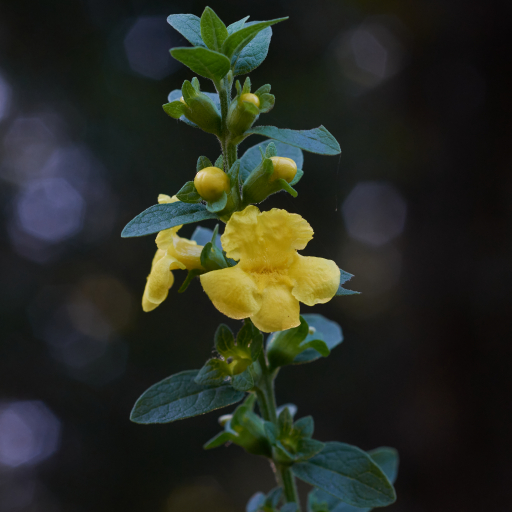
Plant Overview
Often called the Mullein Foxglove, Dasistoma macrophylla is a striking woodland native that hides a secret, slightly "predatory" life. While it looks like a typical wildflower with its sunny yellow blooms, it is actually a hemiparasite. This means that while it creates its own energy from the sun, it isn't above "plugging into" the roots of nearby Oak trees to steal a little extra water and minerals.
🔍 How to Identify
- 🌼 The Blooms: It features bell-shaped, butter-yellow flowers that are roughly an inch long. If you look closely inside the "throat" of the flower, you'll see a dense coating of soft, woolly white hairs designed to guide pollinators.
- 🍃 The Foliage: The leaves are large and transform as they move up the stem; the lower leaves are deeply lobed (almost like a fern), while the upper leaves are smaller and more oval-shaped.
- 📏 The Stature: This is a tall, stately plant that can reach up to 6 feet in height, often standing like a golden spire in the dappled sunlight of a forest edge or woodland clearing.
🏡 In Your Garden
- 🌳 The Oak Connection: You won't usually find this plant in a nursery because it is "host-specific." It requires the presence of an Oak tree (Quercus family) to truly thrive. If you find one on your property, it is a sign of a healthy, mature local ecosystem.
- 🦋 Pollinator Paradise: While it might be a "thief" to trees, it is a generous friend to wildlife. Its deep tubes are perfectly designed for bumblebees and long-tongued bees, who are the primary visitors to its mid-to-late summer blossoms.
⚠️ Safety & Toxicity
- ✅ General Safety: Dasistoma macrophylla is not known to be toxic to humans or common household pets. It does not possess the same dangerous cardiac glycosides found in the "true" Foxglove (Digitalis).
- 🖐️ Skin Sensitivity: The stems and leaves are covered in fine hairs. While not "stinging," these can occasionally cause mild mechanical irritation to those with very sensitive skin if handled roughly.
✨ Fun Fact
✨ The Botanical Vampire: Because it only takes some of its nutrients from its host and still has green leaves to make its own food, scientists call it a "hemiparasite." It’s essentially a part-time vampire of the botanical world!

Detailed Care Instructions
To grow Dasistoma Macrophylla plants, you can follow these steps:
- Choose a suitable planting location: Dasistoma Macrophylla prefers partial shade to full shade environments. Select a location in your garden that receives filtered sunlight or an area under large trees.
- Prepare the soil: This plant prefers well-draining, organic-rich soil. Amend the soil by adding compost or organic matter to improve its fertility and drainage.
- Planting: Dig a hole that is slightly larger than the plant's root ball. Carefully place the plant in the hole, ensuring that the top of the root ball is level with the soil surface. Fill in the hole with soil, gently firming it around the root ball.
- Watering: Provide ample water to help the plant establish itself. Water the plant deeply and regularly, ensuring the soil is consistently moist but not waterlogged.
- Mulching: Apply a layer of organic mulch around the base of the plant. Mulching helps retain soil moisture, suppresses weeds, and maintains a more consistent soil temperature.
- Fertilizing: Dasistoma Macrophylla generally does not require much fertilizer. However, you can apply a balanced slow-release fertilizer once a year during the spring season to encourage healthy growth.
- Pruning: As the plant grows, you may need to prune it to maintain its shape and remove any dead or damaged parts. Prune in the early spring before new growth starts.
- Protect from pests: Monitor the plant for any infestation of pests like aphids or slugs. Use appropriate natural or organic pest control methods, if necessary.
- Provide additional support: If your Dasistoma Macrophylla plant has tall stems that require support, you can use stakes or cages to hold them upright.
Remember, each plant has its specific needs, so it's always advisable to research the plant's requirements and adapt these guidelines accordingly.

Place in a bright room that is sun drenched almost all day. Or directly in a south-facing window.

To properly water this plant, you want to ensure that the soil is moist but not waterlogged. It is recommended to water deeply and infrequently, allowing the soil to dry out slightly in between waterings. It is important to avoid getting water on the leaves as this can lead to the development of fungus and other issues. Additionally, it is important to take into consideration the environment in which the plant is located as it may require more or less water depending on factors such as temperature and humidity.
In order to effectively fertilize the Dasistoma Macrophylla plant, it is recommended to use a slow-release fertilizer with a balanced NPK ratio. This should be applied during the spring and summer growing seasons, but avoided during the dormant period in winter. The fertilizer should be placed approximately 1-2 inches away from the base of the plant and watered in thoroughly. In addition to fertilizing, it is important to maintain proper watering techniques and a well-draining soil to promote healthy growth.
The ideal soil for growing this plant should have a pH value between 6.0 and 7.5. It should be well-draining and hold moisture, but not become waterlogged. The soil should be rich in organic matter and provide a good balance of nutrients, including nitrogen, phosphorus, and potassium. It is important to avoid using soil that is too dense or heavy, as it can restrict root growth and suffocate the plant. A mixture of equal parts garden soil, peat moss, and perlite is a good option for potting this plant. Alternatively, a mix of loamy soil, sand and compost, or sandy soil with compost and leaf mold can also be used. It is important to maintain consistent soil moisture levels by watering the plant regularly, but allowing the soil to dry out slightly between watering sessions.
Propagation of this plant can be achieved through division of the root system or stem cutting. To propagate through division, carefully remove the plant from its pot or the ground and gently separate the roots into smaller sections, ensuring that each section has a healthy root system and a good amount of leaves. Plant the sections in separate pots or in the ground and water regularly.
For stem cutting propagation, take a 5-6 inch long cutting from a healthy stem that has not flowered yet. Remove the lower leaves and dip the cut end into rooting hormone powder, then plant the cutting in a pot filled with well-draining soil. Keep the soil moist and place the pot in a warm, shaded area until new growth appears.
Both methods of propagation should be done in the spring or early summer for optimal results.








