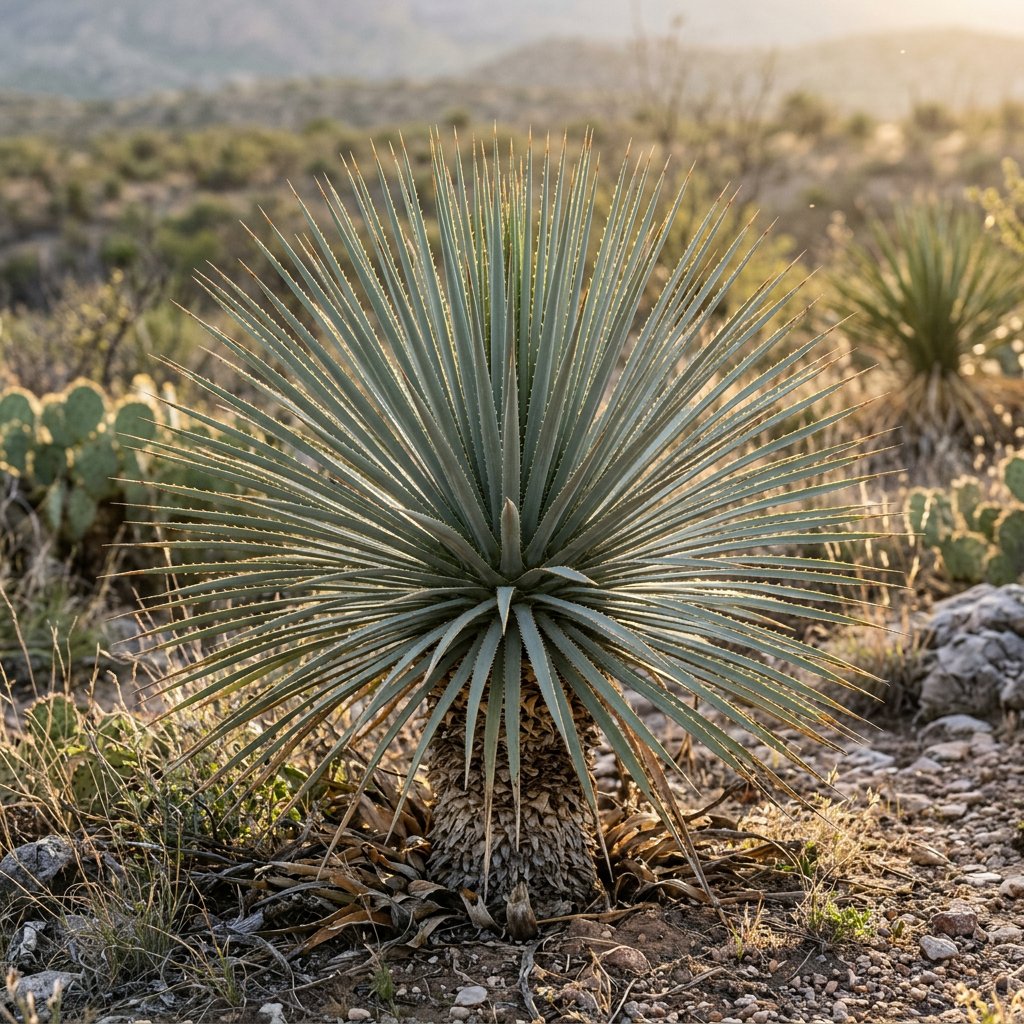
Plant Overview
Known as the Desert Spoon or Sotol, this dramatic succulent is the quintessential architect of the American Southwest and Northern Mexico. Imagine a giant, silver-blue sea urchin frozen in time amidst the desert sand—that is the Dasylirion wheeleri. Beyond its beauty, it has been a cornerstone of desert life for centuries, providing everything from woven mats to a potent distilled spirit.
🔍 How to Identify
- 🍃 The Foliage: Hundreds of long, narrow, blue-gray leaves radiate from a central core, forming a perfectly symmetrical, spherical rosette that can reach 5 feet in height.
- 🪚 Saw-toothed Edges: The leaf margins are lined with sharp, hooked teeth that point toward the leaf tip. These "teeth" are a primary defense against thirsty desert animals.
- 🥄 The "Spoon" Base: The plant earns its nickname from the hidden base of the leaf. When a leaf is removed, the bottom is broad, curved, and ivory-colored, looking exactly like a handcrafted spoon.
🏡 In Your Garden
- 🏜️ The Drainage Rule: This plant is an expert survivalist that thrives on neglect, but it has one "deal-breaker": soggy soil. It requires gritty, fast-draining earth to prevent its roots from rotting during wet winters.
- ☀️ Sun Seeker: To maintain its tight, architectural shape and striking silver-blue hue, it needs full, unadulterated sun. In shaded spots, the leaves may become green, floppy, and lose their iconic structural integrity.
⚠️ Safety & Toxicity
- ⚔️ Physical Hazard: While not chemically toxic, the Dasylirion is "armed." The serrated leaf edges are incredibly sharp and can easily slice through skin or snag clothing.
- 🐾 Placement is Key: It is safe for pets and children in terms of ingestion, but the physical thorns make it a hazard. It is best planted as a "security hedge" or a focal point well away from walkways and play areas.
✨ Fun Fact
- 🍹 Desert Moonshine: The heart (pith) of the Dasylirion wheeleri is the primary ingredient for Sotol, a distilled spirit similar to Tequila or Mezcal. It takes roughly 15 years for a single plant to mature enough to be harvested for production!

Detailed Care Instructions
To grow a Dasylirion Wheeleri plant, also known as Desert Spoon or Sotol, you need to follow these steps:
- Choose the Right Location: Select a location that receives full sun. These plants require at least 6 hours of direct sunlight each day.
- Soil Preparation: Ensure the soil is well-draining. Desert Spoon plants require good drainage to thrive. If your soil is heavy or clay-based, consider adding a mixture of sand, gravel, and organic matter to improve drainage.
- Planting: Dig a hole twice the size of the plant's root ball. Place the Dasylirion Wheeleri into the hole, making sure the top of the root ball is level with the soil surface. Backfill the hole with a mixture of soil and organic matter, gently firming it around the plant.
- Watering: Water the newly planted Desert Spoon deeply and thoroughly. Afterward, allow the soil to dry out between watering sessions. These plants are drought-tolerant and prefer less frequent watering than most other plants.
- Mulching: Apply a layer of organic mulch around the base of the plant to help retain moisture and regulate soil temperature.
- Pruning: Trim off any dead or damaged leaves as needed. Also, remove the flower stalk after it has finished blooming to maintain a neat appearance.
- Fertilizing: Desert Spoon plants do not typically require regular fertilization. However, you can apply a slow-release, balanced fertilizer once or twice a year during the growing season to provide a nutrient boost.
- Protection: Dasylirion Wheeleri is generally resistant to pests and diseases. However, if you notice any signs of pest infestation or disease, treat them promptly with appropriate organic or chemical controls.
Remember that each plant has unique care requirements, so it is advisable to research specific details on growing and caring for Dasylirion Wheeleri in your particular region.

Place in a bright room that is sun drenched almost all day. Or directly in a south-facing window.

To water this plant, you should first check the moisture level of the soil by inserting your finger about 2 inches into the soil. If the soil is dry, it's time to water. Use a watering can or hose with a gentle flow to avoid disturbing the plant's roots. Water the soil directly around the plant, avoiding the leaves and stem. Allow the soil to drain completely and avoid leaving standing water. This plant prefers well-draining soil, so do not overwater as it may cause root rot. The frequency of watering will depend on the temperature and humidity of your location, but typically once a week is sufficient.
To fertilize this desert plant, use a slow-release granular fertilizer with a balanced ratio of nitrogen, phosphorus, and potassium. Apply the fertilizer in the spring when the plant starts to grow actively. Do not over-fertilize as it can cause the plant to grow too quickly and become weak. Make sure to water the plant before and after fertilizing to avoid burning the roots. Always follow the instructions on the fertilizer packaging and use gloves while handling any chemical fertilizers.
The ideal soil mixture for this particular plant should be well-draining and gritty, with a low fertility level. A mixture of sand, perlite, and gravel is recommended, as it will allow water to flow through the soil easily and prevent the roots from becoming waterlogged. The pH level of the soil should be slightly acidic to neutral. It is important to avoid using heavy or compacted soils, as they can lead to root rot and other issues. The plant should also be occasionally fertilized with a low-nitrogen, high-potassium fertilizer to promote growth and health.
Propagation of this plant can be achieved through various methods, including seed propagation, division of offsets, and stem cuttings. Seed propagation involves collecting fresh seeds and planting them in well-draining soil mix. The seeds should be placed about ¼ inch deep and kept moist. Germination usually occurs within 2-4 weeks.
Division of offsets involves carefully digging up the plant and separating the offsets from the main plant. The offsets should have their own roots before being carefully transplanted into separate containers.
Stem cuttings can also be used to propagate this plant. The stem cuttings should be taken from a mature plant and should be at least 6 inches long. The bottom of the stem cutting should be cut at a 45-degree angle and dipped in a rooting hormone before being planted in a well-draining soil mix. The soil should be kept moist and the cutting should be placed in a warm and well-lit area. After a few weeks, roots should begin to form, and the plant can be transplanted into a larger container.
Common pests of the desert spoon include Scale insect, mealybugs. Make a habit of checking your desert spoon frequently for pests so that any infestations can be caught and managed early.








