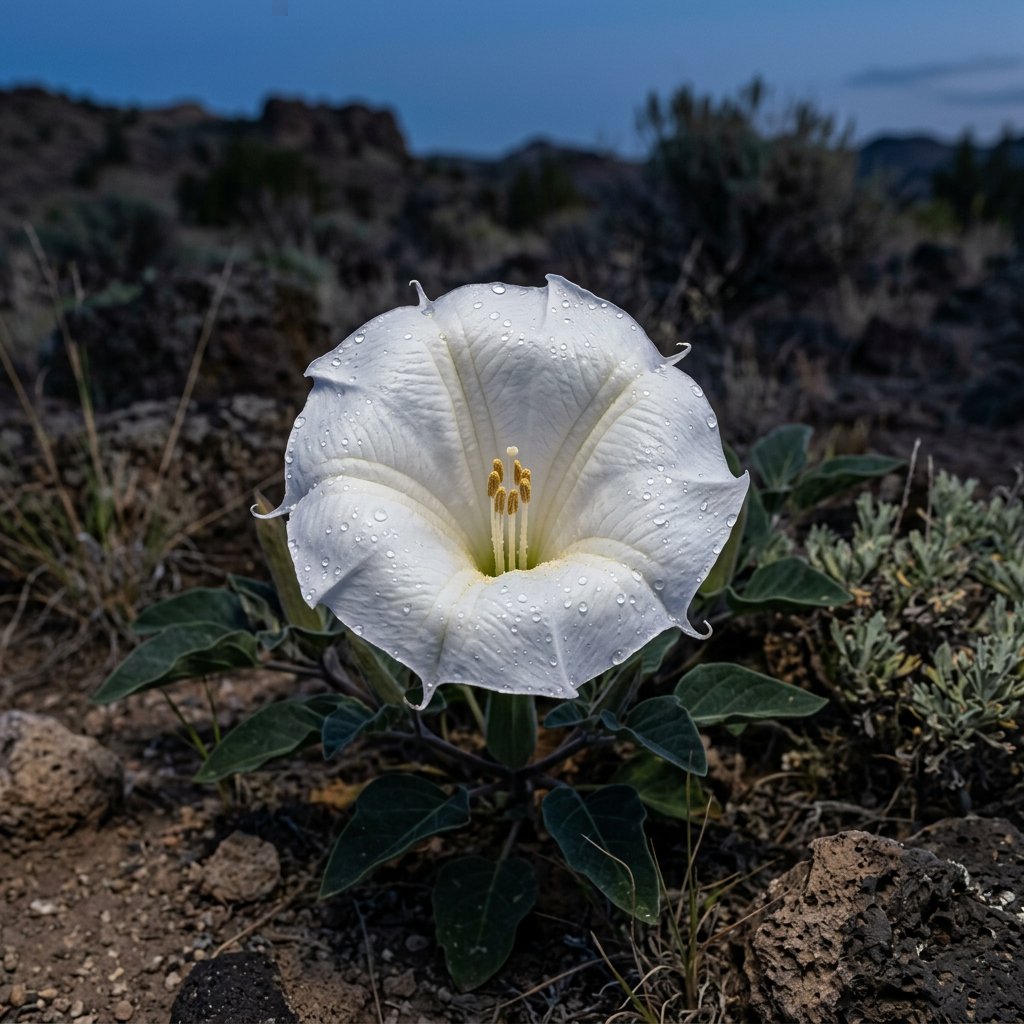
Plant Overview
Often called the Sacred Datura or Moonflower, Datura wrightii is a desert-dwelling beauty famous for its massive, luminescent white blooms. It is a plant of contradictions—ghostly elegant at night yet ruggedly tough during the day. It gained global fame through the iconic desert paintings of Georgia O'Keeffe, who was captivated by its spiraling, trumpet-like form.
🔍 How to Identify
- 🎺 The Flower: Large, white trumpets up to 8 inches long and 6 inches wide. They often feature a subtle, delicate lavender or violet tint along the edges.
- 🍃 The Foliage: Broad, heart-shaped leaves that are grayish-green and covered in fine, velvety hairs. When crushed, the leaves emit a pungent, somewhat unpleasant odor.
- 🏐 The "Thorn Apple": Its seed pod is a distinctive, nodding sphere about the size of a golf ball, covered in sharp, woody spines.
🏡 In Your Garden
- 🏜️ The Deep Taproot: This plant survives harsh droughts by developing a massive, tuberous taproot. Because of this "anchor," it hates being moved; choose its permanent home carefully, as transplanting often leads to failure.
- 🌙 Night Blooming: It is a true "creature of the night." The flowers unfurl at dusk with a sweet, heavy fragrance to attract nocturnal Hawk Moths, then wilt and curl closed by the heat of the following morning.
- ☀️ Sun Seeker: While it can handle some shade, it thrives in intense heat and well-draining soil. It is a pioneer species, often popping up in disturbed soils or along roadsides where other plants struggle.
⚠️ Safety & Toxicity
- 🚫 High Toxicity: Every part of the plant—from the seeds to the nectar—contains dangerous levels of tropane alkaloids. It is extremely toxic if ingested and can cause severe hallucinations, respiratory distress, or death.
- 🐾 Pets & Kids: This plant is not recommended for households with curious pets or small children. Even skin contact with the sap can cause irritation or dilated pupils (if you touch your eyes), so always wear gloves when pruning.
✨ Fun Fact
The Hawk Moth, the plant's primary pollinator, is often called a "hummingbird moth." It has a specialized proboscis (tongue) that can reach nearly 4 inches long—perfectly evolved to drink nectar from the very bottom of the Datura’s deep trumpet!

Detailed Care Instructions
| Color | White |
| Soil Ph | Neutral, Alkaline |
| Toxicity | Toxic |
| Soil Type | Loamy, Well-Drained |
| Bloom Time | Summer, Fall |
| Plant Type | Herbaceous, Perennial |
| Mature Size | 3-6 Ft. |
| Native Area | North America, Central America, South America |
| Sun Exposure | Full Sun |
| Hardiness Zones | 9-11 |
Growing Datura wrightii, also known as the sacred datura or Jimson weed, can be a rewarding experience. Here are some steps to help you successfully grow this plant:
- Choose the right location: Datura wrightii thrives in full sun and prefers well-drained soil. Make sure the chosen location receives at least 6-8 hours of direct sunlight each day.
- Prepare the soil: Datura wrightii prefers rich, fertile soil. You can improve the soil by incorporating organic matter like compost or well-rotted manure. Ensure the soil is well-drained to prevent waterlogging.
- Planting: Start by obtaining datura seeds or seedlings from a reputable source. If using seeds, they require stratification to germinate successfully. Stratification involves exposing the seeds to a period of cold temperature to initiate germination. Place the seeds in a damp paper towel in a plastic bag and refrigerate them for about four weeks before planting.
- Sow the seeds or transplant the seedlings: If directly sowing the seeds, plant them at a depth of about ¼ inch in prepared soil. Space the seeds or seedlings about 12-18 inches apart to give them enough room to grow.
- Watering: Datura wrightii prefers moderate watering. Allow the top inch of soil to dry out between watering sessions. Overwatering can lead to root rot, so ensure the soil is well-drained.
- Fertilization: Datura wrightii plants are not heavy feeders, but you can apply a balanced, slow-release fertilizer during the growing season to enhance their growth and health. Follow the instructions on the fertilizer package for dosage and application.
- Mulching: Apply a layer of organic mulch, such as wood chips or straw, around the base of the plant. This helps in moisture retention, prevents weed growth, and regulates soil temperature.
- Pruning: Datura wrightii can grow tall and bushy. Prune them lightly to shape the plant and remove any dead, damaged, or diseased parts.
- Pests and diseases: Monitor your plants for pests like aphids and caterpillars. Treat any infestations promptly with appropriate organic or chemical insecticides. Watch out for any signs of diseases, such as leaf spots or fungal infections.
- Harvesting: Datura wrightii produces trumpet-shaped, fragrant flowers that bloom in the evening. You can harvest the flowers for decorative purposes or allow the plant to disperse its seeds naturally for propagation.
Note: It's important to be cautious when cultivating Datura wrightii, as all parts of the plant are toxic if ingested. Take necessary precautions to keep it away from children and pets.

Place in a window with dappled sun or a spot in the middle of a room. Or directly in a window facing west or east.

To water this plant, it is important to provide it with consistent moisture. The soil should be kept moist, but not waterlogged. The best way to achieve this is to water deeply and thoroughly, allowing the excess water to drain out of the pot or soil before watering again. However, it is important to not let the soil dry out completely between waterings. The watering frequency may vary depending on the temperature and humidity of the environment, as well as the size of the plant and the pot it is in. It is best to observe the plant to determine its watering needs. Additionally, it is recommended to avoid getting water on the leaves and flowers, as this may promote the growth of fungal diseases.
To fertilize the plant, use a balanced fertilizer with equal amounts of nitrogen, phosphorus, and potassium. Apply the fertilizer once a month during the growing season, which is typically in the spring and summer months. Make sure to water the plant thoroughly before applying the fertilizer to avoid burning the roots. Follow the dosage instructions on the fertilizer package and avoid over-fertilizing the plant as it can lead to disease and stunted growth.
Datura Wrightii plants thrive in soil that is well-draining and loamy, with a slightly acidic to neutral pH level. The soil should be rich in organic matter, such as compost or aged manure, to provide essential nutrients. It is also recommended to add perlite or sand to improve drainage. The plant prefers full sun to partial shade and should be watered regularly, but not excessively. It is important to avoid over-fertilizing the plant as it can cause problems with growth and blooms. Choose a high-quality soil mix that meets these requirements for optimal growth and health of the Datura Wrightii plant.
To propagate this plant, you will need to collect its seeds from the mature fruits. Allow the fruits to fully ripen and dry on the plant. Once dry, remove the seeds and soak them in water overnight to soften the seed coat. Sow the seeds in well-draining soil and place in a warm, bright location. Keep the soil moist and germination should occur within a few weeks. Once the seedlings are large enough to handle, they can be transplanted into larger pots or directly into the garden. The plant can also be propagated through stem cuttings in the spring or summer. Select a healthy stem and make a clean cut just below a node. Remove the lower leaves and dip the cut end in rooting hormone before planting it in a well-draining potting mix. Keep the soil moist and place the cutting in a warm, bright location until roots form. Once the roots have formed, the plant can be transplanted into a larger pot or directly into the garden.








