Plant Overview
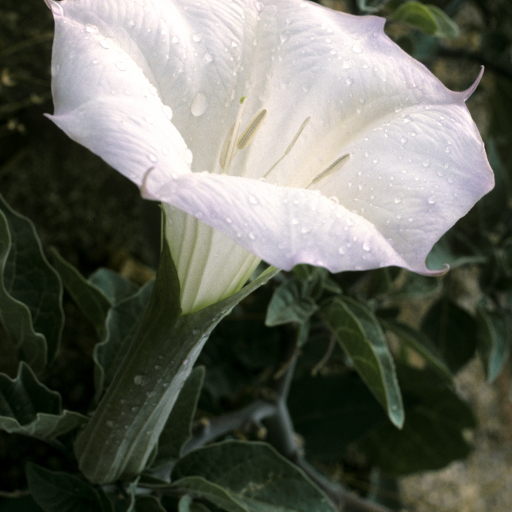
Known as the "Devil’s Trumpet," "Hell’s Bells," or the "Thorn Apple," the Datura is a plant of dramatic contradictions. Its massive, pristine white or purple flowers are hauntingly beautiful and bloom primarily at night, releasing a heavy, sweet fragrance. However, behind its ethereal appearance lies a dark reputation as one of the most toxic plants found in gardens and wild spaces alike.
🔍 How to Identify
- 🎺 The Flowers: Large, upright, trumpet-shaped blooms that can reach up to 7 inches long. They usually open in the evening and close by noon the next day.
- 🍃 The Foliage: Broad, ovate leaves with wavy or "toothed" edges. When crushed, the leaves emit a distinct, somewhat foul odor often described as smelling like rancid peanut butter.
- 🦔 The Fruit: A distinctive, golf-ball-sized seed pod covered in sharp, woody spines—giving it the nickname "Thorn Apple."
🏡 In Your Garden
- ☀️ Sun Seeker: Datura thrives in full sun and heat. It is surprisingly hardy and can grow in poor, sandy soil where other plants might struggle, often appearing as a "weed" in disturbed ground.
- 🌱 The Spreading Habit: It is a prolific self-seeder. If you don't remove the spiky seed pods before they burst, you may find dozens of "volunteers" popping up across your yard the following spring.
- 💧 Drought Nuance: While it appreciates regular watering to produce the best blooms, its deep taproot allows it to survive long periods of neglect, making it a "tough-as-nails" ornamental.
⚠️ Safety & Toxicity
- 💀 Status: EXTREMELY TOXIC. All parts of the Datura plant—roots, leaves, seeds, and flowers—contain high levels of tropane alkaloids (scopolamine and atropine).
- 🚫 The Danger: Ingestion can be fatal to humans, dogs, cats, and livestock. It causes severe hallucinations, rapid heart rate, and respiratory failure. Even handling the plant without gloves can cause skin irritation or eye dilation if you touch your face after contact. It is strongly recommended to keep this plant out of gardens where children or curious pets play.
✨ Fun Fact
The nickname "Jimsonweed" is a corruption of "Jamestown Weed." In 1676, hungry British soldiers in Jamestown, Virginia, consumed the plant as a salad. They reportedly spent eleven days in a state of total temporary insanity before recovering, leading to the plant's permanent place in American colonial folklore.

Detailed Care Instructions
Growing Datura, commonly known as Brugmansia or Angel's Trumpet, can be a rewarding experience, but it requires care as some parts of the plant are toxic. Here’s a step-by-step guide to help you grow Datura:
1. Choose the Right Species
- Determine which type of Datura or Brugmansia you want to grow. Common species include Datura stramonium (Jimson weed) and Brugmansia spp. (Angel's Trumpet).
2. Select a Location
- Sunlight: Datura prefers full sun, so choose a location that receives at least 6-8 hours of sunlight daily.
- Space: Ensure there's enough room for the plant to grow, as they can become quite large.
3. Soil Preparation
- Datura thrives in well-draining soil. A mixture of potting soil, compost, and sand is ideal.
- Make sure the soil pH is slightly acidic to neutral (around 6.0 to 7.0).
4. Planting
- Seeds: If starting from seeds, plant them about ¼ inch deep in the spring after the last frost. Keep the soil moist until germination, which usually takes 2-3 weeks.
- Seedlings: If transplanting seedlings, ensure they are hardened off (acclimatized) to outdoor conditions for a few days before planting.
5. Watering
- Water the plants regularly, especially during dry spells. However, avoid waterlogging the soil, as Datura does not tolerate standing water.
6. Fertilizing
- Feed Datura plants with a balanced fertilizer every month during the growing season (spring to early fall). A fertilizer that is higher in phosphorus can help enhance flowering.
7. Pruning
- Prune the plants regularly to encourage bushier growth and to remove any dead or diseased branches. This can also help to improve air circulation.
8. Pest and Disease Control
- Monitor for common pests like aphids, spider mites, and whiteflies. Use insecticidal soap or neem oil if infestations occur.
- Ensure proper spacing between plants to minimize the risk of fungal diseases.
9. Winter Care
- In cooler climates, Datura plants can be brought indoors before the first frost or cut back to the ground and covered with mulch.
- Brugmansia can be perennial in warmer climates and may not need special winter care.
10. Enjoying Your Datura
- Once established, Datura will produce striking flowers that are often trumpet-shaped and fragrant, typically blooming in the evening.
Caution
- Datura contains alkaloids that can be toxic if ingested. Handle with care and keep it away from pets and children.
By following these steps, you should be able to successfully grow Datura and enjoy its beautiful, dramatic blooms. Happy gardening!

Place in a bright room that is sun drenched almost all day. Or directly in a south-facing window.

To water this plant, one should first check the soil to see if it is dry. If the soil feels dry to the touch, the plant should be watered. One should avoid getting water on the leaves or flowers, as this can cause damage. Instead, water at the base of the plant, allowing the water to soak into the soil. It is important not to overwater this plant, as it prefers well-draining soil and can become waterlogged and damaged if it is constantly wet. One should allow the soil to dry out a bit between waterings, but not to the point where the plant starts to wilt. It is also important to avoid letting water sit in the saucer or tray underneath the pot, as this can lead to root rot.
To fertilize a Datura plant effectively, follow these steps:
- Timing: Fertilize during the growing season, which typically spans from spring to late summer. Avoid fertilizing in the fall and winter when the plant is dormant.
- Type of Fertilizer: Use a balanced, slow-release fertilizer or a liquid fertilizer formulated for flowering plants. Look for a product with an N-P-K ratio of around 10-10-10 or 15-15-15.
- Application:
- For slow-release fertilizer, apply according to the manufacturer's instructions, usually around every 6-8 weeks.
- For liquid fertilizer, dilute it to half-strength and apply every 2-4 weeks during the growing season.
- For slow-release fertilizer, apply according to the manufacturer's instructions, usually around every 6-8 weeks.
- Method:
- For granular fertilizers, spread the recommended amount evenly around the base of the plant, being careful to keep the granules away from the plant's stem. Water thoroughly after application to help the fertilizer penetrate the soil.
- For liquid fertilizers, water the plant a day before application. Apply the diluted solution around the base of the plant, avoiding the leaves to prevent burn.
- For granular fertilizers, spread the recommended amount evenly around the base of the plant, being careful to keep the granules away from the plant's stem. Water thoroughly after application to help the fertilizer penetrate the soil.
- Soil Preparation: Ensure the soil is well-draining and enriched with organic matter. This provides a good base for nutrient uptake.
- Watering: Maintain regular watering, especially during hot periods. However, ensure the plant does not sit in waterlogged soil.
- Monitoring: Observe the plant for signs of nutrient deficiencies (like yellowing leaves or poor growth) and adjust fertilization accordingly.
Always follow the specific manufacturer’s instructions for any product you use, and consider conducting a soil test to determine existing nutrient levels before applying fertilizer.
For growing Datura plant, it is best to use a well-draining soil that is rich in organic matter. The soil should have a pH level between 6.5 and 7.5 and should be able to retain moisture without becoming waterlogged. A mixture of perlite, peat moss, and sand can be used to create a loose and airy soil that allows for good drainage. It is also important to ensure that the soil is fertile and contains enough nutrients to support the growth of the plant. Adding compost or aged manure to the soil can provide a source of nutrients for the Datura plant.
Propagating the plant in question can be done through several methods, primarily by seeds or cuttings. Here’s a detailed guide for each method:
Seed Propagation
- Seed Collection:
- Wait for the seed pods to mature on the plant; they usually turn brown and dry out.
- Carefully harvest the pods and open them to extract the seeds. Ensure you handle them gently to avoid damage.
- Wait for the seed pods to mature on the plant; they usually turn brown and dry out.
- Preparation for Planting:
- Clean the seeds to remove any debris.
- Optional: Soak the seeds in water for 24 hours to enhance germination.
- Clean the seeds to remove any debris.
- Planting:
- Choose a well-draining seed starting mix and fill seed trays or small pots.
- Plant the seeds about 1/4 inch deep and cover lightly with soil.
- Water gently to ensure the moisture is evenly distributed without displacing the seeds.
- Choose a well-draining seed starting mix and fill seed trays or small pots.
- Germination Conditions:
- Place the trays or pots in a warm location with indirect sunlight.
- Maintain consistent moisture without saturating the soil. A humidity dome or clear plastic cover can help retain moisture.
- Germination usually occurs within 2-3 weeks.
- Place the trays or pots in a warm location with indirect sunlight.
- Transplanting:
- Once seedlings develop two sets of true leaves, they can be transplanted into larger pots or directly into the garden if the conditions are favorable.
Cutting Propagation
- Once seedlings develop two sets of true leaves, they can be transplanted into larger pots or directly into the garden if the conditions are favorable.
- Selecting Cuttings:
- Choose healthy stems from an existing plant, preferably semi-hardwood stems.
- Cut a segment approximately 6-8 inches long, ensuring it has at least one leaf node.
- Choose healthy stems from an existing plant, preferably semi-hardwood stems.
- Preparation:
- Remove any lower leaves on the cutting to prevent rot and reduce moisture loss.
- Optional: Dip the cut end in rooting hormone to promote root development.
- Remove any lower leaves on the cutting to prevent rot and reduce moisture loss.
- Planting:
- Prepare pots with a well-draining potting mix.
- Insert the cut end into the soil, burying it about 2-3 inches deep.
- Prepare pots with a well-draining potting mix.
- Watering:
- Water the cutting thoroughly and allow excess water to drain.
- Maintain consistent moisture in the soil, ensuring it doesn't dry out.
- Water the cutting thoroughly and allow excess water to drain.
- Conditions for Rooting:
- Place the pots in a warm, bright location but out of direct sunlight.
- Covering the cuttings with a plastic bag or using a propagation dome can help maintain humidity and encourage rooting.
- Place the pots in a warm, bright location but out of direct sunlight.
- Aftercare:
- Roots should develop in about 4-6 weeks. You can test by gently tugging on the cutting; resistance indicates root development.
- Once well-rooted, transplant the new plants into larger pots or the garden.
General Care
- Roots should develop in about 4-6 weeks. You can test by gently tugging on the cutting; resistance indicates root development.
- Light: Ensure that your young plants receive plenty of indirect sunlight as they establish.
- Watering: Water them regularly but avoid overwatering, which can lead to root rot.
- Fertilizing: Once the seedlings or cuttings are established, consider using a balanced fertilizer to encourage growth.
By following these methods, you can successfully propagate the specified plant, resulting in new growth and expansion of your collection.







