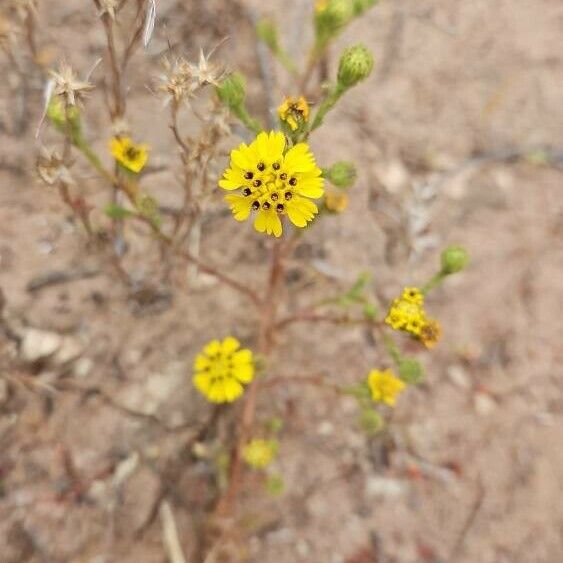
Plant Overview
Commonly known as the Panicled Tarplant, this golden Californian native is a late-summer superstar. While most wildflowers wither under the scorching sun, the Tarplant waits for the heat to arrive before showing off its sunny disposition. Its name comes from the sticky, aromatic resin that coats its stems and leaves, a clever evolutionary trick to conserve water and discourage hungry herbivores.
🔍 How to Identify
- 🌼 Sunny Blooms: It features classic daisy-like flower heads with bright yellow "petals" (ray florets) and a darker yellow center.
- 🌿 Sticky Texture: The entire plant is covered in glandular hairs that secrete a tacky, resinous "tar." If you touch it, you’ll definitely feel the stickiness!
- 🎋 Branching Form: It grows with a "panicled" habit, meaning it has a central stem that branches out into many smaller flowering stems, creating a delicate, airy silhouette.
🏡 In Your Garden
- ☀️ Late-Season Hero: This plant is a vital resource for bees and butterflies in late summer and autumn when most other native nectar sources have disappeared.
- 🏜️ Tough as Nails: It thrives in poor, rocky, or clay soils and requires almost no supplemental water once established. It’s perfect for xeriscaping or "wild" corners of the garden.
- 👃 Aromatic Presence: The "tar" has a very distinct, pungent scent—some describe it as spicy or like turpentine—which adds a unique olfactory layer to a native plant garden.
⚠️ Safety & Toxicity
- ✅ Generally Safe: The Panicled Tarplant is not considered toxic to humans or common household pets.
- 🧤 Skin Irritation: The sticky resin is not poisonous, but it can be a nuisance. It can cling to pet fur or clothes, and for those with very sensitive skin, the resin might cause mild contact irritation if handled extensively.
✨ Fun Fact
The Panicled Tarplant is part of a group of plants that underwent a "rapid radiation" in Hawaii. Millions of years ago, a relative of this California tarplant hitched a ride to the islands and evolved into the famous, giant Silverswords found on volcanic peaks!

Detailed Care Instructions

Place in a bright room that is sun drenched almost all day. Or directly in a south-facing window.

Some plants require more regular watering than others, which should be done every few days. It's critical to maintain the soil moist all of the time. The water requirements of the same plant placed in pots with varying sizes will differ. Because the water in the smaller pot evaporates faster than the water in the larger pot, it will require more watering. Regardless of pot size, the surface should constantly be maintained moist.








