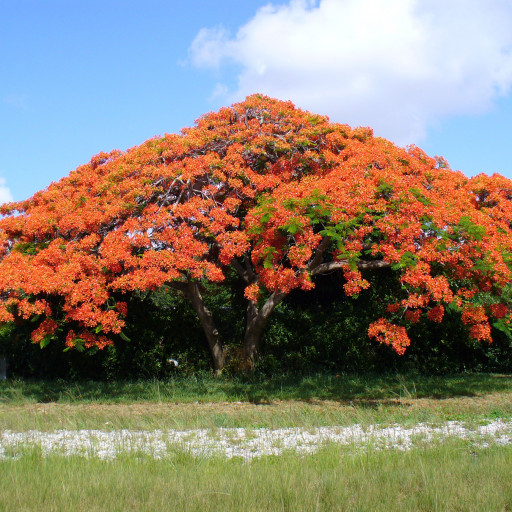
Plant Overview
Known as the "Flame of the Forest" or the "Royal Poinciana," Delonix regia is widely considered one of the most beautiful trees in the world. Originally from the dry deciduous forests of Madagascar, its massive umbrella-like canopy erupts into a sea of scarlet during the hottest months, providing both breathtaking beauty and deep, cooling shade. In many tropical cultures, its blooming marks the peak of summer or the arrival of the monsoon rains.
🔍 How to Identify
- 🌿 Feathery Foliage: The leaves are "bipinnate," meaning they look like delicate, lacy fern fronds. This light foliage allows dappled sunlight to reach the ground.
- 🌺 Flaming Flowers: Large, five-petaled blossoms. Four petals are solid scarlet or orange-red, while the fifth "standard" petal is slightly larger and splashed with yellow and white streaks.
- 🫛 Giant Seed Pods: After the flowers fade, long, flat, woody pods appear. These dark brown pods can grow up to 2 feet long and hang from the branches like heavy ornaments.
- 🌳 Umbrella Form: The tree naturally grows much wider than it is tall, creating a distinct flat-topped, spreading silhouette that acts as a natural parasol.
🏡 In Your Garden
- 🌞 Space & Roots: This is not a tree for small spaces. Because of its wide-reaching surface roots, it should be planted at least 15–20 feet away from houses, driveways, or sidewalks to prevent the roots from lifting the pavement.
- 💧 Drought Response: While it loves tropical humidity, it is remarkably drought-tolerant. In fact, a period of dry weather actually triggers a more spectacular flowering display. If it stays too wet year-round, you may get more leaves but fewer "flames."
⚠️ Safety & Toxicity
- 🐾 Pet Safety: The tree is generally considered non-toxic; however, the seed pods contain high levels of tannins. If a curious dog or cat chews on them, it may lead to mild nausea or digestive upset.
- 👶 Child Safety: The hard seeds inside the pods can be a choking hazard for small children. The bark and leaves are not known to cause skin irritation.
✨ Fun Fact
In the Caribbean, the dried seed pods are often called "shak-shaks." Because the seeds rattle inside the woody casing when shaken, they are frequently used as natural percussion instruments in traditional folk music!

Detailed Care Instructions
| Color | Red, Orange |
| Soil Ph | 4.9 To 10.6 |
| Lighting | Full Sun |
| Soil Type | Well-Drained Clay, Loamy, Sandy Or Gravelly |
| Bloom Time | Summer |
| Plant Type | Flowering Tree |
| Mature Size | 20 To 40 Feet |
| Native Area | Madagascar |
| Sun Exposure | Full Sun |
| Hardiness Zones | 10 To 12 |
To grow a Delonix Regia (Royal Poinciana) plant, you can follow these steps:
- Choose a suitable location: Delonix Regia prefers warm climates and plenty of sun, so select a location that receives at least 6-8 hours of direct sunlight daily.
- Prepare the soil: The soil should be well-draining, loamy, and slightly acidic. Amend the soil with organic matter such as compost or well-rotted manure to improve its fertility and drainage.
- Planting: Dig a hole that is twice as wide and deep as the plant's root ball. Place the plant in the hole, ensuring that the top of the root ball is level with the surrounding soil. Backfill the hole with the amended soil, gently firming it around the roots.
- Watering: Immediately after planting, thoroughly water the Delonix Regia plant to settle the soil. Keep the soil evenly moist but not waterlogged during the initial establishment period, which usually lasts a few months. Once established, water the plant deeply and less frequently, allowing the top few inches of soil to dry out between waterings.
- Fertilization: Apply a balanced, slow-release fertilizer in spring and mid-summer to provide essential nutrients. Follow the package instructions for the recommended dosage.
- Pruning: Regular pruning can help shape the plant and promote healthy growth. Prune during the dormant season or after flowering to remove dead or diseased branches, maintain size, and encourage air circulation.
- Mulching: Apply a layer of mulch around the base of the plant to retain soil moisture, suppress weed growth, and regulate soil temperature. Keep the mulch a few inches away from the stem to prevent rot.
- Protection from frost: Delonix Regia is sensitive to frost, so if you live in a colder climate, consider planting it in a container that can be moved indoors during the winter or provide frost protection, such as covering the plant with a frost cloth.
- Pest management: Monitor the plant for common pests like aphids, mealybugs, or scales. If an infestation occurs, use organic or chemical treatments according to the instructions provided.
- Patience: Delonix Regia is a slow-growing tree, so be patient and provide it with optimal growing conditions. Over time, it will develop into a beautiful tree with stunning flowers.
Remember to research specific care information for your region, as climate and growing conditions can vary.

Place in a window with dappled sun or a spot in the middle of a room. Or directly in a window facing west or east.

Delonix regia is a perennial plant species that is widely grown for its stunning flowering display. To water this plant effectively, there are a few important factors to consider.
Firstly, it is important to note that Delonix regia requires regular watering, but it is also essential not to overwater the plant. Overwatering can lead to root rot and other problems, so it is important to strike a careful balance in watering.
The amount of water required will depend on the size of the plant, the ambient temperature and humidity, and the soil in which it is growing. In general, Delonix regia prefers well-draining soil that is not too heavy or waterlogged. If the soil is too compacted, it can prevent proper drainage and lead to waterlogging.
When watering the plant, it is best to water deeply rather than frequently. This means giving the plant a thorough soaking, so that the water penetrates deep into the soil and reaches the roots. This encourages the roots to grow deep and strong, which helps the plant to become more drought-resistant over time.
It is also important to avoid getting water on the leaves or flowers of the plant, as excess water on the leaves can encourage fungal growth and other problems. To avoid this, it is best to water the plant at the base, using a watering can or hose with a spray nozzle.
In general, it is a good idea to water Delonix regia in the morning or evening, when the weather is cooler and the sun is less intense. This allows the water to soak in more effectively and reduces the risk of water evaporating before it has a chance to penetrate the soil.
By following these watering tips and monitoring the plant's moisture levels carefully, it is possible to ensure optimal growth and health for Delonix regia.
To fertilize your plant, use a balanced fertilizer with equal parts nitrogen, phosphorus, and potassium. Apply the fertilizer once in spring and once in summer. Follow the package instructions for the recommended amount for your plant size and water it thoroughly afterward. Avoid fertilizing in winter when the plant is dormant.
The recommended type of soil to use with this particular plant is a well-draining soil mixture with good moisture retention abilities. It should be rich with organic matter, such as compost, to provide necessary nutrients to support healthy growth. It is important that the soil pH level falls between 6.0-7.5 to prevent any nutrient deficiencies or toxicities. Additionally, it is best to avoid using heavy clay soils or soils that retain too much water as they can lead to root rot and other plant diseases.
To propagate this plant, you will need to first collect mature seeds from the parent plant. These seeds should be fully formed and not green or immature.
Once you have collected the seeds, you will need to prepare a well-draining soil mix and plant the seeds no more than 1 inch deep in the soil. Water the soil thoroughly and place the pot in a warm, sunny location.
Keep the soil moist but not waterlogged, and within a few weeks, you should start to see seedlings emerging from the soil.
Once the seedlings have grown a few sets of leaves, you can transplant them into individual pots with fresh soil. These plants should be kept in a warm, sunny location and watered as needed.
As the plants grow larger, they can be transplanted into larger containers or into the garden. Be sure to provide plenty of water and fertilize regularly during the growing season to encourage healthy growth.
Common pests of the royal poinciana include Scale insect, mealybugs, spider mites, larvae. Make a habit of checking your royal poinciana frequently for pests so that any infestations can be caught and managed early.








