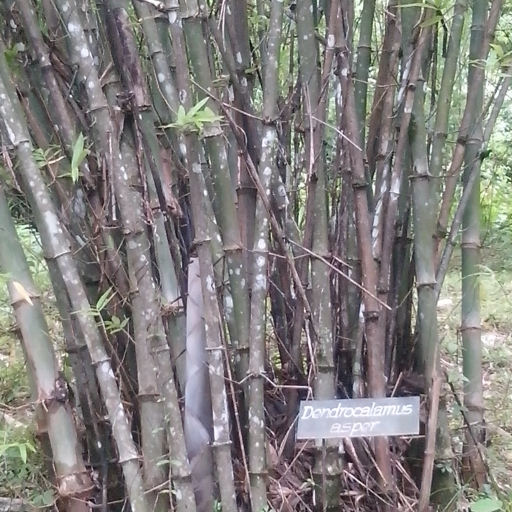
Plant Overview
Known as "Rough Bamboo" or the "Dragon Bamboo," Dendrocalamus asper is a true titan of the grass family. Originating from the tropical regions of Southeast Asia, this giant clumping bamboo is famous for its prehistoric scale and architectural strength. It is widely considered one of the most valuable bamboo species in the world, serving as both a primary construction material and a gourmet food source.
🔍 How to Identify
- 🎋 The Culms (Stems): These are massive, reaching up to 10 inches in diameter. When young, the stems are covered in a beautiful, velvety layer of fine brown hairs, giving them a "rough" texture compared to other smooth bamboos.
- 💍 The Nodes: The rings around the stem are very prominent. Near the base of the plant, you will often see several rings of small, dormant aerial roots circling the nodes.
- 🍃 The Foliage: It produces long, lance-shaped leaves that form a dense, drooping canopy. The sheer volume of leaves creates a deep, cooling shade beneath the grove.
🏡 In Your Garden
- 🐘 Space Requirements: This is not a plant for a small suburban backyard. Because it can grow over 100 feet tall, it needs significant vertical and horizontal space. Fortunately, it is a "clumper" (sympodial), meaning it stays in a tight group and won't aggressively sprint across your garden like "running" bamboo varieties.
- 💧 Thirst for Humidity: To reach its full potential, Dendrocalamus asper requires deep, rich soil and plenty of moisture. It thrives in tropical and subtropical climates and is quite sensitive to heavy frost, which can damage its massive culms.
⚠️ Safety & Toxicity
- ✅ Status: Generally non-toxic and safe for touch.
- 🍲 Edibility Note: While the young shoots are a world-renowned delicacy, they should never be eaten raw. Like many bamboo species, the raw shoots contain cyanogenic glycosides (natural toxins) that are neutralized only by boiling them thoroughly before consumption. It is perfectly safe for pets and children to be around.
✨ Fun Fact
- 🏗️ Vegetable Steel: Dendrocalamus asper is often called "vegetable steel" because its wood is incredibly thick-walled and strong. In Indonesia and Colombia, it is used to build entire multi-story houses, bridges, and even high-end eco-resorts!

Detailed Care Instructions
To grow Dendrocalamus asper, also known as Giant Bamboo, you can follow these steps:
- Climate: Ensure that you live in a warm and humid climate. Dendrocalamus asper thrives in tropical and subtropical regions, where temperatures range from 20-35°C (68-95°F).
- Soil: Choose well-draining soil that is rich in organic matter. The pH level of the soil should be slightly acidic to neutral. If the soil in your area is not suitable, you can improve it by adding compost or well-rotted manure.
- Sunlight: Dendrocalamus asper prefers full sun exposure to partial shade. Make sure the plant receives at least 6 hours of direct sunlight per day.
- Planting: Select healthy and mature bamboo culms (stems) for planting. Dig a planting hole slightly larger than the root ball of the culm. Place the culm in the hole and backfill with soil. Ensure that the culm is planted vertically, and the soil is firmly packed to provide stability.
- Watering: Keep the soil consistently moist, but not waterlogged. Water the plant deeply once a week during dry periods. Adjust the watering frequency according to the weather conditions.
- Fertilization: Apply a balanced slow-release fertilizer during the growing season to provide essential nutrients. Follow the manufacturer's instructions for the proper application rate. Organic fertilizers, such as compost or well-rotted manure, can also be used.
- Mulching: Apply a layer of organic mulch, such as wood chips or straw, around the base of the plant. Mulch helps retain moisture, suppresses weed growth, and improves the soil's fertility.
- Pruning: Remove any dead or damaged culms from the plant to maintain its health and appearance. Pruning can be done in late winter or early spring before new growth emerges.
- Support: Dendrocalamus asper can grow up to 35 meters (115 feet) tall, so providing support with stakes or a trellis may be necessary to prevent the culms from bending or breaking.
- Pest and Disease Control: Monitor the plant regularly for any signs of pests or diseases. Common pests affecting bamboo include scale insects, aphids, and mites. If any pest infestation is discovered, treat it with appropriate insecticides or organic remedies. Fungal infections can be controlled by improving air circulation and avoiding overwatering.
By following these steps, you should be able to successfully grow Dendrocalamus asper.
The best way to water this particular plant is to make sure that the soil is moist but not waterlogged. You can achieve this by watering deeply and slowly, and ensuring that the water penetrates to the roots. One way to test if the plant needs watering is to stick your finger into the soil up to the first knuckle and check for moisture. If the soil is dry, water the plant. However, be careful not to overwater as this can lead to root rot. It's best to water the plant in the early morning or late afternoon when temperatures are cooler and there is less evaporation.
To fertilize this plant, apply a balanced fertilizer with equal parts nitrogen, phosphorus, and potassium every two to three months during the growing season. Be sure to water the plant well before and after fertilizing to avoid burning the roots. Avoid over-fertilizing as it can lead to excessive growth and weaken the plant, making it more susceptible to disease and pests.
The Dendrocalamus Asper plant prefers a specific type of soil to thrive. The soil should be well-draining and should have a pH level of 6 to 7.5. It must be rich in organic matter, and it should be kept moist but not waterlogged. The plant is tolerant of slightly acidic soil and can even grow in sandy soil as long as it is mixed with humus or compost. It is advisable to avoid heavy clay soil as it may cause root rot. A mix of potting soil and perlite or sand can be an ideal growing medium for the plant. Additionally, adding a layer of mulch on top of the soil can help to retain moisture and keep the soil healthy. The key to healthy Dendrocalamus Asper growth lies in ensuring the soil is well-aerated and fertile.
Dendrocalamus Asper is a type of bamboo plant that can be propagated through various methods. Here are the steps for propagating Dendrocalamus Asper:
- Select healthy and mature bamboo culms (stems).
- Cut the culms into sections that are about 60 centimeters long.
- Remove the branches and leaves from the lower end of each section.
- Cut a small hole in the node (joint) of the bamboo section you want to propagate.
- Place the bamboo section in a container with water and leave it for 2 to 3 weeks to allow root growth.
- Change the water every 2 to 3 days to prevent it from becoming stagnant and to keep it fresh.
- Keep the container in a warm and bright location, but avoid direct sunlight.
- Once new roots start to grow, transplant the bamboo section into a pot or container filled with a suitable potting mix.
- Water the new plant regularly, and protect it from direct sunlight and extreme weather conditions.
- Wait for the plant to grow and mature before transplanting it to its final location, such as in the garden or a larger container.








