Plant Overview
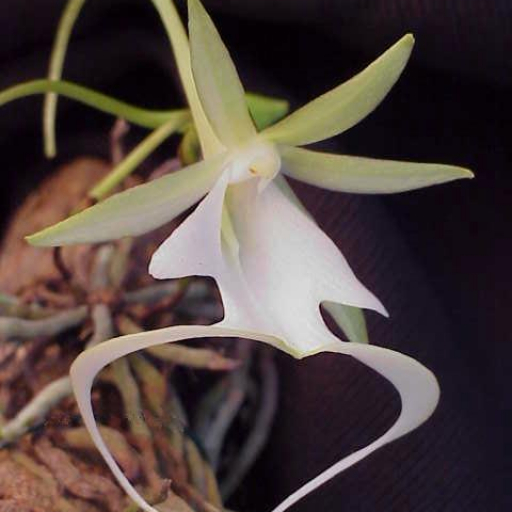
Often called the "Ghost Orchid," this ethereal beauty is one of the most coveted and mysterious plants in the world. Found deep in the cypress swamps of Florida and Cuba, it appears to float mid-air when in bloom, earning its spectral name. It is a botanical marvel that has abandoned leaves entirely, relying on its complex root system to breathe and feed.
🔍 How to Identify
- 🌿 The "Spider" Roots: Instead of leaves, you will see a flat, radiating network of grayish-green roots that cling tightly to tree bark. These roots contain chlorophyll and do all the heavy lifting for photosynthesis.
- 👻 The Floating Bloom: The flower is a brilliant, snowy white with two long, curling tendrils at the bottom that resemble the legs of a leaping frog.
- 🕯️ Leafless Stature: Unlike almost any other orchid you’ll encounter, this plant is permanently leafless; it looks like a cluster of green worms until the moment it decides to flower.
🏡 In Your Garden & Habitat
- 🌳 The Host Tree: In the wild, it strictly prefers the bark of native trees like the Pop Ash or Pond Apple. It doesn't take nutrients from the tree but uses it as a high-up anchor to catch the humid swamp breeze.
- 🧪 The Symbiotic Secret: This orchid is notoriously difficult to grow outside its natural habitat because it requires a very specific "mycorrhizal" fungus in its roots to survive. Without this microscopic partner, the plant cannot process nutrients.
- 🌬️ Air and Water: It thrives in environments with nearly 100% humidity and constant air movement—conditions that are nearly impossible to replicate in a standard home setting.
⚠️ Safety & Toxicity
- 🛡️ Legal Protection: While not toxic to humans or pets, the Ghost Orchid is critically endangered. In many regions, it is a felony to remove it from the wild or even touch it, as human oils can damage its delicate surfaces.
- 🐾 Pet Safety: There are no known records of toxicity, but because this plant is a protected species, it should never be kept in an area where it could be disturbed by curious pets.
✨ Fun Fact
The Ghost Orchid emits a deep, fruity fragrance only at night. This is a targeted signal for its primary pollinator, the Giant Sphinx Moth, which possesses a proboscis (tongue) long enough to reach the nectar hidden deep within the flower’s long "spur."

Detailed Care Instructions
Growing Dendrophylax lindenii, also known as the ghost orchid, can be challenging as it has specific growing requirements. Here are some instructions to help you grow this unique plant:
- Obtain seeds or tissue culture: Dendrophylax lindenii is a rare and endangered orchid, making it difficult to find seeds or tissue cultures for sale. Contact orchid specialty nurseries or conservation organizations to inquire about acquiring a plant or seeds legally.
- Provide suitable growing conditions: Ghost orchids are epiphytic orchids that naturally grow on trees in swampy habitats, so replicating these conditions is crucial. You will need a greenhouse or terrarium with high humidity levels (70-80%) and temperatures between 65-85°F (18-29°C).
- Choose a suitable growing medium: Ghost orchids do not grow in soil but instead attach their roots to the tree bark. You can recreate this by using a mix of sphagnum moss, tree fern fiber, and fine bark. Mount the plant on a piece of cork or tree fern slab.
- Provide proper lighting: Ghost orchids prefer bright, indirect light. Place the plant in an area where it will receive filtered or diffused sunlight. Supplemental artificial lighting with high-quality grow lights can also be beneficial.
- Maintain high humidity: Mist the plant regularly with distilled water to maintain high humidity levels. You can also place the plant on a humidity tray filled with water or use a humidifier to ensure the adequate moisture levels.
- Watering and fertilizing: Water the orchid when the growing medium starts to dry out, usually every 4-7 days. Use distilled or rainwater to prevent mineral buildup in the roots. Fertilize the plant with a balanced orchid fertilizer at quarter strength, approximately once a month during the growing season.
- Provide air movement: Ghost orchids require good air circulation to prevent the growth of fungi and other pests. Use fans or ventilation in your growing space to maintain adequate air movement.
- Be patient: Dendrophylax lindenii is a slow-growing orchid and may take several years to bloom. It requires a long, hormone-induced dormant period during the winter months before producing flowers. Be patient and provide consistent care for the plant.
Remember that growing Dendrophylax lindenii successfully can be quite challenging, and it's important to follow specific care instructions. If possible, seek guidance from experienced orchid growers or conservation organizations to ensure your success and contribute to the preservation of this rare species.

To properly water this plant, you should research its natural habitat and growing conditions. Consider the type of soil it prefers and how much moisture it requires. It may need occasional misting or watering with distilled or rainwater, as tap water can be too harsh for some species. Additionally, you should ensure that the pot or container has proper drainage and that any excess water is promptly removed. Monitor the plant regularly to assess its moisture needs and adjust your watering routine accordingly.
To fertilize this plant, use a balanced fertilizer with equal parts of nitrogen, phosphorus, and potassium. Dilute the fertilizer to half strength and apply it once a month during the growing season. Do not fertilize during periods of dormancy or stress, and always water the plant well before and after fertilizing to prevent root burn.
Dendrophylax Lindenii is a type of epiphytic orchid that requires a specific type of soil in order to thrive. This type of plant must be grown in a soilless medium that consists of a mixture of organic materials such as sphagnum moss, shredded bark, and coconut coir. The soil should not contain any fertilizers or other additives that can harm the delicate roots of the plant. It is important to keep the soil moist but not waterlogged, and to provide adequate drainage to prevent root rot. The plant also requires high levels of humidity and indirect sunlight in order to grow properly. It is important to place the plant in a location that provides ample airflow and prevents the buildup of moisture that can lead to disease or mold growth. When planted in the correct soil and provided with the optimal growing conditions, Dendrophylax Lindenii can thrive and produce beautiful blooms year after year.
Propagation of this plant can be done through the process of division. To begin, carefully remove the plant from its pot or container and gently separate any visible offsets or new growth from the parent plant. Be sure to use a clean, sharp instrument, such as a knife or scissors, to avoid damaging the delicate roots or stems of the plant. Once the new growth has been separated, it can be planted in a separate container with a suitable growing medium or substrate, such as sphagnum moss or an orchid bark mix. Water the new plant regularly and provide it with the proper levels of light and humidity for its specific species. Over time, the new plant will establish its own root system and grow into a mature specimen.








