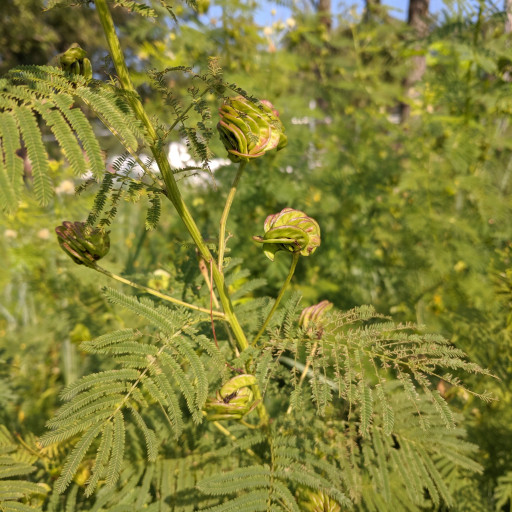
Plant Overview
Known as the "Prairie Mimosa" or "Bundle-grass," the Illinois Bundleflower is a resilient star of the North American grasslands. It is often nicknamed the "Fried Egg Plant" by some due to its white-and-yellow puffball blooms, though its most striking feature is the odd, brain-like cluster of seed pods it develops later in the season. A true workhorse of the prairie, this plant is a favorite for restoration projects because it improves the soil wherever it grows.
🔍 How to Identify
- 🌿 Feathery Foliage: The leaves are bipinnately compound, meaning they are divided into many tiny, fern-like leaflets that give the plant a delicate, airy appearance.
- ☁️ Puffball Blooms: In mid-summer, it produces small, globose flower heads that look like white or pale-cream pom-poms with protruding yellow-tipped stamens.
- 🥨 Curved Seed Pods: Its most defining trait is the "bundle." Flat, curved pods cluster together in a tight, dark-brown ball that persists into winter, resembling a small, woody rose or a cluster of miniature bananas.
🏡 In Your Garden
- 🌱 Nitrogen Fixer: As a member of the legume family, this plant "fixes" nitrogen into the soil through its root system. It’s essentially a natural fertilizer, making it a fantastic companion for "tired" garden beds.
- 🪵 Deep Taproot: It develops a massive, deep taproot early in life. This makes it incredibly drought-resistant once established, but it also means it hates being moved. Choose its forever home carefully, as transplanting an adult plant is rarely successful.
- 🦋 Wildlife Magnet: It is a high-protein buffet for wildlife; the seeds are a vital food source for birds like Northern Bobwhites, while the nectar attracts a wide variety of native bees and butterflies.
⚠️ Safety & Toxicity
- ✅ General Safety: Desmanthus illinoensis is generally considered non-toxic to humans and common pets. In fact, it is often used as a high-quality forage plant for livestock.
- 🧪 Chemical Note: The root bark contains certain alkaloids (including DMT) that have made it a subject of interest in ethnobotanical circles. However, in a standard garden setting, it poses no topical or airborne threat to kids or pets.
- 🌾 Dermatitis: While rare, the fine hairs on the stems may cause very mild skin irritation for those with highly sensitive skin during pruning.
✨ Fun Fact
The seeds are incredibly hardy! In the wild, they have a "hard coat" that often requires the heat of a prairie fire or the digestive tract of an animal to crack open before they can germinate, allowing the plant to survive for years in the soil seed bank.

Detailed Care Instructions
To grow Desmanthus illinoensis (Illinois bundleflower), follow these steps:
- Climate and Soil: Check if the plant is suitable for your climate and soil conditions. Desmanthus illinoensis is native to central and southern United States, and it thrives in well-drained soils with a pH between 6.0 and 7.5.
- Seed Collection: Collect seeds from mature Desmanthus illinoensis plants during the fall months. Seeds are contained within small pods that appear after the flowers dry out.
- Seed Treatment: Mimic natural processes that break seed dormancy by scarifying or stratifying the seeds. Scarification involves scratching the seed coat, and stratification involves exposing seeds to cool/moist conditions to simulate winter conditions. These treatments help seeds germinate better.
- Seed Sowing: Sow the treated seeds in early spring after the last frost date. An outdoor garden bed or large pots can be used for planting. Alternatively, you can start seeds indoors 4-6 weeks before the last frost and transplant the seedlings later.
- Planting: Sow the seeds 1/4 inch deep and cover with soil. Space the seeds or seedlings about 12-18 inches apart to allow adequate room for growth.
- Watering: Keep the soil consistently moist but not waterlogged. Desmanthus illinoensis prefers regular watering during the germination and establishment stages.
- Sunlight: Place the plants in a sunny location that receives at least 6 hours of sunlight per day. They can tolerate partial shade, but full sun is ideal.
- Maintenance: Maintain the desired moisture levels, and weed around the plants regularly. Mulching can help suppress weeds and retain moisture.
- Pruning: Prune the plants after flowering to improve density and encourage branching. This will also help prevent leggy growth.
- Harvesting: Harvest the seed pods when they turn brown and start to split open. Collect the seeds and dry them thoroughly before storing in a cool, dry place.
By following these steps, you can successfully grow Desmanthus illinoensis plants. Remember to consult local gardening resources or extension offices for region-specific advice.

Place in a bright room that is sun drenched almost all day. Or directly in a south-facing window.

Desmanthus Illinoensis is a plant that requires a moderate amount of water to thrive. The best approach is to water deeply and infrequently, allowing the soil to dry out between watering sessions. When watering, it is important to avoid getting the leaves wet as this can increase the risk of fungal diseases.
It is recommended to water the plant at the base using a watering can or a drip irrigation system, rather than using a hose or sprinkler which can disturb the soil and cause erosion. Additionally, it's best to keep an eye on the weather conditions as the watering frequency may need to be adjusted depending on how much rainfall the plant receives.
Overall, a consistent watering schedule and proper drainage will help keep the Desmanthus Illinoensis plant healthy and thriving.
To fertilize this plant, it is recommended to apply a balanced fertilizer with equal amounts of nitrogen, phosphorus, and potassium. The application should be done in spring and fall, and the fertilizer should be spread evenly around the base of the plant. Care should be taken not to over-fertilize as this can lead to excessive growth and poor plant health. Additionally, it is important to water the plant deeply after fertilizing to ensure that the nutrients are distributed throughout the soil and absorbed by the plant roots.
Desmanthus Illinoensis thrives in soils that have a neutral to alkaline pH level, typically in the range of 6.5 to 7.5. The soil should be well-draining and have adequate levels of organic matter. The plant prefers soils that are rich in nutrients, particularly nitrogen. It is also important to avoid soils that are compacted, as this can limit root growth and nutrient uptake. In general, a loamy soil with a good balance of sand, silt, and clay is ideal for growing Desmanthus Illinoensis. Careful attention should be paid to water management, as the plant is sensitive to both drought and waterlogging.
Desmanthus Illinoensis is a perennial plant that can be propagated through several methods. One way is to propagate it through seeds. To do this, collect mature seeds from the plant and sow them in a well-draining potting mix. Keep the soil moist and provide ample light for the seeds to germinate.
Another way to propagate Desmanthus Illinoensis is through stem cuttings. Take 6-8 inches long stem cuttings from an established plant and remove the leaves from the bottom half. Dip the cut end in rooting hormone and plant it in a potting mix. Keep the soil moist and provide bright but indirect light to encourage root growth.
Desmanthus Illinoensis can also be propagated through division. This method is ideal for established plants that have multiple stems. Carefully dig up the plant and gently separate the stems, ensuring that each stem has roots attached to it. Replant each stem in a potting mix and water regularly.
Regardless of the propagation method used, it is important to keep the soil moist and provide ample light and warmth for the new plants to grow. Once the plant is established, it can be transplanted into a larger pot or planted in the ground.








