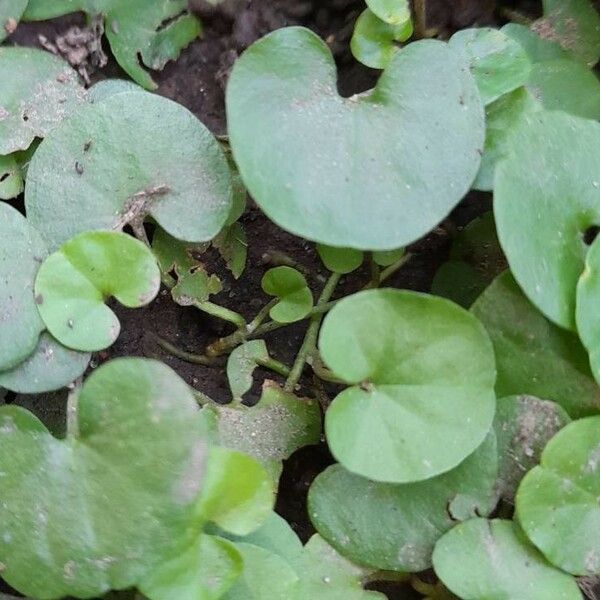
Plant Overview
Known as the "Silver Ponyfoot" or the "Waterfall Plant," Dichondra microcalyx is a low-growing beauty that creates a shimmering carpet of foliage. Whether it's cascading over the edge of a hanging basket or filling in the gaps between stepping stones, this plant adds a touch of metallic elegance to any landscape. It is beloved by gardeners for its ability to look like a literal stream of liquid silver when grown in elevated containers.
🔍 How to Identify
- 🍃 Leaf Shape: Features small, distinctive kidney-shaped (or "ponyfoot") leaves that grow symmetrically along thin, trailing stems.
- ✨ Texture & Color: The foliage is typically a soft, silvery-green color, covered in a fine layer of tiny white hairs that give it a shimmering, velvety appearance.
- 🧶 Growth Habit: It is a prostrate perennial that spreads rapidly via surface runners, forming a dense, thick mat that rarely exceeds two inches in height.
🏡 In Your Garden
- ☀️ The Sun Factor: While it can tolerate partial shade, its iconic silver sheen is most vibrant when it receives plenty of direct sunlight. In deep shade, it may turn more "green" and lose its metallic luster.
- 💧 Drainage is Vital: This plant is surprisingly drought-tolerant once established, but it is highly sensitive to overwatering. It "hates wet feet," so ensuring your soil or potting mix drains rapidly is the secret to preventing root rot.
- 🧗 The Perfect Spiller: Because it doesn't have a deep root system, it is an ideal candidate for rock gardens and "spiller" roles in container gardening, where it can trail down several feet like a living curtain.
⚠️ Safety & Toxicity
- 🐾 Pet Friendly: Good news for pet owners—this species is generally considered non-toxic to cats, dogs, and horses.
- 👶 Gentle Touch: Unlike many ground covers, it has no thorns, prickles, or irritating sap, making it a "touch-friendly" addition to family-oriented garden paths.
✨ Fun Fact
In the mid-20th century, Dichondra varieties became incredibly popular as "mow-less" lawn substitutes in California and other warm climates because they create a lush, green carpet that requires almost no trimming!

Detailed Care Instructions
To grow Dichondra Microcalyx plant, you can follow these steps:
- Obtain seeds or seedlings: You can buy seeds or small seedlings from a local nursery or online.
- Choose a suitable location: Dichondra Microcalyx plants prefer full sun to partial shade. Choose a location in your garden that receives at least 6-8 hours of direct sunlight per day.
- Prepare the soil: Dichondra plants prefer well-draining soil with a pH level of 5.5-8.0. Add organic matter, such as compost or well-rotted manure, to improve soil fertility and drainage.
- Plant the seedlings or sow the seeds: If using seedlings, dig small holes in the prepared soil and place the seedlings, gently pressing the soil around them. If using seeds, scatter them evenly over the soil surface and lightly cover them with a thin layer of soil. Water gently so as not to disturb the seeds.
- Water regularly: Keep the soil consistently moist until the plants are established and start to grow. Avoid overwatering as it can lead to root rot. Once established, water deeply but infrequently, allowing the top inch of soil to dry out before watering again.
- Provide proper nutrition: Apply a balanced fertilizer once or twice during the growing season to promote healthy growth. Follow the manufacturer's instructions for application rates.
- Control weeds: Keep the surrounding area free of weeds that might compete with the Dichondra Microcalyx plant for nutrients and water. Hand-pulling or using organic mulch can help prevent weed growth.
- Prune and shape: Dichondra Microcalyx plants have a trailing habit and can become invasive if left unattended. Regularly prune and shape the plant to keep it compact and tidy.
- Monitor pests and diseases: Watch out for common garden pests like aphids, mites, or whiteflies. Use organic pest control methods or consult a professional if necessary.
- Propagate and divide: Dichondra Microcalyx plants can be propagated by stem cuttings or dividing the plant. This can help you expand your plant collection or control its spread.
To water this particular plant, the soil should be moist but not too wet. It is important to avoid letting the plant sit in standing water as this can lead to root rot. As the plant grows, it may require more frequent watering. It is best to water deeply and infrequently rather than shallowly and frequently. Depending on the humidity and temperature, the plant may need to be watered every few days or once a week. It is important to monitor the soil moisture level and adjust watering as needed.
To fertilize the Dichondra Microcalyx plant, you can follow these instructions:
- Choose a balanced, slow-release fertilizer with an NPK ratio of around 10-10-10 or similar.
- Dilute the fertilizer according to the instructions on the packaging. Generally, a dilution ratio of 1/4 to 1/2 strength is suitable for non-flowering plants like Dichondra Microcalyx.
- Apply the diluted fertilizer to the soil around the base of the plant, avoiding direct contact with the leaves.
- Gently water the plant after applying the fertilizer to help it absorb the nutrients properly.
- Repeat the fertilization process every four to six weeks during the growing season (spring and summer).
- Monitor the plant for any signs of nutrient deficiency or excess, such as yellowing leaves or stunted growth. Adjust the fertilization schedule or dilution strength accordingly if needed.
- Avoid over-fertilization, as it can lead to nutrient burn or other adverse effects. It's better to err on the side of caution and provide slightly less fertilizer than recommended, rather than risking nutrient overload.
Remember, it's essential to research specific care requirements for Dichondra Microcalyx and understand its unique needs for optimal growth.
Dichondra Microcalyx plants can benefit from a well-draining soil that is rich in organic matter. The soil should be loamy and have a pH range of 6.0 to 7.5. Sandy soils can also be used but may require more frequent watering. The soil should be kept consistently moist but not waterlogged. A good ratio for the soil mix would be 40% loam, 40% organic matter, and 20% sand. It is important to avoid using heavy clay soils as they can cause waterlogging and root rot. A good way to improve soil quality is to amend it with compost or well-rotted manure. Adding perlite or vermiculite to the mix can also improve drainage.
To propagate Dichondra Microcalyx plant, you can follow the method outlined below:
- Start by selecting a healthy parent plant: Look for a mature and disease-free Dichondra Microcalyx plant that displays robust growth and has vibrant foliage.
- Prepare a suitable propagation medium: Dichondra Microcalyx can be propagated using either water or a well-draining potting mix. If choosing water propagation, fill a container with filtered or distilled water. For soil propagation, prepare a container with a well-draining potting mix.
- Take stem cuttings: Using a sterilized knife or pair of scissors, carefully cut a 4-6 inch section of a healthy stem from the parent plant. Ensure that the cutting has at least 2-3 sets of leaves.
- Remove lower leaves: Trim off the lower set of leaves from the stem cutting. This step helps prevent excessive moisture loss and allows the plant to focus its energy on root development.
- Optional: Apply rooting hormone (auxin): To encourage quicker root development, dip the cut end of the stem in a rooting hormone powder or gel. This step is optional and can be skipped if desired.
- Plant the cutting: Insert the trimmed end of the cutting into the propagation medium, ensuring that at least one set of leaves is above the surface. If using water propagation, just place the cutting in the water, making sure the leaf nodes are submerged.
- Provide appropriate conditions: Place the container in a warm and well-lit area, away from direct sunlight. Maintain a consistently moist propagation medium or water level, ensuring not to oversaturate the soil or water. This will help support the development of roots.
- Monitor and care for the cutting: Regularly check the moisture levels of the propagation medium or water and adjust as necessary. Avoid overwatering or allowing the stem cutting to dry out.
- Be patient: Root development can take several weeks. During this time, the cutting may experience some wilting or leaf loss as it redirects energy towards root growth.
- Transplanting: Once the cutting has developed a healthy root system, it can be transplanted into a larger pot or directly into the garden. Ensure the new location provides suitable lighting, temperature, and moisture conditions for the plant's optimal growth.
Remember to conduct further research or seek additional guidance if needed, as different plant species may require specific propagation techniques or conditions.








