Plant Overview
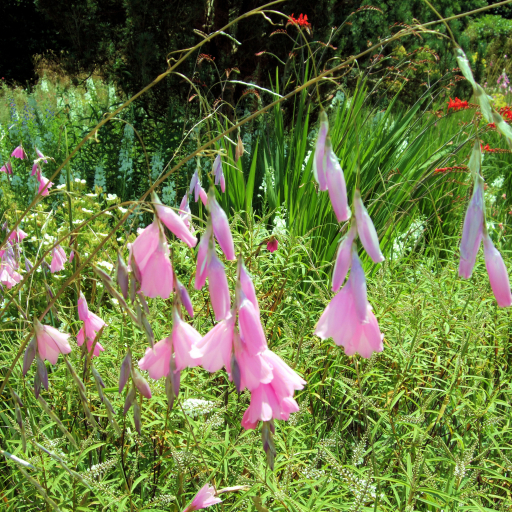
Often called "Angel’s Fishing Rod" or "Fairy Bells," this South African beauty is a masterclass in garden elegance. It is famous for its exceptionally long, wiry stems that arch gracefully over ponds or borders, dangling delicate bell-shaped flowers that sway in the slightest breeze. This plant brings a sense of movement and "haute couture" style to any sunny landscape, looking like a collection of magical fishing lines cast into the air.
🔍 How to Identify
- 🌿 Grass-like Foliage: It features tough, evergreen, sword-shaped leaves that form a dense, fountain-like clump at the base, resembling a tidy ornamental grass.
- 🎣 Arching Wands: The most distinct feature is its incredibly thin yet strong flowering stems that can reach up to 5 or 6 feet, curving downward elegantly under the weight of the blooms.
- 🔔 Pendent Bells: Drooping, funnel-shaped flowers ranging from pale pearly pink to deep wine-magenta, hanging in clusters like delicate jewelry on a string.
🏡 In Your Garden
- 🚫 Settling In: Dierama grows from corms and develops a deep, sensitive root system. It famously "hates" being moved once established, so choose its forever home carefully to avoid a multi-year "sulk" where it refuses to bloom.
- ☀️ The Sweet Spot: It thrives in deep, rich soil that stays moist but drains perfectly. It is a favorite for gravel gardens or pond edges, as it loves the reflected light and needs the airflow to keep its foliage healthy.
⚠️ Safety & Toxicity
- ✅ General Safety: Dierama pulcherrimum is not known to be toxic to humans, cats, or dogs, making it a safe choice for family gardens.
- 🛡️ Physical Texture: While non-toxic, the leaves are quite fibrous and tough. They aren't particularly palatable for curious pets, and the narrow leaf tips can be slightly sharp if you are working closely in the flower bed.
✨ Fun Fact
The genus name Dierama is derived from the Ancient Greek word for "funnel" or "funnel-shaped," which perfectly describes the geometric precision of its hanging blossoms.

Detailed Care Instructions
| Humidity | High |
| Lighting | Full Sun |
| Difficulty | Medium |
| Hibernation | Cold Period |
| Temperature | 16°C - 27°C |
| Hardiness Zones | 8 - 10 |
Here are some steps you can follow to help grow Dierama pulcherrimum, also known as Angel's Fishing Rod or Fairy's Fishing Rod:
- Climate and Location: Dierama pulcherrimum prefers mild to warm climates and should be planted in a location that receives full sun to partial shade.
- Soil: The plant thrives in well-draining soil that is rich in organic matter. Prepare the soil by adding compost or well-rotted manure to improve fertility and drainage.
- Planting: Choose a suitable spot in your garden where the plant can have enough space to grow. Dig a hole that is slightly larger than the plant's root ball and place the plant in the hole, ensuring that the top of the root ball is level with the soil surface. Backfill the hole with soil, gently firming it around the plant.
- Watering: Water the plant regularly, especially during dry periods, to keep the soil consistently moist but not waterlogged. Avoid overwatering, as it can lead to root rot. Mulching around the plant can help retain soil moisture.
- Fertilization: Apply a balanced slow-release fertilizer in spring to promote healthy growth. Follow the recommended dosage instructions on the fertilizer package.
- Pruning: Dierama pulcherrimum generally does not require much pruning. However, you can remove any dead or damaged foliage and spent flower stalks to maintain the plant's appearance.
- Support: As the plant grows, it may need support to prevent the long flower stalks from drooping or bending over. Install stakes or a trellis nearby and tie the stalks to them loosely, allowing room for movement.
- Dividing: Over time, Dierama pulcherrimum can form clumps. To keep the plant healthy, divide the clump every few years in early spring. Dig up the clump, carefully separate the individual plants, and replant them at the desired spacing.
Remember to monitor for pests and diseases and take appropriate action if necessary. Enjoy the graceful, pendulous flowers that Dierama pulcherrimum produces, which can attract pollinators like bees and butterflies to your garden.

Place in a bright room that is sun drenched almost all day. Or directly in a south-facing window.

Dierama Pulcherrimum is a plant that requires regular watering to thrive. When watering this plant, it is important to ensure that the soil is moist but not waterlogged. Overwatering can cause the plant to rot, while underwatering can lead to dehydration and death.
To water Dierama Pulcherrimum, you can use a watering can or a hose with a gentle spray nozzle. Aim to water the soil around the base of the plant rather than directly onto the foliage. This will help to prevent fungal diseases and ensure that the water reaches the roots where it is needed most.
During the growing season, which is typically from spring to early autumn, you should aim to water your Dierama Pulcherrimum once or twice a week. In hotter weather or if the soil is particularly dry, you may need to water more frequently.
In winter, when the plant is dormant, you can reduce watering to once a month or less. This will help to prevent waterlogging and rot.
In summary, when watering Dierama Pulcherrimum, aim to keep the soil moist but not waterlogged. Water around the base of the plant rather than onto the foliage and adjust your watering frequency according to the season and weather conditions.
To fertilize this plant, apply a balanced fertilizer with equal amounts of nitrogen, phosphorous, and potassium once a month during the growing season. Be sure to follow the manufacturer's instructions for dosage and application. Avoid fertilizing the plant during the dormant season. Water the plant well before and after fertilization to prevent fertilizer burn.
The soil that is best suited for this plant is a well-draining soil that is rich in nutrients. It should have a slightly acidic to neutral pH level and be able to retain moisture without becoming waterlogged. The soil should also be loose and friable to allow for good root development and airflow. The addition of organic matter such as compost or leaf mold can improve soil structure and fertility. It is important to avoid soils that are too heavy or dense, as this can lead to poor drainage and root rot. A soil mix consisting of equal parts of peat moss, perlite, and coarse sand can provide a good balance of nutrients, drainage, and moisture retention for this plant.
Dierama Pulcherrimum plant can be propagated by division or by seed.
To propagate by division, wait until the plant has finished flowering and become dormant. Dig up the entire clump and carefully separate the smaller plantlets from the larger parent plant. Each plantlet should have a good root system and a few healthy leaves attached. Plant these plantlets in well-drained soil and keep them well-watered until they become established.
To propagate by seed, collect mature seed pods from the plant after the flowers have faded. Allow the pods to dry out for a few days and then split them open to collect the small black seeds. Sow the seed in a container filled with a well-drained potting mix and cover lightly with soil. Keep the soil moist and warm (around 20-25 degrees Celsius) until the seeds germinate, which may take several weeks. Once the seedlings have grown a few leaves, transplant them to individual pots and continue to care for them until they are large enough to be planted in the garden.








