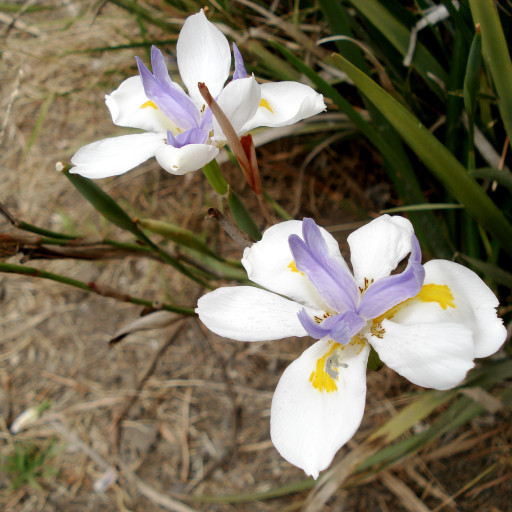
Plant Overview
Often called the "Fortnight Lily," this South African beauty is a staple in architectural landscaping and drought-tolerant gardens. It earns its rhythmic nickname because it tends to bloom in cycles—bursting into flower, resting for about two weeks, and then blooming again. Its elegant, iris-like flowers and fountain-shaped foliage give it a sophisticated "wild" look that lasts all year round.
🔍 How to Identify
- 🌸 The Bloom: Pristine white petals featuring three distinct yellow-orange "nectar guides" and central segments tipped with a soft, ethereal violet.
- 🗡️ Foliage: Stiff, sword-shaped leaves of deep forest green that grow in a flat, fan-like spray, creating a structural, fountain-like silhouette.
- 🌱 Growth Habit: It forms dense, evergreen clumps that spread via underground rhizomes, making it excellent for filling large garden borders.
🏡 In Your Garden
- ✂️ Pruning Secret: Never cut the flower stalks back after the petals fall! Unlike most plants, the Fortnight Lily produces new buds on the same stalk for several years. Only remove them if they have completely turned brown and dried out.
- 🌊 Drought Resilience: Once its root system is established, this plant is incredibly "set it and forget it." It can survive long dry spells, though it prefers a deep soak during the peak of summer to keep the leaves lush.
- ☀️ Versatile Light: While it blooms most prolifically in full sun, it is one of the few flowering perennials that remains attractive and healthy even in the dappled shade of large trees.
⚠️ Safety & Toxicity
- 🐾 Mildly Toxic: Like many members of the Iridaceae family, it contains compounds that can cause stomach upset. It is best kept away from curious "grazing" pets.
- 🤢 Symptoms: Ingestion of the leaves or the fleshy rhizomes (roots) by dogs or cats may lead to vomiting, drooling, or lethargy.
- 🧤 Skin Sensitivity: The sap is generally harmless, but those with very sensitive skin might experience mild irritation when dividing the clumps; gardening gloves are recommended.
✨ Fun Fact
In its native South Africa, the Dietes iridioides is often used in traditional medicine and is sometimes planted near homes because it is believed to protect the household from bad luck or lightning strikes!

Detailed Care Instructions
| Humidity | Normal |
| Lighting | Full Sun |
| Toxicity | Poisonous |
| Difficulty | Medium |
| Hibernation | Cold Period |
| Temperature | 15°C - 30°C |
| Hardiness Zones | 8B - 11 |
To grow Dietes Iridioides (also known as African iris or butterfly iris), follow these steps:
- Choose the right location: Select a spot that receives full sun to partial shade. The plant can tolerate a range of soil types but prefers well-draining soil.
- Prepare the soil: Before planting, amend the soil with organic matter or compost to improve drainage and fertility.
- Propagation: African iris can be propagated using seeds or by dividing existing clumps. If growing from seeds, sow them in a seed tray filled with a well-draining potting mix. Cover the seeds lightly and keep the soil consistently moist until germination occurs. If dividing clumps, gently dig up the plant and separate the rhizomes. Each division should have healthy roots and shoots.
- Planting: Dig a hole that is slightly wider and deeper than the root ball or division. Place the plant in the hole, making sure the crown is level with the soil surface. Backfill the hole with soil, firming it gently to eliminate air pockets.
- Watering: Irrigate the plant deeply after planting, and provide regular waterings until it establishes. Once established, African iris is drought-tolerant and generally does not require frequent watering. However, during extended dry periods, it is essential to water deeply to ensure the plant's health.
- Mulching: Apply a layer of organic mulch, such as straw or wood chips, around the base of the plant to help retain soil moisture and suppress weed growth. Avoid placing the mulch directly against the plant's crown.
- Fertilization: African iris does not require heavy fertilization; however, applying a balanced slow-release fertilizer in spring can promote healthy growth. Follow the manufacturer's instructions for application rates.
- Pruning: Deadhead spent flowers regularly to encourage continuous blooming. Trimming back the foliage in late winter or early spring can help rejuvenate the plant.
- Protection: Protect the plant from extreme cold temperatures, as it is sensitive to frost. If necessary, cover the plant or move potted specimens indoors during freezing conditions.
Overall, African iris is a hardy and low-maintenance plant that can add beauty to any garden. Just make sure to provide it with the right growing conditions, occasional watering, and minimal care, and it should thrive.

Place in a bright room that is sun drenched almost all day. Or directly in a south-facing window.

Dietes Iridioides is a type of plant that belongs to the Iridaceae family. It is a perennial plant that is native to certain regions in Africa. This plant is notable for its unique and striking flowers that feature a variety of colors, including yellow, white, and purple.
When it comes to watering Dietes Iridioides, it is important to note that this plant has specific requirements. It is a drought-resistant plant that prefers well-draining soil. Therefore, it is important to avoid overwatering the plant, as this can cause root rot.
In general, it is best to water Dietes Iridioides sparingly and only when the soil is dry to the touch. This will help ensure that the plant's roots do not become waterlogged. It is also a good idea to water the plant in the morning or evening, as this will help prevent evaporation and ensure that the water is absorbed by the soil.
When watering Dietes Iridioides, it is important to avoid getting water on the plant's foliage, as this can lead to fungal growth and disease. Instead, water the soil around the plant's base, taking care not to saturate the soil.
Overall, Dietes Iridioides is a low-maintenance plant that is well-suited to dry climates. With proper watering and care, this plant can thrive and add beauty to any garden or landscape.
To fertilize this plant, use a balanced fertilizer with equal amounts of nitrogen, phosphorus, and potassium. Apply the fertilizer during the growing season, which is typically in the spring and summer. Use a granular or slow-release fertilizer and apply it to the soil around the plant. Water the plant well after fertilizing to help the nutrients reach the roots. Avoid over-fertilizing, which can lead to excessive growth and weaker plants.
When planting the Dietes Iridioides, it is recommended to use a well-draining soil mixture that is also rich in organic matter. The soil should not be allowed to become waterlogged or overly dry, as this can cause stress to the plant. The pH of the soil should be slightly acidic to neutral, with a range between 6.0 and 7.0 being appropriate. It is also important to ensure that the plant is not planted too deeply, as this can lead to rotting of the roots. Adding a layer of mulch to the top of the soil can help to retain moisture and regulate soil temperature, which can benefit the overall health of the plant. It is recommended to fertilize the plant in the spring with a balanced fertilizer, and to avoid fertilizing during the dormant winter months.
To propagate this plant, you will need to locate a healthy parent plant that has matured to the point of producing flowers. Using a sharp, sanitized knife or scissors, cut a mature flowering stem from the parent plant, making sure to make the cut at a 45-degree angle. Next, remove any leaves or buds from the lower 2/3 of the stem, leaving only a few leaves at the top.
Prepare a planting mix of well-draining potting soil, perlite, and sand, and moisten it thoroughly. Dip the cut end of the stem into rooting hormone powder and then insert it into the planting mix, making sure the leaf nodes are below the surface.
Cover the planting container with plastic wrap or a clear plastic bag to create a humid environment and place it in a warm, bright location, but out of direct sunlight. Keep the planting mix consistently moist, but not overly wet.
After three to four weeks, check for root development by carefully tugging on the stem. If there is resistance, roots have formed. If not, re-cover the container and wait another week. Once roots have formed, carefully transplant the new plant to a larger pot or into the ground in a well-draining location.








