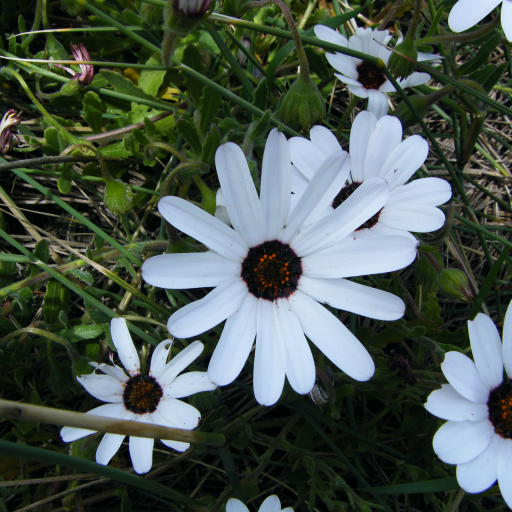
Plant Overview
Known as the White African Daisy or the enchanting Weather Prophet, Dimorphotheca pluvialis is a sun-loving annual that turns dry landscapes into snowy fields of white. Native to the sandy plains of South Africa and Namibia, this "Rain Daisy" has earned its nickname for its uncanny ability to predict the weather by closing its petals before a storm arrives.
🔍 How to Identify
- 🌼 The "Eye": The most striking feature is the flower head, featuring brilliant white ray florets surrounding a central disc that is often yellow, ringed with a deep violet or metallic blue circle.
- 🌓 Bicolor Petals: While the tops are pure white, the undersides of the petals often have a subtle mauve or coppery-blue tint, which becomes visible when the flower "sleeps" at night.
- 🍃 Textured Foliage: The leaves are narrow, light green, and slightly hairy or sticky to the touch, often featuring wavy or toothed margins that hug the ground in a bushy habit.
🏡 In Your Garden
- ☀️ Sun Worshipper: This plant is a true heliotrope; the flowers will only open in full, direct sunlight and will literally follow the sun’s path across the sky throughout the day.
- 🌱 The "Self-Starter": Because it is an annual with a short lifecycle, it compensates by being an Olympic-level self-seeder. Once you plant them, expect "volunteer" daisies to pop up in the same spot next spring without any help from you.
- 🏜️ Drainage is King: Coming from arid regions, it has evolved to thrive in poor, sandy soils. It hates "wet feet," so avoid heavy clay or overwatering, which can lead to root rot.
⚠️ Safety & Toxicity
- ✅ General Safety: Dimorphotheca pluvialis is generally considered non-toxic to humans and is not listed on major toxic plant databases for pets (unlike some of its distant cousins).
- 🐾 Pet Precaution: While safe, it is always wise to discourage cats or dogs from munching on garden plants, as ingesting large amounts of any fibrous plant material can cause mild stomach upset or vomiting in sensitive animals.
✨ Fun Fact
The name Dimorphotheca actually means "two-shaped receptacle." This refers to the plant's clever survival strategy: it produces two different types of seeds from the same flower head to ensure that at least some will germinate regardless of whether the season is wet or dry!

Detailed Care Instructions
To grow Dimorphotheca Pluvialis (also known as rain daisy or Cape marigold), here are some steps you can follow:
- Climate and soil: Dimorphotheca Pluvialis prefers a warm climate with full sun exposure. It is best suited for USDA hardiness zones 9-11. The plant thrives in well-draining soil with a slightly acidic to neutral pH level.
- Planting: Start by preparing the soil. Loosen it well and remove any weeds or debris. Sow the seeds directly into the ground after the last frost date has passed. You can also start them indoors 6-8 weeks before the last frost date and transplant them later. Plant the seeds about ¼ inch (0.6 cm) deep in the soil.
- Watering: Keep the soil consistently moist but not waterlogged until the seeds germinate. After that, water the plant deeply once or twice a week, depending on the weather conditions. Avoid overwatering, as it can cause root rot.
- Fertilizing: Dimorphotheca Pluvialis doesn't require heavy fertilization. A balanced, slow-release fertilizer applied at the beginning of the growing season is generally sufficient. Follow the instructions on the package for application rates.
- Pruning and pinching: To encourage branching and bushier growth, pinch or prune back the tips of the plant when it reaches around 6 inches (15 cm) in height. This will also promote more flower production.
- Mulching: Applying a layer of organic mulch around the base of the plant can help conserve moisture and suppress weed growth. Use materials like straw, wood chips, or compost.
- Pests and diseases: Dimorphotheca Pluvialis is generally resilient to pests and diseases. However, keep an eye out for common garden pests like aphids, snails, or slugs. Treat infestations promptly using organic pest control methods if necessary.
- Harvesting: The flowers of Dimorphotheca Pluvialis can be harvested for cut arrangements. Wait until the flowers are fully open, and cut them early in the morning when they are at their freshest. Remove the stems just above a leaf node to encourage continued blooming.
By following these steps, you should be able to grow Dimorphotheca Pluvialis successfully. Remember to provide proper care, be patient, and enjoy the beautiful blooms of this plant.

Place in a bright room that is sun drenched almost all day. Or directly in a south-facing window.

To water this plant, it is important to first check the soil moisture level. Stick your finger about an inch into the soil and see if it feels dry. If it is dry, water the plant slowly and deeply, allowing the water to fully penetrate the soil. Be sure not to overwater the plant, as it is susceptible to root rot. It is best to water early in the morning or in the evening to avoid evaporation and minimize stress on the plant.
To fertilize this plant, use a balanced fertilizer with equal parts nitrogen, phosphorus, and potassium. Apply the fertilizer in the early spring before new growth appears, and again in the middle of summer. Use a slow-release fertilizer or dilute the fertilizer with water to avoid burning the plant. Water the plant before and after applying the fertilizer to prevent stress on the roots. Avoid over-fertilizing as this can lead to excess growth and reduced flowering.
When planting the unnamed plant species Dimorphotheca Pluvialis, it is recommended to use a well-draining soil that is rich in organic matter. A mixture of peat moss, coco coir, and perlite can be used to ensure adequate drainage, while adding compost or other organic fertilizers can improve soil fertility. It is important to avoid using heavy or compacted soil, as this can cause root rot and inhibit proper plant growth. Additionally, the plant prefers a pH level between 6.0 and 7.5, so adjusting the soil acidity may be necessary. Overall, a loose, nutrient-rich soil with good drainage will best support the healthy growth of this plant.
Dimorphotheca Pluvialis plant can be propagated through seeds. To do this, start by selecting healthy plants that are free from diseases and pests. Allow the flowers to dry out on the plant and collect the seed heads. Clean and store the seeds in a cool, dry place until you are ready to plant.
Prepare the soil by loosening it and adding organic matter such as compost or manure. Sow the seeds thinly on the surface of the soil, cover lightly with soil, and water gently. Keep the soil moist until the seeds germinate, which should occur within two to three weeks.
Thin out the seedlings once they have two sets of true leaves, leaving only the strongest ones. When the plants are about 4-6 inches tall, transplant them into individual pots or directly into the garden, spacing them about 12 inches apart.
Ensure that the plants get enough sunlight, water, and nutrients to encourage healthy growth. Deadhead the flowers to promote a longer blooming period. Dimorphotheca Pluvialis plant can also be propagated through cuttings, but this method is less common.








