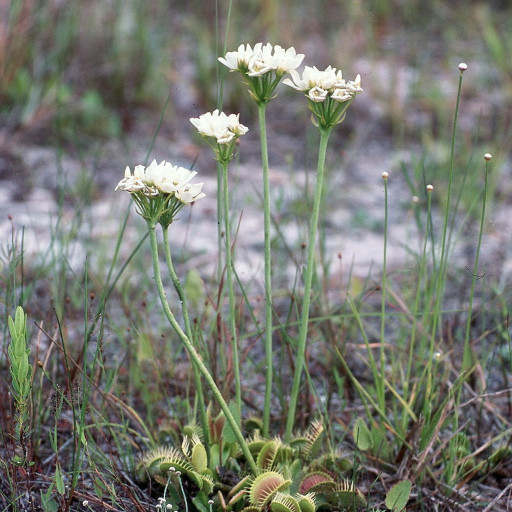
Plant Overview
Known as the "Venus Flytrap," this botanical predator is perhaps the most famous plant on Earth. Native to a tiny sliver of the Carolinas in the United States, it has fascinated scientists for centuries with its active hunting strategy. Charles Darwin famously dubbed it "one of the most wonderful plants in the world" because of its animal-like reflexes.
🔍 How to Identify
- 🦷 The "Jaws": Each leaf ends in two hinged lobes lined with long, comb-like "teeth" (cilia) that interlock when the trap snaps shut.
- 🧶 Trigger Hairs: Look closely inside the trap; you will see three tiny, sensitive hairs on each lobe that act as motion sensors to detect prey.
- 🌿 Low Rosette: The plant grows in a circular cluster close to the ground, with bright green foliage that often turns a deep, attractive red inside the traps to lure insects.
🏡 In Your Garden
- 🧪 The "No-Food" Rule: Evolution taught this plant to thrive in nutrient-starved bogs. Never use standard potting soil or fertilizer, as the minerals will "burn" the roots. They prefer a mix of pure peat moss and perlite.
- 💧 Mineral Sensitivity: These plants are incredibly picky about their drink. Tap water contains minerals that can be fatal over time; always use distilled water, reverse osmosis water, or rainwater.
- 😴 Winter Nap: To stay healthy for more than one season, they require a cool dormancy period for 3-4 months during the winter. They may look like they are dying, but they are simply resting to regrow stronger in the spring.
⚠️ Safety & Toxicity
- 🐾 Non-Toxic: The Venus Flytrap is perfectly safe for cats, dogs, and humans. It contains no poisons or irritants.
- 🚫 Plant Health Warning: While it isn't dangerous to you, it is "dangerous" for the plant if you poke the traps. Closing a trap without a meal consumes an immense amount of energy, and doing it repeatedly can exhaust and kill the leaf.
✨ Fun Fact
The Venus Flytrap can actually "count." To avoid closing on a falling raindrop or a stray piece of dust, the trap only snaps shut if a trigger hair is touched twice within about 20 seconds. It won't start the digestion process until the struggling insect touches the hairs five more times!

Detailed Care Instructions
| Color | White |
| Soil Ph | Acidic |
| Humidity | High |
| Lighting | Part Sun |
| Soil Type | Poor, Sandy Soil Kept Constantly Wet |
| Bloom Time | May To June |
| Difficulty | Medium |
| Plant Type | Herbaceous Plant With A Perennial Life Cycle |
| Hibernation | Cold Period |
| Mature Size | 6 To 12 Inches Tall By 6 To 9 Inches Wide |
| Native Area | The Carolinas |
| Temperature | 20°C - 30°C |
| Sun Exposure | Full Sun To Partial Shade |
| Hardiness Zones | 5 To 8 |
To grow Dionaea Muscipula, also known as the Venus flytrap, you can follow these steps:
- Choose the right location: Place your plant in a location that receives bright, indirect sunlight for at least 4-6 hours a day. A windowsill or well-lit area would be ideal.
- Provide the right soil: Venus flytraps grow best in moist, well-draining soil. You can create your own soil mix by combining peat moss and perlite or sand in a 1:1 ratio.
- Use distilled or rainwater: Dionaea Muscipula is sensitive to minerals found in tap water, so it is recommended to water it with distilled or rainwater. Make sure the soil remains moist but not soaking wet.
- Maintain humidity: These plants thrive in high humidity levels. You can increase humidity by placing the pot on a tray filled with water and pebbles. As the water evaporates, it creates a humid microclimate around the plant.
- Avoid fertilizers: Venus flytraps get most of their nutrients from captured insects. Fertilizing can harm the plant, so avoid using fertilizers.
- Avoid touching the traps: Venus flytrap's traps are the primary means of capturing prey. Avoid touching or triggering the traps unnecessarily as it can cause them to weaken or die.
- Provide occasional feeding: If your plant is not catching enough insects naturally, you can consider feeding it small insects like flies or ants. Only feed live insects and avoid overfeeding.
- Dormancy period: Dionaea Muscipula goes through a dormancy period during winter. Reduce watering during this time and keep the plant in a cooler location (around 50-55°F or 10-13°C). Resume normal care once spring arrives.
- Propagation: Venus flytraps can be propagated through leaf cuttings or divisions. Leaf cuttings involve carefully cutting off a leaf from the plant and planting it in a separate pot of fresh soil. Divisions can be done by separating multiple plants that have grown together.
Remember, Dionaea Muscipula is a carnivorous plant that requires specific care and conditions to thrive. With proper attention and care, you can successfully grow and enjoy this unique plant.

Place in a bright room that is sun drenched almost all day. Or directly in a south-facing window.

The Dionaea Muscipula plant prefers to be watered with distilled water or rainwater, as tap water tends to contain chemicals that can harm the plant. The soil should be kept continuously moist, but not waterlogged, as waterlogged soil can cause the roots to rot. It is important to not allow the soil to dry out completely, but to avoid overwatering by checking the soil moisture regularly, and only watering when the top inch of soil feels dry to the touch. When watering, water the soil directly at the base of the plant, avoiding getting water on the leaves or traps, as this can cause damage to the sensitive digestive tissues. In general, the Dionaea Muscipula plant should be watered enough to keep the soil consistently moist, but not so much that the soil becomes saturated or waterlogged.
To fertilize this plant, mix a very weak solution of a carnivorous plant or orchid fertilizer in distilled water. Avoid tap water as it can contain minerals that are harmful to the plant. Feed the plant once a month during the growing season, taking care not to over-feed. Apply the fertilizer directly to the soil, not the trap leaves, using a dropper or a spray bottle.
The best type of soil for this particular plant is a mixture of peat moss and perlite. The soil should be acidic, with a pH of around 4.5 to 5.5. It's important that the soil is well-draining, as the plant doesn't like to be waterlogged. The peat moss provides nutrients and moisture retention, while the perlite improves drainage and aeration. It's also important to use a pot with drainage holes to prevent excess water from accumulating at the bottom of the pot.
To propagate this plant, take a sterile razor blade and make a very small horizontal cut on the rhizome near the base of the plant. Cuttings should be taken in the spring, when new growth is emerging. Make sure that the cutting has at least one healthy root, and plant it in a mixture of peat moss and sand. Keep the soil moist and place the cutting in a warm, bright location, but out of direct sunlight. The cutting should start to develop new growth within several weeks.
Common pests of the venus fly trap include Fungus gnats. Make a habit of checking your venus fly trap frequently for pests so that any infestations can be caught and managed early.








