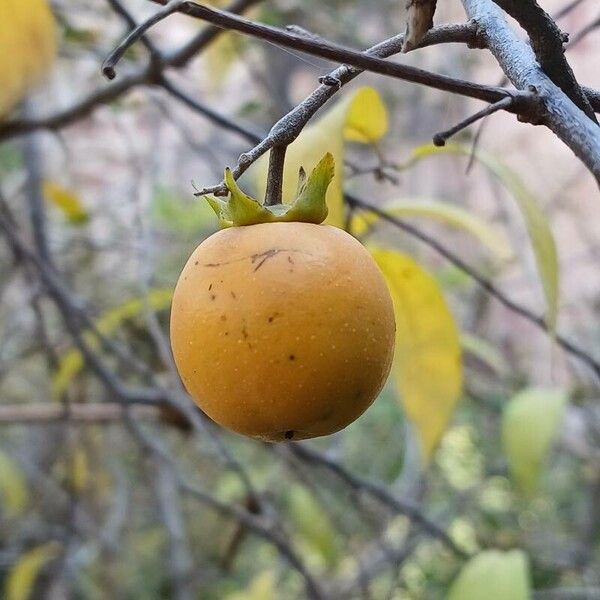
Plant Overview
Often called the Mountain Persimmon or Bistendu, Diospyros montana is a hardy, sculptural tree native to the dry forests of South and Southeast Asia. While it belongs to the same family as the sweet persimmons we find in grocery stores, this wild relative is far more rugged, often guarding its small, jewel-like fruit with sharp, woody spines. In its native range, it is both respected for its medicinal properties and feared for its potent chemistry.
🔍 How to Identify
- 🌿 Folliage: The leaves are elliptic and glossy green, arranged alternately along the stems. They often turn a subtle, dusty yellow before falling during the dry season.
- ⚔️ Armor: Older branches and trunks are frequently armed with stout, sharp thorns, a natural defense mechanism that makes the tree look remarkably "wild."
- 🟡 Fruit: It produces small, globose berries (roughly 1–4 cm) that transition from a hard green to a waxy, golden-yellow or reddish-brown when mature.
🏡 In Your Garden & Habitat
- 🏜️ Rugged Resilience: This tree is a champion of rocky, dry terrains. It is rarely grown as a standard ornamental but is highly valued in "xeriscaping" or wilder landscapes for its ability to thrive in poor, well-draining soil with minimal water.
- 🌳 Growth Habit: It typically grows as a large shrub or a small-to-medium tree. Because of its slow growth and dense wood, it is often used in its native habitat as a natural "living fence" to keep livestock away from crops.
⚠️ Safety & Toxicity
- 🚫 Toxic Fruit: Unlike the common persimmon, the fruit of Diospyros montana is highly astringent and toxic when unripe. It contains compounds that have historically been used by locals to stun fish in water.
- 🐾 Pet & Human Danger: Ingestion of the fruit, seeds, or crushed leaves can cause severe gastrointestinal distress, vomiting, and dizziness in humans and pets. It is generally considered non-edible.
✨ Fun Fact
🎨 The "Ebony" Connection: Because it belongs to the genus Diospyros, this tree is a cousin to true Ebony. While it doesn't have the solid black heartwood of its famous relatives, its wood is still incredibly hard and heavy, traditionally used to craft high-quality walking sticks and agricultural tools.

Detailed Care Instructions







