Plant Overview
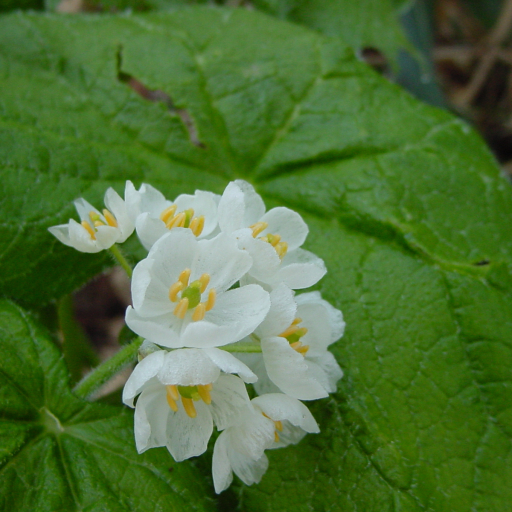
Known as the "Skeleton Flower," this woodland gem performs a mesmerizing magic trick every time it rains. Native to the cold, moist mountain forests of Japan and China, its delicate white petals lose their pigment and turn completely transparent when wet, revealing a network of veins that look like fine lace. As the petals dry, they magically return to their opaque, snowy-white state.
🔍 How to Identify
- 💧 Ghostly Petals: The most famous feature is the small, rounded white petals that become clear as glass when touched by raindrops or heavy dew.
- ☂️ Umbrella Foliage: It sports large, bold, lime-green leaves that are deeply lobed and shaped like jagged umbrellas, often growing in pairs.
- 🫐 Jeweled Fruit: After the spring blooms fade, the plant produces clusters of striking, deep-blue berries held up by bright red stalks.
🏡 In Your Garden
- 🌧️ Moisture is Non-Negotiable: This plant mimics the damp forest floor. It thrives in consistently moist, humus-rich soil and will wilt quickly if the ground dries out, especially during the summer heat.
- ❄️ The Winter Sleep: As a cold-climate perennial, it requires a chilly winter dormancy period to recharge. It is the perfect choice for "problem" deep-shade spots under tall trees where more sun-loving flowers fail to grow.
⚠️ Safety & Toxicity
- 🛡️ Low Risk: Diphylleia grayi is generally considered non-toxic to humans and common household pets like cats and dogs.
- 🚫 Don't Forage: While not known to be poisonous, the berries and rhizomes are not edible and may cause mild digestive upset if ingested by curious children or pets.
✨ Fun Fact
The "skeleton" effect isn't caused by a chemical reaction or a loss of pigment. It is a structural phenomenon—the petals have a loose cellular structure with air pockets that scatter light to look white. When water fills those gaps, the light passes straight through, making the flower look like it has vanished into thin air!

Detailed Care Instructions
To grow Diphylleia grayi (commonly known as the skeleton flower), follow these steps:
- Obtain a Diphylleia grayi plant: Purchase a live plant from a reputable nursery or source seeds to start from scratch. It's important to ensure the plant is suitable for your growing region as this species is native to East Asia.
- Choose the right planting location: Diphylleia grayi typically prefers moist, well-draining soil and partial shade. Find a spot in your garden or yard that meets these requirements.
- Prepare the soil: The soil should be rich in organic matter and have good drainage. Amend the soil if necessary by adding compost or well-rotted manure.
- Planting: If you have a live plant, dig a hole slightly larger than the root ball and gently place the plant in, making sure it's at the same depth as it was in the pot. If starting from seeds, follow the seed packet instructions for planting depth and spacing.
- Watering: Keep the soil consistently moist but not waterlogged. Avoid letting the soil dry out completely, as this can harm the plant.
- Mulching: Apply a layer of organic mulch around the base of the plant to help retain moisture and regulate soil temperature. This will also help suppress weed growth.
- Fertilizing: Use a balanced, slow-release fertilizer once a year in spring or early summer. Follow the instructions on the fertilizer packaging for application rates.
- Pruning: Prune any dead or damaged foliage to maintain the overall health and appearance of the plant. This is usually done in early spring before new growth starts.
- Protection from extreme temperatures: If you live in an area with harsh winters, consider protecting the plant by covering it with mulch or a frost blanket during the colder months.
- Propagation: Diphylleia grayi can be propagated by division or through seeds. If you want to propagate through division, carefully separate the plant into smaller sections with roots and replant them.
Remember to research and adapt these steps based on your specific climate and growing conditions to give your Diphylleia grayi plant the best chance to thrive.

Place in a dark room with little light, like a dark bedroom or a spot far away from a window or directly in a north-facing window.

This plant should be watered regularly to keep the soil moist, but not waterlogged. It prefers to be watered with room temperature water rather than cold water. To determine when the plant needs to be watered, check the soil's moisture level by inserting your finger into the soil to a depth of about 1 inch. If the soil feels dry, it's time to water. If the soil feels moist, wait a few more days before watering. Additionally, it's important to avoid getting water on the leaves and flowers of the plant, as this can cause them to rot. Instead, water the soil directly at the base of the plant.
To fertilize this plant, use a balanced fertilizer with equal amounts of nitrogen, phosphorous, and potassium during the growing season (spring through summer). Mix the fertilizer with water according to the package instructions and apply it to the soil around the base of the plant. Avoid fertilizing in the fall and winter, as the plant is dormant during this time. Additionally, be cautious not to over-fertilize, as this can harm the plant.
The soil that is recommended for the plant that cannot be named commonly is a nutrient-rich, well-draining soil with a slightly acidic pH level. The plant prefers soil that is moist but not waterlogged, as it is sensitive to excessive moisture. To improve drainage, it is recommended to add perlite or sand to the soil mix. Furthermore, organic matter such as compost, leaf mold, or peat moss can be added to improve soil texture and provide additional nutrients to the plant. It is also important to avoid using heavy clay soils as they retain too much moisture and do not provide adequate airflow to the roots.
To propagate this plant, one can collect seeds from the existing flowers once they have matured. The seeds can then be planted in a well-draining soil mixture and covered lightly with soil. The container should be kept in a warm, humid location until the seeds germinate. Once the seedlings have developed enough, they can be transplanted into their own containers or into a larger pot for further growth. Additionally, this plant can be propagated through division of the root system. Carefully remove the plant from its pot and cut away sections of the root system with a clean, sharp knife. Each section should have its own set of healthy roots and leaves. These cuttings can then be potted separately and cared for as individual plants.








