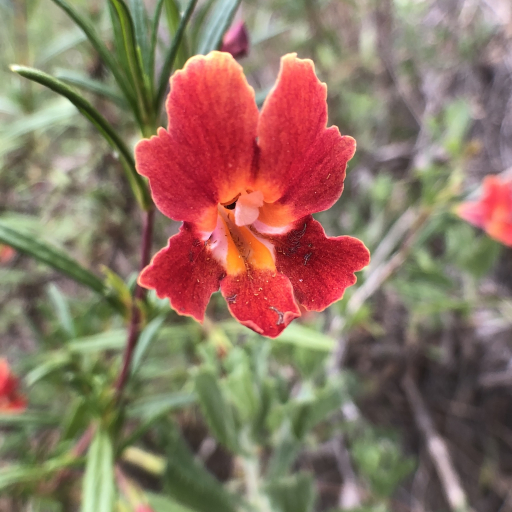
Plant Overview
Known affectionately as the Mission Red Monkeyflower, this California native is a showstopper in coastal sage scrub and chaparral landscapes. Its charming name comes from the blossoms, which some say resemble the face of a tiny, grinning monkey. With its deep, ruby-red blooms and hardy nature, it is a favorite for gardeners looking to bring a splash of wild "West Coast" energy to their space.
🔍 How to Identify
- 🌺 Velvety Blooms: The flowers are funnel-shaped and a rich, dark red to reddish-orange, featuring five distinct lobes that flare out at the end.
- 🌿 Sticky Foliage: The narrow, dark green leaves are often "resinous" or sticky to the touch—a clever adaptation that helps the plant retain moisture and discourage hungry bugs.
- 🪴 Woody Habit: Unlike some herbaceous wildflowers, this is a sub-shrub with woody stems at the base, typically growing in a rounded, somewhat leggy bush up to 3 or 4 feet tall.
🏡 In Your Garden
- 💧 The Summer Dormancy: Because it is a chaparral native, it is highly drought-tolerant. In fact, it prefers to "sleep" during the hot, dry summer months. Avoid over-watering during this time, as soggy soil can lead to root rot.
- 🐝 Hummingbird Magnet: If you want a lively garden, this is your plant. The tubular shape and vibrant red color are specifically evolved to attract hummingbirds, who act as its primary pollinators.
- ✂️ Pruning Nuance: To keep it from looking "twiggy," give it a light trim after the flowering season ends. This encourages a fuller, bushier shape for the following spring.
⚠️ Safety & Toxicity
- ✅ Safe Status: Diplacus puniceus is generally considered non-toxic to humans and common household pets like cats and dogs.
- 🧤 Skin Sensitivity: While not poisonous, the sticky resin on the leaves can be an irritant to people with very sensitive skin or those with contact allergies. Wearing gloves while pruning is a good practice.
✨ Fun Fact
The genus name was recently changed from Mimulus to Diplacus. The original name Mimulus comes from the Latin mimus, meaning "mime" or "actor," because the flower's shape was thought to resemble the masks worn by classical performers!

Detailed Care Instructions
To grow Diplacus puniceus, commonly known as red monkey flower, you can follow these steps:
- Choose a suitable location: Select a spot in your garden or outdoor space that receives full sun to partial shade. The plant prefers well-draining soil.
- Prepare the soil: Monkey flowers prefer slightly acidic to neutral soil, so amend the soil with compost or peat moss if needed. Make sure the soil is loose and well-draining.
- Sow seeds or transplant: You can grow Diplacus puniceus from seeds or purchase young plants from a nursery. If starting from seeds, follow the packet instructions for sowing depth and spacing. If transplanting, dig a hole slightly larger than the root ball of the plant and place it carefully, gently covering the roots with soil.
- Watering and care: Monkey flowers prefer moist soil but should not be waterlogged. Keep the soil consistently moist but not overly saturated. Be careful not to let the soil dry out completely. Water deeply and regularly during dry periods.
- Mulching: Apply a layer of organic mulch around the plant to help retain moisture, suppress weeds, and maintain a cool root environment.
- Pruning: Trim back any dead or damaged stems or flowers as needed. This will help promote healthy growth and prolong blooming.
- Fertilization: Use a balanced, slow-release fertilizer according to the package instructions during the growing season. Avoid over-fertilizing, as excessive nutrients can lead to excessive foliage growth at the expense of flowering.
- Pests and diseases: Diplacus puniceus is generally resistant to pests and diseases. However, keep an eye out for aphids, snails, and slugs. If necessary, use appropriate organic pest control methods.
- Propagation: Monkey flowers can be propagated by collecting and sowing seeds or by taking stem cuttings. If taking cuttings, dip them in rooting hormone and plant them in moist potting mix until they establish roots.
- Winter care: Diplacus puniceus is a native perennial in California, but it may not be fully hardy in colder regions. Consider providing winter protection, such as covering the plant with a layer of mulch, or move potted plants indoors.
Remember, Diplacus puniceus is often found growing naturally in the wild, which makes it an adaptable and relatively low-maintenance plant. Nonetheless, proper care and attention will help it thrive and produce beautiful red flowers.

Place in a bright room that is sun drenched almost all day. Or directly in a south-facing window.

Diplacus Puniceus is a plant that requires regular watering to thrive. The soil should be kept consistently moist, but not waterlogged. It is important to avoid letting the soil dry out completely between waterings, as this can cause stress to the plant and lead to root damage. When watering, it is best to use room temperature water and avoid getting water on the leaves, as this can cause fungal growth. It is recommended to water Diplacus Puniceus plant in the morning so that any excess moisture can evaporate during the day. The frequency of watering will depend on factors such as the size of the plant, the type of soil it is planted in, and the climate. It is recommended to check the soil moisture level regularly by inserting a finger into the soil up to the second knuckle, and watering if the soil feels dry. Over-watering can be detrimental to the plant's health and may cause root rot, so it is important to avoid this.
To fertilize this plant, use a balanced fertilizer with equal parts nitrogen, phosphorus, and potassium. Apply the fertilizer in the early spring or early summer, following the instructions on the package. Avoid over-fertilizing as this could lead to excess growth and reduce the overall health of the plant. Water the plant thoroughly after fertilizing to help distribute the nutrients throughout the soil.
The best soil to use with this particular plant is a well-draining soil mixture that is comprised of a combination of organic matter, such as compost or peat moss, coarse sand, and inorganic materials such as perlite or vermiculite to improve drainage and aeration. It is also recommended to add mineral amendments, such as rock phosphate or greensand, to provide essential nutrients for the plant's growth. The soil pH level should be between 6.0 and 7.5 for optimal growth and nutrient uptake. It is important to avoid soils that are heavy in clay or compacted, as this can impede root growth and lead to waterlogging. Additionally, it is important to provide regular watering and fertilization in accordance with the specific needs of the plant, as excess water or fertilizer can harm the plant and inhibit growth.
Diplacus Puniceus plant can be propagated by taking stem cuttings. To do this, select a healthy stem from the parent plant. Make a clean cut about 4-6 inches long just below a node. Remove any leaves from the cutting except for the top few.
Dip the cut end of the stem cutting into rooting hormone powder to encourage the roots to grow. Plant the cutting into a pot filled with moist potting soil and cover it with a clear plastic bag to create a mini-greenhouse.
Place the pot in a bright, warm spot, away from direct sunlight. Keep the soil moist but not wet, watering as needed. After a few weeks, the cutting should start to grow roots and new leaves. This is a sign that it has rooted successfully.
Once the cutting has established a good root system, it can be transplanted into a larger pot for further growth or planted into the ground in a suitable location.








