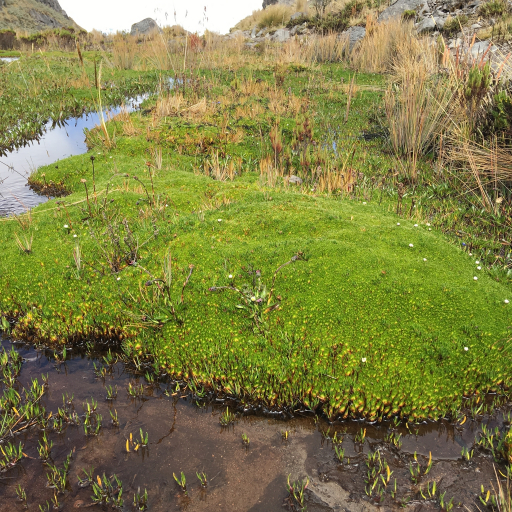
Plant Overview
Known often as the "Andean Cushion Rush," this remarkable survivor is a master of the high-altitude wetlands in the South American Andes. While it is frequently mistaken for a giant clump of moss, it is actually a specialized member of the rush family that has evolved to thrive where few other plants can. It forms dense, springy carpets that act as the literal foundation for entire ecosystems in the Altiplano.
🔍 How to Identify
- 🌿 Growth Habit: It forms incredibly tight, dome-shaped cushions or vast, undulating mats that can feel as firm as a mattress or even a rock when stepped upon.
- 🍃 Leaf Arrangement: The tiny, stiff leaves grow in two distinct, overlapping rows (a "distichous" pattern), creating a braided or scale-like appearance upon close inspection.
- 🟢 Texture and Color: The surface is typically a bright, waxy green, but as the inner leaves die and compress, they turn into a rich, dark peat-like brown beneath the living surface.
🏔️ Habitat & Ecology
- 💧 The Mountain Sponge: In its native environment, it creates "bofedales"—high-altitude peat bogs. These mats soak up glacial meltwater like a sponge, slowly releasing it into the valleys below during the dry season.
- ☀️ High-UV Shield: Its compact growth isn't just for warmth; the density protects the plant's delicate inner tissues from the intense, DNA-damaging ultraviolet radiation found at 4,000 meters above sea level.
- 🧗 Lowland Difficulty: For the hobbyist, this plant is a "challenge mode" species. It rarely thrives at sea level because it misses the thin air, high light intensity, and dramatic nightly temperature drops of its mountain home.
⚠️ Safety & Toxicity
- ✅ Status: Generally considered non-toxic.
- 🐾 Details: There are no records of this plant being harmful to humans, dogs, or cats. However, because it is extremely fibrous and tough, it is not considered edible and could cause mild digestive upset if a curious pet decided to chew on its woody exterior.
✨ Fun Fact
- Because they grow so slowly in the harsh mountain cold—sometimes only a few millimeters a year—a large Distichia cushion that you can stand on might be several hundred years old, having started its life long before modern cities were built in the valleys below!

Detailed Care Instructions
To grow Distichia muscoides, also known as musk grass or swamp grass, you can follow these steps:
- Obtain seeds or divisions of the plant from a reputable nursery or online seller.
- Choose a suitable location that mimics its natural habitat, which includes wetlands or boggy areas with moist, acidic soil. Ensure the location receives partial shade to full sun.
- Prepare the soil by removing any weeds, rocks, or debris. Distichia muscoides prefers nutrient-rich, well-draining soil. If your soil is heavy clay or compacted, consider adding organic matter, such as compost or peat moss, to improve drainage and fertility.
- Sow the seeds or plant the divisions in the prepared soil, following the recommended spacing mentioned on the seed packet or based on the size of the divisions.
- Water the newly planted seeds or divisions thoroughly and keep the soil consistently moist throughout the growing season. Distichia muscoides is a water-loving plant and thrives in wet or boggy conditions, so you may need to water it regularly to maintain proper moisture levels.
- Mulch the area around the plants with organic mulch to help conserve moisture and suppress weed growth.
- Monitor the moisture levels regularly and ensure the plants are not drying out. If needed, continue watering generously.
- Limit foot traffic around the area where Distichia muscoides is growing to prevent soil compaction.
- Fertilize the plants sparingly with a balanced, slow-release fertilizer specifically formulated for wetland or aquatic plants. Follow the recommended application rates on the product label.
- Periodically check for any pest or disease infestations and take appropriate measures if necessary. Distichia muscoides is generally pest and disease resistant.
- Enjoy the growth and development of your Distichia muscoides, which will likely produce upright, grass-like foliage that grows in clumps or mats.
Remember to check and follow any specific care instructions provided with the plant or seeds you obtain, as different varieties or cultivars of Distichia muscoides may have specific requirements.
Distichia Muscoides plant is a type of plant that requires regular watering in order to thrive and grow. To provide optimal watering for this plant, it is important to follow the following guidelines:
- Check the soil: Before watering the plant, it is important to check the soil moisture level by placing a finger or probe into the soil to check how dry it is. If the soil is dry, then it is time to water the plant.
- Watering frequency: It is recommended to water Distichia Muscoides plant once or twice a week depending on how dry the soil is. If the soil is dry, then it needs to be watered more frequently.
- Watering amount: When watering, ensure that the water reaches the roots of the plant. A good rule of thumb is to water until the soil is moist but not soggy. The amount of water required will depend on the size of the pot and the plant.
- Water quality: The type of water used to water the Distichia Muscoides plant is also important. It is recommended to use room temperature water that is free from chlorine, salts, and other chemicals.
- Watering time: It is best to water the plant early in the morning or late in the afternoon. This helps to prevent water evaporation and ensures that the plant can absorb the water properly.
By following these guidelines, you can ensure that your Distichia Muscoides plant receives the optimal amount of water and can grow healthy and strong.
To provide nutrients to this plant, use a balanced fertilizer with an N-P-K (nitrogen-phosphorus-potassium) ratio of 10-10-10 or 20-20-20. Apply the fertilizer as directed on the package, typically once every 4-6 weeks during the growing season (spring and summer). Avoid over-fertilizing, as it can lead to burning of the foliage or root damage. Water the plant thoroughly before and after fertilizing to prevent stress on the roots.
Distichia Muscoides plant thrives in soil that is specifically formulated for the needs of this plant. This type of soil should be well-draining and hold moisture evenly, without becoming waterlogged or overly dry. It should also be rich in nutrients such as nitrogen, potassium, and phosphorus.
The ideal soil for Distichia Muscoides plant is a mixture of organic materials such as peat moss, compost, and coarse sand or perlite to ensure good drainage. The pH level of the soil should be slightly acidic, around 5.5 to 6.5.
When planting Distichia Muscoides plant, it is important to ensure that the soil is loose and aerated to allow for proper root growth. The plant should be planted at the same level as it was in its original container, avoiding burying the stem or exposing the roots.
When caring for Distichia Muscoides plant, it is important to keep the soil consistently moist but not waterlogged, as this can lead to root rot. It is also recommended to fertilize the plant every few weeks during the growing season to ensure that it has access to the necessary nutrients for healthy growth.
To propagate this plant, you can take stem cuttings from the mature plant in the spring or summer. Cut a few inches of healthy stem just below a node, and remove the lower leaves. Dip the cut end in rooting hormone, and plant it in a pot filled with a well-draining potting mix. Keep the soil moist and the plant in a warm, bright location. After a few weeks, check for root growth by gently tugging on the cutting. Once roots have formed, you can transplant the new plant into a larger pot or into the ground.








