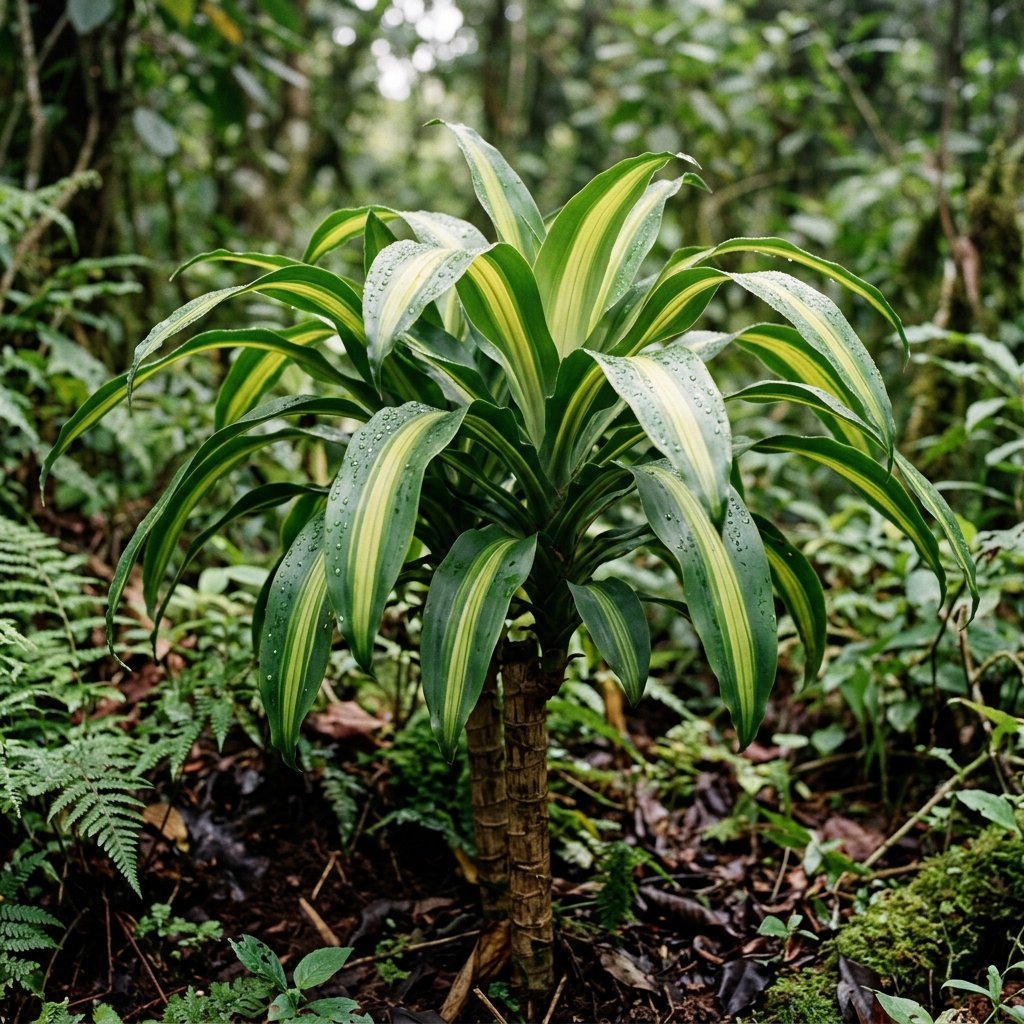
Plant Overview
Often referred to as the "Corn Plant" because its arching leaves look remarkably like maize, this African native is a staple of interior design. It’s a slow-growing survivor that brings a sense of tropical architecture to living rooms without the need for a greenhouse. In its native habitat, it can reach massive heights, but indoors, it behaves as a disciplined, elegant companion that can live for decades with minimal fuss.
🔍 How to Identify
- 🪵 The Cane: Look for a sturdy, light brown woody stem that resembles a miniature tree trunk or a thick bamboo stalk.
- 🍃 The Foliage: Long, sword-shaped leaves that grow in a dense rosette at the top of the cane, often arching gracefully downward.
- 🎨 The Stripes: Most common varieties feature a bold, lime-yellow or cream stripe running straight down the center of deep green leaves.
🏡 In Your Garden
- 🚿 Water Sensitivity: This plant is a bit of a "clean water" snob. If you notice the tips of the leaves turning brown and crispy, it is likely reacting to fluoride or chlorine in your tap water. Using filtered water or rainwater usually solves the problem.
- 🌤️ Light Nuance: While it is famous for surviving in dim corners, "surviving" isn't "thriving." To keep the yellow variegation bright and the growth steady, place it in bright, indirect light. Direct afternoon sun will scorch the leaves, leaving permanent brown scars.
⚠️ Safety & Toxicity
- 🐾 Toxic to Pets: Dracaena fragrans contains saponins, which are toxic to both dogs and cats. If ingested, it can cause vomiting, drooling, and in cats, distinctively dilated pupils.
- 👶 Human Safety: Generally non-toxic to humans if touched, but the leaves can be slightly sharp. Ingestion by small children may lead to mild stomach upset or loss of appetite.
✨ Fun Fact
- 🌸 Midnight Blooms: It is rare for a Corn Plant to flower indoors, but when it does, it’s unforgettable. It produces heavy clusters of white flowers that stay closed all day and burst open at night, releasing a scent so powerful and sweet it can fill an entire house!

Detailed Care Instructions
Corn plants are easy to care for once their climate, sun, and water needs are met. Maintain those conditions, and your plant can live for many years.
How fast does corn plant grow?
The corn plant is a slow to moderate growing plant. Its conditions are usually tough to nail correctly, so it may slow down its growth rate when the conditions are not perfect.
How long can corn plant live?
Under the right conditions, dracaena fragrans can live for decades.
What's the difference between corn plant and sweet corn?
The corn plant is entirely unrelated to sweet corn—the stalky vegetable that's grown for food. They are similar in name only.
| Color | White-Yellow; May Be Followed By Red Berries |
| Humidity | Normal |
| Lighting | Shade |
| Toxicity | Poisonous |
| Soil Type | Loamy; Rich Potting Soil For Potted Specimens |
| Bloom Time | Year-Round |
| Difficulty | Easy |
| Plant Type | Broadleaf Evergreen Shrub/Tree |
| Hibernation | Cold Period |
| Mature Size | 6 Feet Or Taller |
| Native Area | Tropical Africa |
| Temperature | 18°C - 25°C |
| Sun Exposure | Filtered Sun |
| Hardiness Zones | 10 To 12 (Usda) |
To grow a Dracaena Fragrans plant, also known as a corn plant, you can follow these steps:
- Positioning: Place the plant in an area that receives bright, indirect sunlight. Dracaena Fragrans can also tolerate low light conditions, but it may result in slower growth.
- Temperature and humidity: Maintain a temperature range between 60-75°F (15-24°C). The plant prefers medium to high humidity levels. Mist the leaves occasionally or place a humidity tray nearby to increase humidity.
- Watering: Allow the top two inches of soil to dry out before watering. Overwatering can cause root rot, so ensure proper drainage. Pour water until it drains out of the bottom of the pot and discard any excess water.
- Fertilization: Apply a balanced houseplant fertilizer every two to three months during the growing season (spring and summer). Follow the package instructions for the proper dosage.
- Pruning: Trim off any yellow or brown leaves using clean, sharp scissors or gardening shears. This helps maintain the plant's appearance and overall health. You can also remove tall or leggy growth to encourage bushier growth.
- Repotting: Dracaena Fragrans plants generally like to be slightly root-bound, so repotting every 2-3 years should be sufficient. Use a well-draining potting mix and choose a pot that is slightly larger than the current one.
- Pest control: Monitor your plant regularly for signs of pests like mealybugs or spider mites. If pests are present, use an organic or chemical insecticide according to the product instructions.
Remember to be patient, as Dracaena Fragrans plants are typically slow-growing. With proper care, your plant should thrive and grow over time.

Place in a window with dappled sun or a spot in the middle of a room. Or directly in a window facing west or east.

Dracaena fragrans plants can be watered by filling a watering can or jug with room temperature water. The soil around the plant should be moistened until it is saturated, but not waterlogged. It is important to allow the top inch of soil to dry out between waterings to prevent overwatering, which can lead to root rot. The plant should be watered on a regular basis, but the frequency will vary depending on the temperature and humidity levels in the plant's environment. It is also important to use a well-draining soil mixture and a pot with drainage holes to prevent water accumulation in the soil.
To fertilize this plant, use a balanced, water-soluble fertilizer every 4-6 weeks during the growing season. Dilute the fertilizer to half the recommended strength. Be sure to water the plant thoroughly before and after fertilizing to avoid burning the roots. Avoid over-fertilizing as this can lead to salt buildup and damage to the plant.
Dracaena Fragrans plant prefers a well-draining and nutrient-rich soil that is slightly acidic with a pH level ranging from 6 to 6.5. It thrives in a soil mix that provides good aeration and moisture retention, so it is recommended to use a mix of peat moss, perlite, and sand or a commercial potting mix that contains a mix of perlite and vermiculite. It is important to ensure that the soil does not become waterlogged or too dry as this can result in root rot or stunted growth. Therefore, it is recommended to water the plant only when the top layer of the soil feels dry to the touch, and to ensure that the soil is well-draining. Furthermore, adding organic fertilizers or slow-release fertilizers to the soil can provide the necessary nutrients for the plant’s growth and promote healthy foliage.
Dracaena Fragrans can be propagated through stem cuttings. Start by selecting a healthy stem with at least one node or growth point. Cut the stem just below the node using clean, sharp pruning shears. Remove any leaves from the bottom two-thirds of the cutting.
Next, dip the cut end of the stem into rooting hormone powder to encourage root growth. Place the cutting in a pot filled with moist potting soil or in a container of water. If using the soil method, bury the bottom two-thirds of the cutting in the soil. If using the water method, make sure the water covers the bottom two-thirds of the cutting.
Place the pot or container in a warm, bright location with indirect sunlight. Keep the soil or water moist but not waterlogged. In a few weeks, roots should start to form. Once the roots are a few inches long, the new plant can be transplanted into a larger pot with well-draining soil.
It's important to note that Dracaena Fragrans can be toxic if ingested, so keep it away from pets and young children.
Common pests of the corn plant include Scale insect, mealybugs, spider mites, thrips. Make a habit of checking your corn plant frequently for pests so that any infestations can be caught and managed early.








