Plant Overview
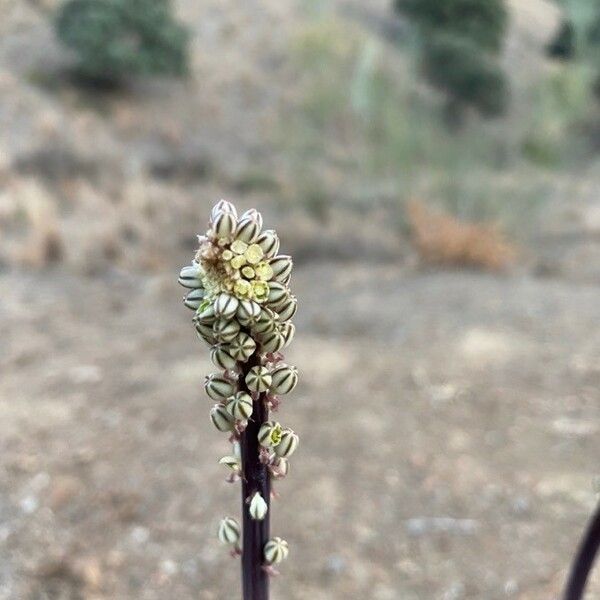
Known as the Western Sea Squill, Drimia hesperia is a resilient survivor from the rugged, volcanic slopes of the Canary Islands. This fascinating bulbous plant is a master of timing, often surprising onlookers by sending up a tall, elegant flower spike from the parched earth long before its leaves even appear. It is a classic "hysteranthous" species, meaning it separates its flowering and leaf-growing seasons to maximize its chances in harsh, dry climates.
🔍 How to Identify
- 🧅 The Bulb: Features a large, robust bulb covered in papery, brownish-red scales that often sits partially exposed above the soil line like a decorative stone.
- 📏 The Inflorescence: A tall, slender stalk that can reach up to 60cm, topped with a dense cluster of small, star-shaped white flowers, each marked with a subtle green or brownish central stripe.
- 🍃 The Foliage: After the flowers fade, a rosette of fleshy, lance-shaped leaves emerges. These leaves are typically a deep bluish-green and have a slightly wavy margin.
🏡 In Your Garden
- 🏜️ Volcanic Roots: Because it originates from rocky island terrain, this plant demands exceptional drainage. It thrives in gritty, cactus-type soil and hates "wet feet," which can cause the bulb to rot quickly.
- 💤 Summer Dormancy: This plant follows a strict Mediterranean cycle. It goes completely dormant in the heat of summer—do not be alarmed when the leaves die back! This is the time to stop watering entirely to mimic its natural dry season.
- ☀️ Sun Seeker: To produce those impressive flower spikes, it requires a position with full sun exposure. It is a perfect candidate for rock gardens or terracotta pots that can be moved out of the rain during its sleeping phase.
⚠️ Safety & Toxicity
- 🚫 Highly Toxic: Like many members of the Hyacinth family, Drimia hesperia contains cardiac glycosides. Every part of the plant, especially the bulb, is dangerous if ingested.
- 🐾 Pet & Child Warning: Keep this plant out of reach of curious pets and toddlers. Ingestion can cause severe stomach upset and, in larger quantities, heart rhythm issues.
- 🧤 Skin Irritation: The sap inside the bulb and leaves can be acrid and irritating to the skin; it is wise to wear gloves when dividing bulbs or repotting.
✨ Fun Fact
The genus name Drimia is derived from the Greek word "drimys," which means "pungent" or "acrid." This refers to the intense, burning sap found within the bulbs, which has been used in traditional medicines—though it is far too dangerous for modern home use!

Detailed Care Instructions
To properly water this plant, it is important to first assess the soil moisture level before watering. This can be done by sticking a finger 2-3 inches into the soil and feeling for moisture. If the soil feels dry, it is time to water.
When watering, gently pour water over the soil until it begins to drain out of the bottom of the container. Avoid getting water on the leaves as this can lead to rot or disease.
It is generally recommended to water this plant once a week, but this may vary based on environmental factors such as temperature and humidity. During periods of high heat or drought, it may be necessary to water more frequently.
In addition to regular watering, it is important to ensure that the soil has good drainage to prevent waterlogging and root rot. Adding perlite or sand to the soil mix can improve drainage. In periods of heavy rainfall, it may be necessary to move the plant to a more protected area or cover it with a tarp to prevent excessive water accumulation.
The ideal soil for Drimia Hesperia plants should be well-draining and slightly acidic. It should also be rich in organic matter and nutrients, as these plants require a fertile growing medium to thrive. A soil pH level of around 6.0 to 6.5 is recommended.
In terms of texture, the soil should be loose and crumbly, with good aeration and water-holding capacity. A mix of sandy loam, perlite, and peat moss is often a good choice for these plants.
It is important to avoid using heavy clay soils or soils that are prone to waterlogging, as this can lead to root rot and other health issues in the plant. Additionally, the soil should be free from pests and diseases, and should be sterilized before planting to ensure that the plant has the best chance of success.








