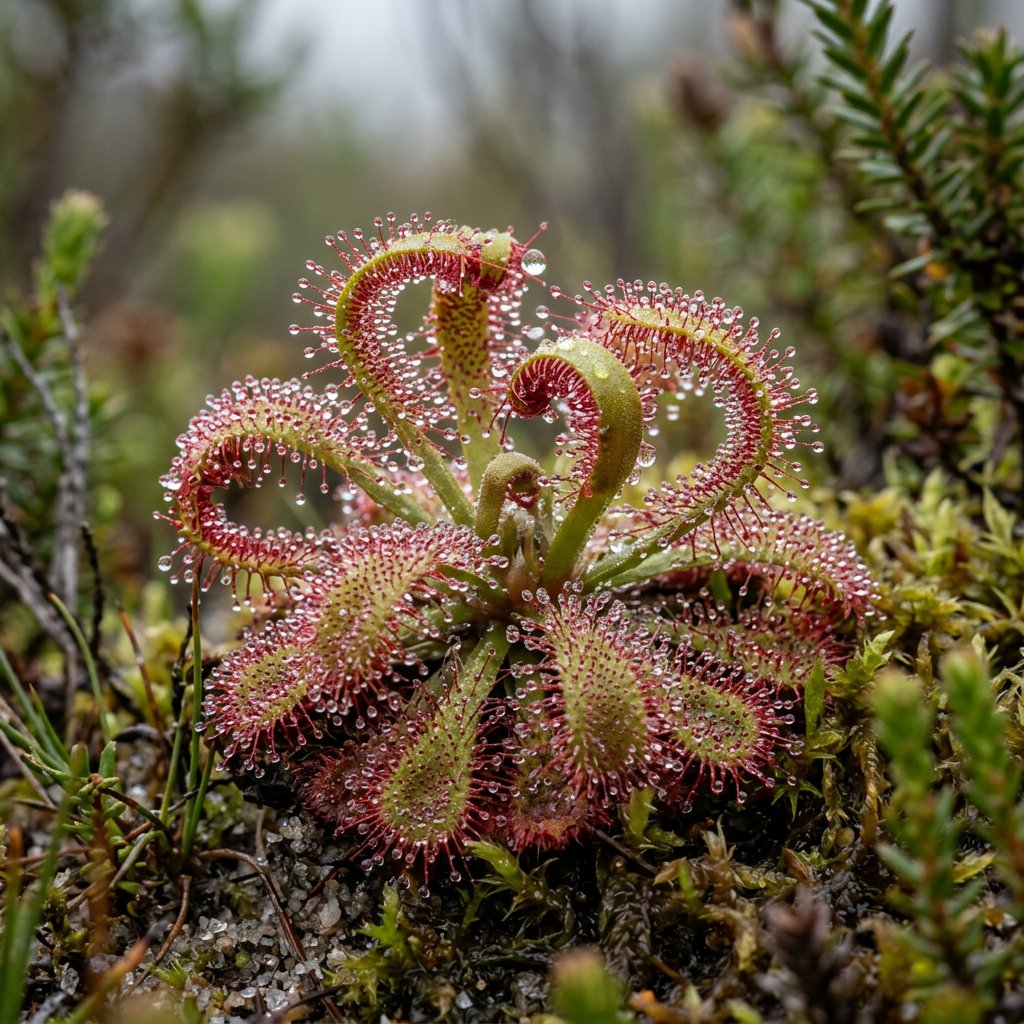
Plant Overview
Often called the "Cape Sundew," this South African native is the world’s most popular carnivorous plant for beginners. It resembles a collection of shimmering, jewel-encrusted ribbons that sparkle in the sunlight, but for a fruit fly, those "jewels" are a sticky, inescapable end. It is famously resilient, often described as the "weed" of the carnivorous plant world because of its ability to thrive and multiply.
🔍 How to Identify
- 🌿 The Foliage: Long, strap-shaped leaves that grow upward and outward from a central rosette, reaching about 4–6 inches in length.
- 💎 The Tentacles: Hundreds of tiny, hair-like red tentacles cover the leaves, each tipped with a glistening drop of sticky mucilage that looks like morning dew.
- 🌸 The Bloom: It produces tall, leafless stalks with small, five-petaled pink or violet flowers that uncurl like a fern frond, opening one at a time.
🏡 In Your Garden
- 💧 The Bog Strategy: Because it evolved in nutrient-poor South African bogs, it has a "reverse" diet. It hates mineral-rich soil and tap water; always use distilled, reverse osmosis, or rainwater to keep its sensitive roots from "burning."
- 🦟 Natural Pest Control: It is a functional powerhouse for indoor gardeners. A single plant can catch dozens of fungus gnats and fruit flies, using its leaves to digest them and absorb the nitrogen it can’t find in the soil.
- ☀️ Light and Color: To keep its vibrant ruby-red hue and sticky "dew," it requires very bright light. If the leaves look green and dry, it’s likely asking for more sun.
⚠️ Safety & Toxicity
- ✅ Safe for Households: Drosera capensis is non-toxic to cats, dogs, and humans.
- 🤏 Touch Sensitivity: While not poisonous, you should avoid touching the sticky leaves. Every time a leaf is triggered to curl, the plant spends a significant amount of energy; "teasing" the plant without a food reward can eventually weaken it.
✨ Fun Fact
The Cape Sundew is a master of movement. Once an insect is trapped, the entire leaf will slowly curl over the prey in a process called "thigmonasty." This allows the plant to bring more digestive enzymes into contact with the insect, effectively turning its leaf into a temporary stomach!

Detailed Care Instructions
| Humidity | Normal |
| Lighting | Full Sun |
| Difficulty | Medium |
| Temperature | 18°C - 24°C |
| Hardiness Zones | Min 6A |
To grow a Drosera Capensis plant, also known as the Cape Sundew, you can follow these steps:
- Choose the right growing conditions: Drosera Capensis plants thrive in warm and humid environments. They require bright, indirect sunlight for at least 6-8 hours a day. Maintain a temperature range of 60-85°F (15-29°C).
- Select a suitable container: Use a shallow tray or pot with good drainage. Since Drosera Capensis plants prefer damp conditions, ensure the container has drainage holes to prevent waterlogging.
- Prepare the soil: These plants prefer a well-draining soil mix with a high percentage of peat moss or sphagnum moss. Create a blend of peat moss and perlite or sand to provide good aeration and moisture retention.
- Sow or transplant the plant: If you have seeds, sprinkle them on the soil's surface or lightly press them into the soil. Alternatively, if you have a mature plant, gently remove it from its current pot and transplant it into the new container.
- Watering: Drosera Capensis plants need constant moisture. Water the plant with distilled or rainwater, as tap water may contain minerals that can harm the plant. Keep the soil consistently damp but not overly saturated. Avoid letting the soil dry out completely.
- Feeding: Drosera Capensis is a carnivorous plant that obtains nutrients from catching insects. It produces sticky, glandular hairs on its leaves that can trap small flying insects. However, you can supplement its diet by occasionally feeding it small insects, such as fruit flies or Drosophila. Never feed the plant raw meat or large insects, as they can rot and harm the plant.
- Humidity: These plants require high humidity to thrive. If the air is dry, you can increase humidity by placing a tray filled with water near the plant or using a humidifier.
- Pest control: Monitor your plant for pests, such as aphids or spider mites. Use organic insecticides or predatory insects like ladybugs to control any infestations.
- Pruning: If the plant becomes too crowded or some leaves die, gently remove them to maintain the plant's appearance. Be careful not to damage the healthy leaves.
- Dormant period: During the winter months, Drosera Capensis tends to enter a dormant period. Reduce watering during this time and keep the plant in a cooler location (around 50-60°F or 10-15°C).
By following these steps, you can successfully grow a Drosera Capensis plant and enjoy its unique carnivorous nature.

Place in a bright room that is sun drenched almost all day. Or directly in a south-facing window.

The plant in question belongs to the genus Drosera and has a specific species name of Capensis. It is commonly known as a type of carnivorous plant that has sticky leaves to trap insects as a source of nutrition.
When watering this plant, it is important to avoid using tap water that has been treated with chemicals such as chlorine or fluoride. The plant prefers water that is low in minerals and has a pH level between 4.5 and 5.5.
One way to ensure the plant receives the proper water is to use distilled or rainwater. It is important to only water the plant when the soil has completely dried out to prevent rotting of the roots.
When watering, it is best to apply water directly to the soil and not to the leaves, as the sticky substance on the leaves can interfere with the plant's ability to photosynthesize. It is also recommended to water from the bottom of the pot, allowing the plant to absorb water through the drainage holes.
Overall, the Drosera Capensis plant requires careful attention to its watering needs to ensure it maintains optimal health and growth.
To fertilize this plant, dilute a water-soluble fertilizer to half-strength and add it to the soil once a month during the growing season. Avoid using fertilizers high in phosphorus or potassium, as they can harm the plant. Additionally, the plant can also be fed live insects, such as fruit flies or small crickets, one or two per week. Do not feed the plant any wild-caught insects, as they may contain harmful toxins.
The Drosera Capensis plant requires a specific type of soil in order to thrive. It is best to use a soil that is low in nutrients and has good drainage. It is also important to use a soil that is slightly acidic, with a pH level between 5 and 6. The ideal soil for the Drosera Capensis plant is a mix of peat moss and silica sand, with a ratio of about 1:1. This type of soil will provide the plant with the right amount of moisture and nutrients it needs to grow and thrive, without causing it to become waterlogged or suffer from nutrient burn. It is also important to avoid using soil that contains any fertilizers or additives, as this can harm the plant and cause it to become diseased or die.
To propagate this plant, you should take stem cuttings that are at least three inches long. Using a sharp, clean pair of pruning shears, cut the stem just below a node where there are leaves growing. Remove the lower leaves from the cutting so that only a few leaves are remaining at the top.
Once you have prepared the cutting, you can dip the cut end into a rooting hormone powder or gel. This will encourage the cutting to develop roots faster.
Next, place the cutting in a potting mix that is made up of one part peat moss and one part sand. Be sure to keep the soil moist during the rooting process, but avoid overwatering which can cause the cutting to rot.
Place the container in a warm, bright location with indirect sunlight. After a few weeks, the cutting should start developing roots and new growth. At this point, you can transplant the new plant into its own container filled with a suitable growing medium and continue to care for it as you would any other Drosera Capensis plant.








