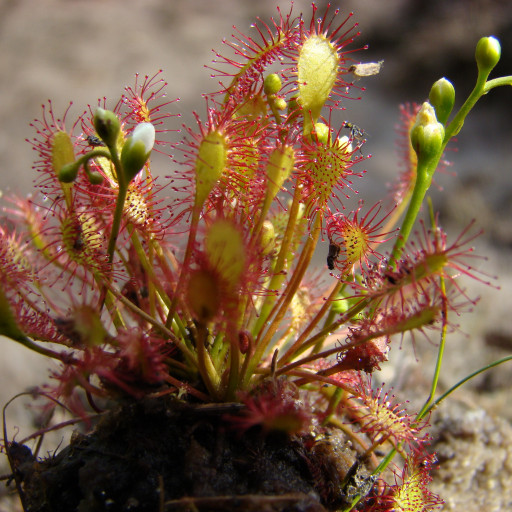
Plant Overview
Often called the Spoonleaf Sundew, Drosera intermedia is a glistening gem of the bog world. While most plants rely solely on soil for nutrients, this clever carnivore has evolved to lure, trap, and digest its own snacks using sparkling droplets of "dew." It is a favorite among terrarium enthusiasts and bog gardeners for its striking red color and active hunting style.
🔍 How to Identify
- 🍃 The Leaves: Unlike its round-leaved cousins, this sundew features elongated, oblong leaf blades (resembling a spoon) that sit at the end of long, slender stalks.
- 💎 The "Dew": Each leaf is covered in hundreds of tiny, red-tipped tentacles that secrete a clear, sticky mucilage. In the sun, these droplets sparkle like diamonds, lure-ing unsuspecting insects.
- 🌸 Summer Blooms: It sends up a tall, smooth flower stalk that produces small, five-petaled white flowers. The stalk is purposefully tall to keep pollinators safe from the sticky traps below.
🏡 In Your Garden
- 💧 The "Bog" Method: This plant is a true wetland dweller. It hates drying out and prefers to sit in a tray of standing water. To mimic its natural habitat, use a mix of peat moss and sand or perlite, and never use tap water—it requires distilled, reverse osmosis, or rainwater to survive.
- ☀️ Light for Color: To achieve its iconic deep-crimson hue, it needs intense, direct light. If the plant stays bright green and lacks "dew" on the tentacles, it is likely asking for a sunnier spot.
- ❄️ Winter Hibernation: As a temperate plant, it goes through a natural dormancy period. In late autumn, it will form a tight, green bud (hibernaculum) at its center. Don't throw it away—it's just sleeping until spring!
⚠️ Safety & Toxicity
- ✅ Non-Toxic: Drosera intermedia is generally considered safe and non-toxic to humans, cats, and dogs.
- Sticky Sticky Business: While the "glue" is harmless to human skin, it is incredibly tacky. Avoid touching the leaves frequently, as it costs the plant significant energy to produce the mucilage.
✨ Fun Fact
Charles Darwin was famously obsessed with sundews. He once wrote in a letter to a friend, "At the present moment, I care more about Drosera than the origin of all the species in the world," because he was so amazed by their ability to "sense" and move toward prey.

Detailed Care Instructions

Place in a bright room that is sun drenched almost all day. Or directly in a south-facing window.

Drosera Intermedia is a carnivorous plant, which means that it needs special care and attention. When it comes to watering this plant, it is important to keep in mind that it requires a specific type of water and frequency.
The type of water that is best for Drosera Intermedia is distilled, reverse osmosis, or rainwater. This is because these types of water do not contain any minerals or chemicals that could harm the plant. If using tap water, be sure to let it sit for 24 hours to allow the chlorine to dissipate.
When watering Drosera Intermedia, it is important to keep the soil moist but not soggy. An easy way to achieve this is to place the pot in a shallow tray of distilled or rainwater and let the plant soak up the water from the bottom. This will ensure that the roots do not become waterlogged, which can lead to root rot.
Watering frequency will depend on the surrounding environment and the size of the pot. In general, it is best to water Drosera Intermedia when the top inch of soil feels dry to the touch. Avoid letting the soil completely dry out as this can cause stress to the plant.
In summary, giving Drosera Intermedia the right type of water and watering it correctly is essential to its growth and overall health.
The relative humidity levels between 30 and 50 percent are ideal for these plants. They exhibit unpleasant symptoms when the moisture content in the environment is unfavorable. Avoid letting the air temperature rise too high or low and use a humidifier, whenever possible. Misting is also beneficial, although frequent watering is also necessary. The optimal relative humidity will promote plant growth.
Unfortunately, oblong-leaf sundew are susceptible to a host of common pests and diseases. Common oblong-leaf sundew diseases include Rotting root. Prompt pruning of any dead or diseased branches should keep these common diseases under control.








