Plant Overview
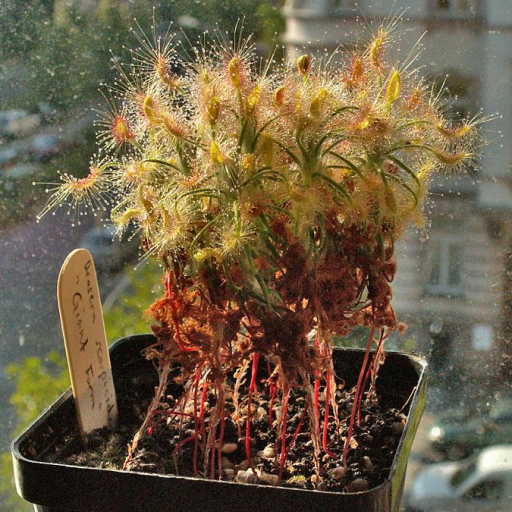
Commonly known as the Shaggy Sundew, Drosera scorpioides is a miniature carnivorous powerhouse hailing from the white sands of Western Australia. Despite its tiny size—rarely growing larger than a golf ball—it looks like a prehistoric, glistening palm tree. It is one of the most popular "Pygmy Sundews" among collectors because of its robust, "shaggy" appearance and its incredibly active hunting style.
🔍 How to Identify
- 🌵 The "Shaggy" Stem: As the plant grows, it forms a vertical stem covered in the dry, papery remains of old leaves (stipules), giving it a hairy or shaggy look.
- 💎 Glistening Tentacles: The narrow, lime-green leaves are tipped with bright red glandular hairs that secrete a sticky, glue-like "dew" to trap unsuspecting gnats and fruit flies.
- 🌀 The Central Bud: In the center of the rosette, you’ll find a dense, silvery-white cluster of bristles (stipule bud) which protects the plant from the harsh Australian sun.
🏡 In Your Garden
- 🚫 Hands Off the Roots: This species is famous for having a surprisingly long, hair-thin taproot. It hates being moved, so it is best to plant it in its "forever home" immediately. If you disturb the roots, the plant may go into a permanent sulk.
- ❄️ Winter "Gemmae": Instead of seeds, this plant produces tiny green scales called gemmae in its center during winter. These are essentially "instant plants" that you can flick onto damp soil to grow a whole colony of clones.
- 💧 Pure Hydration: Like most carnivores, it is a "clean water" snob. It requires distilled water, reverse osmosis water, or rainwater, as the minerals in tap water will burn its sensitive roots.
⚠️ Safety & Toxicity
- ✅ Non-Toxic: Drosera scorpioides is not known to be poisonous to cats, dogs, or humans.
- 🍯 Sticky Situation: While safe, the "dew" is an incredibly strong biological glue. It won't hurt a human finger, but it can be messy, and you might accidentally damage the delicate leaves if you touch them too often.
✨ Fun Fact
The name scorpioides refers to its flower stalk, which emerges in a tight coil that slowly unfurls as it blooms—mimicking the curved, defensive posture of a scorpion's tail!

Detailed Care Instructions
To grow Drosera scorpioides, also known as spoonleaf sundew, you should follow these steps:
- Obtain seeds or plantlets: You can either purchase seeds or acquire plantlets from a trusted nursery or a specialized carnivorous plant retailer.
- Choose the right container: Sundews prefer to grow in a shallow container with good drainage. Use a plastic or glass container that has drainage holes, or you can use a terrarium or bog garden setup.
- Prepare the growing medium: Drosera scorpioides requires a moist and nutrient-poor growing medium. A suitable mix can consist of sphagnum moss, peat moss, perlite, and sand in equal parts. Avoid using regular potting soil, as it contains nutrients that can harm the plant.
- Sow the seeds or plant the seedlings: If using seeds, scatter them evenly on the soil surface without covering them, as sundew seeds need light to germinate. If using plantlets, gently place them into the growing medium while taking care not to damage their roots.
- Provide the right conditions: Sundews thrive in moist, humid environments with good air circulation. Place the container in a location with bright, indirect sunlight, such as a south-facing window. It's essential to maintain humidity levels, so covering the container with a clear plastic dome or a plastic bag can help retain moisture.
- Watering: Drosera scorpioides loves consistently moist conditions, so keep the soil evenly moist. Use distilled or rainwater since tap water often contains minerals that can harm carnivorous plants. Avoid letting the soil dry out completely or becoming waterlogged.
- Feeding: Sundews are insectivorous plants that supplement their nutrition with insects. They have sticky tentacles that capture and digest small insects. If your plant does not trap enough prey naturally, you can occasionally offer it small insects like fruit flies, ants, or gnats. However, feeding is not strictly necessary, as sundews can survive on their own in suitable growing conditions.
- Maintenance: Trim any dead or blackened leaves regularly to maintain the plant's health and appearance. Additionally, removing the flower stalks once they start to wither can redirect more energy towards the growth of leaves.
Remember that growing carnivorous plants can be challenging, and Drosera scorpioides is no exception. Nevertheless, with proper care and attention to its specific needs, you can successfully cultivate this fascinating plant.

Place in a bright room that is sun drenched almost all day. Or directly in a south-facing window.

To water this plant, you will want to make sure that the soil is consistently moist. One way to do this is to use a tray or saucer filled with water and to place the plant's pot on top of it, allowing the water to absorb through the drainage holes. Alternatively, you can water the plant from above, being careful not to get water on the leaves. It is important to use distilled or rainwater, as this plant is very sensitive to minerals and chemicals found in tap water. It is recommended to keep the soil moist but not waterlogged, as this can lead to root rot. Additionally, this plant should be grown in well-draining soil and kept in high humidity conditions.
To fertilize this plant, use a liquid fertilizer that is high in nitrogen. Dilute the fertilizer according to the package instructions and apply it to the soil around the base of the plant. Do not get any fertilizer on the leaves as it may damage them. Fertilize every two weeks during the growing season and reduce to once a month during the dormant period. Be careful not to over-fertilize as it can harm the plant.
Drosera Scorpioides thrives in a specific type of soil that is well-draining and low in nutrients. The ideal soil mixture is a combination of sphagnum peat moss, washed sand, and perlite in equal parts. The sphagnum peat moss provides moisture retention while the sand and perlite aid in drainage. Avoid using regular potting soil or soil that contains high levels of nutrients, as it can harm the plant and cause it to die. It's important to keep the soil moist, but not soggy, by watering when the top layer feels dry to the touch.
One way to propagate this plant is by taking leaf cuttings. Select healthy, mature leaves and use a sharp, clean knife to cut them into sections about 1 inch long. Place these sections upside down on damp sphagnum moss in a container with a lid. Keep the container in a bright, humid location and mist the moss regularly to keep it moist. In a few weeks, tiny plantlets should begin to form at the base of the leaf sections. When they are large enough to handle, gently transplant them into individual pots filled with a soil mix designed for carnivorous plants. Over time, the plantlets will develop into mature plants, ready to produce new leaves and flowers themselves.
Common pests of the shaggy sundew include Aphids. Make a habit of checking your shaggy sundew frequently for pests so that any infestations can be caught and managed early.








