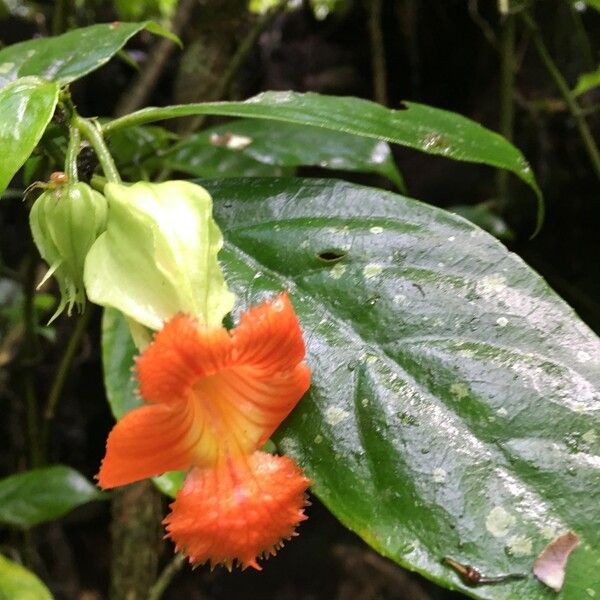
Plant Overview
Hailing from the misty understory of Central American rainforests, Drymonia rubra is a hidden jewel prized by collectors for its moody, velvet-textured foliage and waxy, tubular blooms. Often referred to simply as "Red Drymonia," this plant acts more like a scrambling vine than a typical shrub, seeking out humidity and dappled light to show off its deep, wine-colored accents.
🔍 How to Identify
- 🌿 Velvety Foliage: The leaves are large, elliptical, and covered in fine hairs that give them a luxurious, matte appearance. They often sport a deep green top with a striking burgundy or reddish-purple underside.
- 🌺 Tubular Blooms: The flowers are thick, waxy, and shaped like narrow funnels. They are usually a vibrant red or orange, sometimes with yellow throats, designed perfectly for a hummingbird’s beak.
- 🌱 Scrambling Habit: Unlike upright houseplants, this species has "leggy" stems that love to trail over the sides of a basket or climb up a moss pole using its adventurous roots.
🏡 In Your Garden & Home
- ☁️ Humidity is Essential: Because it originates in tropical cloud forests, Drymonia rubra will struggle in dry indoor air. It thrives in a dedicated "plant nook" with a humidifier or inside a large terrarium where the air stays thick and moist.
- 🍃 The "Epiphyte" Secret: In the wild, it often grows on tree branches rather than in heavy soil. When potting it, skip the heavy garden dirt. Use a chunky, airy mix of orchid bark, perlite, and peat to keep the roots oxygenated and prevent rot.
⚠️ Safety & Toxicity
- 🟢 Generally Safe: Drymonia rubra belongs to the Gesneriad family (relatives of African Violets), which are typically considered non-toxic to humans and pets.
- 🐾 Precautionary Measure: While it lacks the dangerous alkaloids found in other tropicals, ingesting any plant material can cause mild stomach upset in curious cats or dogs. It is best kept on a high shelf or in a hanging basket.
✨ Fun Fact
In its native jungle habitat, Drymonia rubra has evolved a "wait-and-see" strategy for reproduction. Its flowers produce a thick, sticky pollen that glues itself to the foreheads of hummingbirds, ensuring that the bird carries the genetic prize directly to the next receptive flower!

Detailed Care Instructions

Water-loving plants flourish in wet or sloppy soil and near ponds. The extensive root system enables these plants to absorb plenty of water. The surface of the soil should be kept moist at all times. Place your pot in a container filled with water to guarantee that plants get enough water. If the ground becomes dry, it is recommended that you water it well. Plants in smaller pots will need to be watered more frequently. Water the soil in which the plant is standing thoroughly using a watering can.








