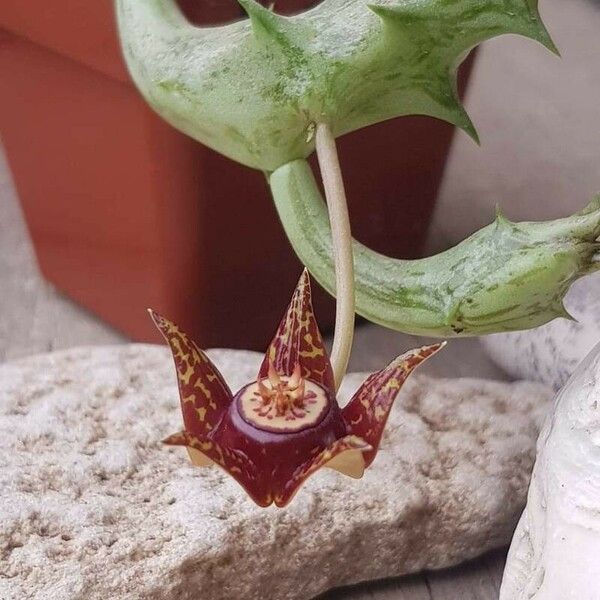
Plant Overview
Hailing from the arid landscapes of the Horn of Africa, Duvalia somalensis is a miniature marvel that looks more like a creature from the deep sea than a terrestrial plant. Often nicknamed the "Starfish Succulent," this tiny plant is prized by collectors for its bizarre, chocolate-hued flowers and its compact, alien-like stems. It is a master of camouflage, blending into rocky crevices until its striking blooms demand attention.
🔍 How to Identify
- 🌵 The Stems: Small, prostrate, and clumping. The stems are usually grayish-green but can turn a deep purple or reddish tint when exposed to bright sunlight, featuring 4 to 5 distinct angles.
- ⭐ The Bloom: The flowers are the showstopper—five-pointed, star-shaped, and usually a deep maroon or dark chocolate color. They feature a raised, fleshy ring in the center called an "annulus."
- 👃 The Texture: The flower petals often have a glossy, waxy appearance, sometimes accompanied by tiny, dark hairs that add to their mysterious, organic look.
🏡 In Your Garden
- 🏜️ Drainage is Key: Because this plant evolved in rocky, dry regions of Somalia and Ethiopia, it has a very delicate root system. It is highly susceptible to "wet feet," so it thrives best in a very gritty, porous mineral mix rather than standard potting soil.
- ☀️ Light Sensitivity: While it loves bright light to bring out its deep purple colors, it prefers filtered sunlight during the hottest part of the day. Too much direct, scorching sun can actually "cook" the small stems, leading to scarring.
⚠️ Safety & Toxicity
- 🐾 Pet Safety: Like many members of the Apocynaceae (Milkweed) family, the milky sap inside the stems can be mildly irritating. It is generally best to keep this plant out of reach of curious cats or dogs.
- 🧤 Skin Irritation: While not considered deadly, the sap can cause skin or eye irritation for some people. It is a good practice to wash your hands after handling or propagating the stems.
✨ Fun Fact
- 🪰 The Great Deceiver: Duvalia somalensis belongs to a group known as "carrion flowers." It mimics the scent and appearance of decaying organic matter to trick flies into visiting. The flies act as pollinators, searching for a place to lay eggs but instead helping the plant reproduce!

Detailed Care Instructions








