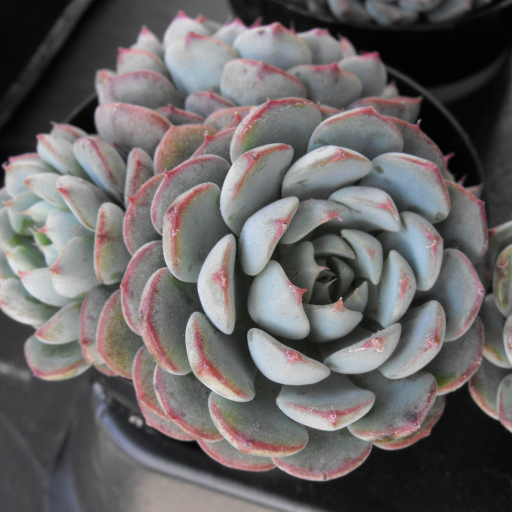
Plant Overview
True to its name, Echeveria Minima is one of the smallest and most charming members of the succulent world. Native to the rugged mountains of Mexico, this "miniature" beauty is beloved for its tight, gem-like rosettes that look almost like hand-carved porcelain. Despite its delicate appearance, it is a hardy survivor that brings a touch of geometric perfection to any sunny windowsill or rock garden.
🔍 How to Identify
- 💎 The Rosette: Features extremely compact, symmetrical rosettes that rarely exceed 3 inches in diameter, often forming dense "carpets" of pups as they age.
- 🎨 Leaf Coloration: The leaves are a soft blue-green or glaucous grey, coated in a powdery wax (farina) that gives them a matte, frosted finish.
- 🔴 The "Sun-Blush": Under bright light or cool temperatures, the very tips and margins of the leaves turn a vivid rosy-pink or deep red, creating a striking contrast.
🏡 In Your Garden
- ☀️ The Light Secret: This plant craves bright light to maintain its tight shape. If it starts to stretch or "reach," it’s telling you it needs more sun; however, the most intense afternoon heat can sometimes scorch its tiny leaves.
- 💧 Watering Wisdom: Like most succulents, it hates "wet feet." The most common mistake is letting water sit inside the center of the rosette, which acts like a bowl and can cause the plant to rot from the inside out. Always water the soil directly.
- 🪨 Substrate Nuance: Because of its tiny root system, it thrives in very gritty, fast-draining soil. It is particularly happy in terracotta pots, which "breathe" and help prevent moisture buildup.
⚠️ Safety & Toxicity
- 🐾 Pet Friendly: Great news for animal lovers! Echeveria Minima is considered non-toxic to cats, dogs, and horses.
- 👶 Child Safe: It is safe for households with children, though the plant itself is quite fragile and its leaves can snap off easily if handled roughly.
- 🛡️ Farina Protection: Avoid touching the leaves too much; the white powdery coating (farina) is the plant’s natural sunscreen and doesn't grow back once rubbed off.
✨ Fun Fact
In the wild, Echeveria minima often grows on vertical cliff faces. Its tiny size is an evolutionary superpower, allowing it to tuck into small rock crevices where larger plants couldn't find enough soil to survive!

Detailed Care Instructions
To grow Echeveria Minima plants, follow these steps:
- Choose a suitable pot: Select a well-draining pot with drainage holes at the bottom. Echeverias prefer pots that are slightly larger than their root ball.
- Soil: Use a well-draining succulent or cactus soil mix. Avoid using regular potting soil, as it retains too much moisture, which can cause root rot.
- Light: Place your Echeveria Minima in a spot that receives bright indirect sunlight for at least 4-6 hours a day. If you are growing indoors, a south or west-facing window is ideal.
- Watering: Allow the soil to dry out completely between watering. Echeverias are drought-tolerant plants and can easily rot if overwatered. Water deeply and thoroughly, ensuring the water reaches the root zone, and then allow the soil to dry out before watering again. In the winter months, reduce watering frequency as the plant goes dormant.
- Temperature: Echeveria Minima prefers moderate temperatures between 65-80°F (18-27°C). Protect it from extreme cold or heat.
- Fertilizer: Use a diluted succulent fertilizer every 2-4 weeks during the growing season (spring and summer). Follow the instructions on the fertilizer package for proper dilution ratios.
- Propagation: Echeveria Minima can be propagated from stem cuttings or leaf cuttings. Allow the cuttings to dry for a few days until the ends callous over, then plant them in well-draining soil and mist occasionally. They should root and begin to grow within a few weeks.
- Pruning: Remove any dead or damaged leaves to maintain the health and appearance of the plant. You can also remove the offsets (small baby plants) that grow around the base and replant them to propagate new plants.
By following these guidelines, you can successfully grow and care for your Echeveria Minima plant.

Place in a bright room that is sun drenched almost all day. Or directly in a south-facing window.

To properly water this plant, you should allow the soil to dry out completely between watering sessions. It is important not to overwater the plant as it can cause root rot. When watering, you should pour water slowly and directly onto the soil, ensuring that the water is absorbed and not left pooling on top of the soil. It is also best to water the plant in the morning or early afternoon to allow any excess water to evaporate before the cooler evening temperatures. Finally, you should avoid getting the leaves wet as this can increase the risk of fungal diseases.
To fertilize this type of plant, you can use a balanced liquid fertilizer (10-10-10) diluted to half strength once every two weeks during the growing season (spring to fall). After watering the plant, apply the fertilizer to the soil around the base of the plant. Do not fertilize during the winter when the plant is dormant.
Echeveria Minima is a type of succulent and requires well-draining soil that allows excess moisture to drain out quickly. It is recommended to use a soil mix formulated specifically for succulents or cacti, which usually consists of sand, perlite, and a loamy soil.
The soil should be coarse and gritty, with good aeration and drainage. A mix of peat moss, coarse sand, and perlite is often used in equal measure to create a well-draining soil that is perfect for Echeveria Minima.
Avoid using regular garden soil or potting mix, as they tend to retain too much moisture, which can lead to root rot and other plant issues. It is also essential to ensure that the soil pH is between 6.0 and 7.0, which is considered neutral to slightly acidic.
Adding organic matter, such as compost or aged manure, can help enrich the soil and provide essential nutrients to the plant. However, it is vital to use organic matter sparingly, as too much can cause soil compaction and increase moisture retention.
Overall, the key to successful Echeveria Minima care is to use a well-draining and nutrient-rich soil mix that promotes healthy root growth and prevents moisture buildup.
To propagate this plant, you need to first select a healthy parent plant with strong stems and leaves. Then, take a clean and sharp pair of scissors or garden shears and cut a stem or leaf from the parent plant at a 45-degree angle. Let the cut end of the stem or leaf dry and callous over for a couple of days to prevent rotting.
Once the cut end has calloused over, fill a small pot or container with well-draining soil, such as cactus soil or a mix of sand and peat moss. Water the soil to moisten it, but do not soak it.
Next, make a shallow hole in the soil with a pencil or your finger, and gently place the stem or leaf cutting into the soil, making sure that the calloused end is facing downwards. Firmly press the soil around the cutting to secure it in place.
Place the pot in a bright area, but avoid direct sunlight as it can scorch the new plant. Keep the soil slightly moist, but not too wet, by watering the plant sparingly every few days or when the soil starts to feel dry.
After a few weeks, new roots and shoots should begin to emerge from the stem or leaf cutting. Once the new plant is well established with a strong root system, it can be transplanted into a larger pot or container with fresh soil.








