Plant Overview
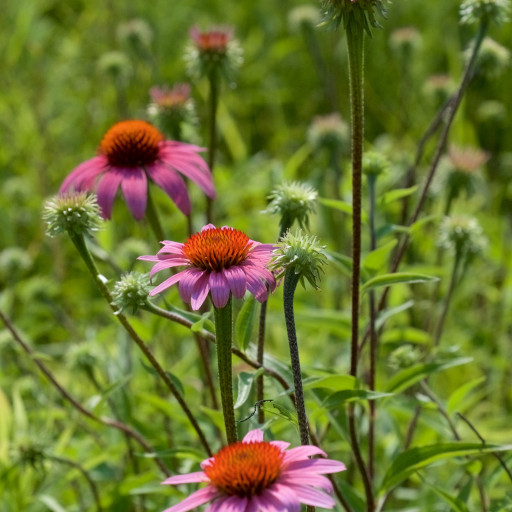
Known as the "Purple Coneflower," this resilient beauty is the crown jewel of the North American prairie. Its name comes from the Greek word for "hedgehog," referring to its prickly, prominent center. A favorite of both butterflies and traditional herbalists, it brings a wild, architectural elegance to any landscape and is famously tough against the elements.
🔍 How to Identify
- 🌸 The Petals: Vibrant pink to deep purple "ray" flowers that often droop slightly downward, framing the center like a colorful shuttlecock.
- 🦔 The Cone: A prominent, spiny central disk that starts flat and rises into a metallic, copper-orange dome as the season progresses.
- 🌿 The Foliage: Sturdy, hairy stems hold dark green, lance-shaped leaves that feel slightly rough or "sandpapery" to the touch.
🏡 In Your Garden
- 🦋 Pollinator Party: This plant is an absolute magnet for Monarch butterflies and honeybees. In late fall, if you leave the dried seed heads standing, you’ll likely see goldfinches perching on them to snack on the seeds.
- ☀️ Drought Warrior: Because it develops a deep taproot, it is incredibly heat-tolerant and thrives on a bit of neglect. However, that same taproot means it hates being moved; choose its "forever home" carefully to avoid transplant shock.
⚠️ Safety & Toxicity
- 🐾 Pet Friendly: Echinacea purpurea is generally considered non-toxic to dogs, cats, and horses, making it a safe and worry-free choice for family backyards.
- 🌼 Allergy Note: While safe, individuals with known sensitivities to the Asteraceae family (like ragweed, daisies, or marigolds) should handle the plant with care, as the hairy stems can occasionally cause mild skin irritation.
✨ Fun Fact
The genus name Echinacea is derived from the Greek word echinos, meaning "hedgehog" or "sea urchin." If you touch the central cone once the petals fall off, you’ll feel exactly why—it is surprisingly stiff and prickly!

Detailed Care Instructions
| Color | Purple, Mauve, Rose-Pink |
| Soil Ph | 6.5 To 7.0 |
| Lighting | Full Sun |
| Soil Type | Normal, Sandy, Or Clay |
| Bloom Time | Mid-Summer To Mid-Fall |
| Plant Type | Flowering Perennial |
| Mature Size | 29 To 47 Inches Tall And 18 To 23 Inches Wide |
| Native Area | North America |
| Sun Exposure | Full Sun Or Part Shade |
| Hardiness Zones | 3 Through 9 |
To grow Echinacea Purpurea plants, also known as purple coneflowers, follow these steps:
- Choose the right location: Echinacea plants prefer full sun to partial shade. Find a spot in your garden that receives at least 6 hours of direct sunlight each day.
- Prepare the soil: The soil should be well-draining, fertile, and loamy. If it is heavy clay soil, amend it with organic matter such as compost to improve drainage and nutrient content.
- Sow seeds: Echinacea seeds can be sown directly in the garden or started indoors. If starting indoors, begin about 8-10 weeks before the last expected frost. Sow the seeds on the surface of damp seed-starting mix and lightly cover them. Keep the soil consistently moist until germination occurs in about 10-20 days.
- Transplanting: If you started the seeds indoors, transplant the seedlings outdoors after the last frost date in your area. Choose a spacing of about 18-24 inches between each plant.
- Watering: Water the plants regularly, aiming for about 1 inch of water per week. Avoid overwatering as Echinacea plants can be susceptible to root rot.
- Mulching: Apply a layer of organic mulch around the plants to help retain moisture, suppress weeds, and regulate soil temperature.
- Fertilizing: Echinacea plants don't require excessive fertilization. However, you can apply a balanced, slow-release fertilizer once or twice during the growing season, following the package instructions.
- Deadheading: To promote continuous blooming, remove faded flowers by cutting them back to a pair of healthy leaves. This will prevent seed formation and encourage the plant to produce new blooms.
- Pest and disease control: Echinacea plants are generally resistant to pests and diseases. However, keep an eye out for common issues like aphids or powdery mildew. If necessary, treat with appropriate organic pest or disease control products.
- Winter care: Echinacea plants are hardy perennials, but mulching around the base of the plants in late fall can provide extra protection during the winter months.
By following these steps, you should be able to successfully grow Echinacea Purpurea plants in your garden.

Place in a window with dappled sun or a spot in the middle of a room. Or directly in a window facing west or east.

To properly water this plant, you should first check the soil moisture level by inserting your finger about two inches into the soil. If the soil feels dry, it is time to water. Use a watering can or a gentle stream from a hose to water the plant slowly and thoroughly around the base of the stem, taking care not to get water on the leaves or flowers. Ensure that the water reaches the roots and saturates the soil. You should avoid overwatering, as this can lead to root rot. It is essential to maintain consistent moisture levels by watering regularly and adjusting as necessary to prevent the soil from drying out completely.
To fertilize this plant, use a balanced fertilizer with equal amounts of nitrogen, phosphorus, and potassium. Apply the fertilizer in early spring before new growth emerges and again in mid-summer. Avoid over-fertilizing, as this can lead to weak stems and an increased susceptibility to disease. Water the plant thoroughly after fertilizing to help distribute the nutrients evenly throughout the soil.
The soil that is ideal for the Echinacea Purpurea plant is well-draining and has a slightly acidic pH level. It should be enriched with organic matter and have good aeration to ensure proper root growth. It is also recommended to avoid heavy clay soils, as they hold onto water and can cause root rot. The addition of sand or perlite can help improve drainage. The plant prefers full sun exposure, so it is best to plant it in an area that receives at least six hours of direct sunlight each day. Additionally, supplemental watering may be necessary during drought conditions.
To propagate this particular plant, begin by selecting a healthy mature specimen and preparing it for division. Carefully dig up the plant, loosening the soil around the roots without damaging them. Using a sharp, clean knife or shears, divide the root ball into sections, ensuring that each section has at least one healthy shoot and an adequate root system.
Once divided, plant each section into well-draining soil, covering the roots and leaving the top of the shoot exposed. Water the newly planted divisions thoroughly and keep them moist but not waterlogged. It is best to plant in the fall or spring, during cooler temperatures.
Alternatively, Echinacea Purpurea can also be propagated by taking stem cuttings. Select a healthy stem that has not yet flowered and cut it just below a node, leaving at least three leaves on the stem. Dip the cut end in rooting hormone and plant in a well-draining soil. Keep the soil moist and provide some shade until the plant is established.
When propagating Echinacea Purpurea, it is important to note that the new plants may not be identical to the parent plant, as variations can occur due to genetic diversity. It may take a few years for the new plant to reach maturity and develop its characteristic blooms.
Common pests of the purple coneflower include Spider mites, aphids. Make a habit of checking your purple coneflower frequently for pests so that any infestations can be caught and managed early.








