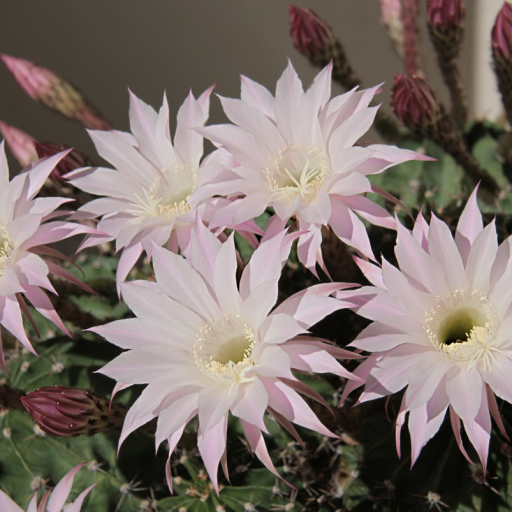
Plant Overview
Often called the Easter Lily Cactus, Echinopsis tubiflora is a showstopper that rewards patient gardeners with a dramatic midnight performance. Originating from the rocky terrains of Argentina and Brazil, this cactus spends most of its year as a humble, spiky globe. However, when it decides to bloom, it produces massive, fragrant trumpets that seem far too large for the plant itself.
🔍 How to Identify
- 🌵 The Body: It typically grows as a dark green, solitary globe that eventually elongates into a cylinder. It features around 11 to 12 deep, sharp ridges (ribs).
- 🗡️ The Spines: It is armed with brownish-yellow spines that have dark, almost black tips. These grow from woolly, circular patches called areoles spaced along the ridges.
- 🎺 The Flower Tube: Its most defining feature is the incredibly long, narrow green tube (the "tuba") that extends outward to support a giant, multi-petaled white or pale pink flower.
🏡 In Your Garden
- ☀️ Light for Blooms: This cactus is a sun-lover. To trigger the energy-intensive blooming process, it needs as much direct sunlight as possible during the growing season; otherwise, it will stay small and flowerless.
- 💤 The Winter Chill: Unlike tropical houseplants, this cactus demands a "hard" winter rest. Keep it in a cool, bright spot (around 50°F or 10°C) and completely withhold water from November to March to ensure flowers appear in spring.
- 🌱 Clumping Habit: As the plant matures, it often produces "pups" or offsets around its base. These can be easily detached and rooted to start an entirely new colony.
⚠️ Safety & Toxicity
- 🛡️ Physical Hazard: While Echinopsis tubiflora is not known to be chemically toxic to humans or pets, its spines are very stiff and sharp.
- 🐾 Pet Warning: Keep this plant on a high shelf if you have curious cats or dogs. A playful swat or a curious sniff can result in painful punctures that are difficult to remove from fur or skin.
✨ Fun Fact
The "Tubiflora" name literally translates to "tube flower." These flower tubes can grow up to 8 inches long in just a few days, stretching outward at an incredible speed to ensure the bloom is high enough to be seen by night-flying moths, its primary pollinators.

Detailed Care Instructions
To grow Echinopsis Tubiflora (also known as the Easter Lily Cactus or the Night Blooming Cactus), follow these steps:
- Choose the right location: Echinopsis Tubiflora requires bright indirect sunlight. Find a location indoors or outdoors that receives bright light, but avoid direct sunlight, as it can scorch the plant.
- Select the right pot: Choose a pot with drainage holes to prevent waterlogging and root rot. Make sure it is slightly larger than the plant's current size, leaving room for growth.
- Soil: Use a well-draining cactus or succulent mix. It should be nutrient-rich and allow excess water to flow freely.
- Watering: Echinopsis Tubiflora is a drought-tolerant plant. Water the cactus thoroughly when the top inch of soil feels dry, but avoid overwatering. Always allow the soil to dry out between waterings to prevent root rot.
- Fertilization: During the growing season (spring and summer), fertilize once a month with a balanced cactus or succulent fertilizer. Follow the instructions on the fertilizer package for proper application.
- Temperature and Humidity: Echinopsis Tubiflora prefers warm temperatures between 65-85°F (18-29°C). It can tolerate slightly cooler temperatures in the winter, down to around 50°F (10°C). It doesn't require high humidity levels and can adapt to normal household humidity.
- Pruning: Prune dead or damaged stems as needed. You can also remove offsets or "pups" that appear around the base of the plant to propagate new specimens.
- Propagation: To propagate Echinopsis Tubiflora, carefully remove an offset from the parent plant, let it dry for a few days to form a callus, then plant it in well-draining soil. Water sparingly until it establishes roots.
- Dormancy: Echinopsis Tubiflora enters dormancy in the winter. Reduce watering during this time and keep the plant in a cooler location (around 50°F or 10°C) to encourage blooming in the upcoming season.
- Flowering: Echinopsis Tubiflora is known for its beautiful night-blooming flowers. The plant typically blooms in spring or summer, usually at night. Enjoy the stunning display of fragrant, white flowers that open in the evening and close by morning.
Remember to be patient with your Echinopsis Tubiflora, as it may take a few years for it to reach maturity and produce flowers.

Place in a bright room that is sun drenched almost all day. Or directly in a south-facing window.

To properly water this plant, one should first determine when it is necessary to water the plant. This can be done by checking the soil moisture level and the humidity levels. If the soil feels dry and the humidity levels are low, then it is time to water the plant.
When watering, be sure to use room temperature water. Avoid using chlorinated or fluoridated water as they can harm the plant. It is recommended to use either distilled or rainwater.
One should water the soil around the plant and avoid getting water on the foliage. Overwatering can lead to root rot and other diseases. It is important to allow the soil to dry out between waterings.
During the growing season, one should water the plant regularly, but reduce watering in the winter when the plant is dormant. When watering, one should ensure that excess water drains away.
Overall, it is important to pay attention to the moisture needs of this plant and adjust watering accordingly to ensure it stays healthy.
To fertilize this specific type of plant, it is recommended to use a balanced fertilizer with equal amounts of nitrogen, phosphorus, and potassium. It is important to dilute the fertilizer to half the recommended strength, as over-fertilizing can damage the plant. During the active growing season, typically spring to early fall, fertilize once a month. In the winter, reduce fertilizing to once every three months or not at all. Avoid fertilizing newly transplanted or young plants until they are established. It is best to apply the fertilizer to moist soil and water afterwards to help distribute the nutrients.
Echinopsis Tubiflora plant prefers well-draining soil with a pH of 6.5 to 7.5. The soil should not retain excess moisture, as this can cause root rot. A mix of coarse sand, perlite, and lava rock can be added to improve drainage. The soil should also provide adequate nutrients to promote healthy growth. A balanced cactus or succulent soil mix may be used, or a homemade mixture of sand, peat moss, and vermiculite may suffice. It is important to avoid using soil that is packed with nutrients, as this may cause excessive growth and harm the plant's health.
To propagate this plant, you will need to collect the seeds from the mature plant and allow them to dry for a few days. Next, you can plant the seeds in a well-draining soil mix and water them lightly. Provide indirect sunlight and keep the soil moist until the seeds germinate, which can take anywhere from a few days to a few weeks.
Once the seedlings have developed their first true leaves, you can begin to fertilize them with a balanced liquid fertilizer every two weeks. Also, gradually increase their exposure to direct sunlight.
Another way to propagate this plant is through stem cuttings. To do this, take a healthy stem cutting and allow it to dry for a few days before planting it in well-draining soil mix. Keep the soil moist but not overly wet and provide indirect sunlight until new growth appears. Once new growth appears, you can gradually increase exposure to direct sunlight.
Propagation through stem cuttings can also be done using offsets. These are small, new growths that develop at the base of the mother plant. Carefully remove them with a sharp, sterile knife or scissors and plant them in well-draining soil mix. Keep the soil moist and provide indirect sunlight until new growth appears. Gradually increase their exposure to direct sunlight once new growth appears.








