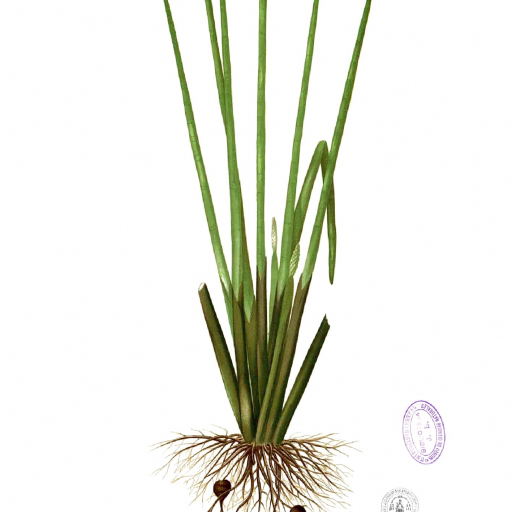
Plant Overview
Affectionately known as the Chinese Water Chestnut, Eleocharis dulcis is a botanical trickster. Despite its name and its appearance once peeled, it isn't a nut at all, but a "corm" or underground tuber of a grass-like sedge. Thriving in marshes and paddy fields across Asia, it has been a staple of celebratory stir-fries and dim sum for centuries, prized for its refreshing, apple-like crunch that persists even after cooking.
🔍 How to Identify
- 🟢 The Stems: It looks more like a rush than a typical plant. The stems are bright green, hollow, and cylindrical, reaching up to 3 feet tall. They lack traditional flat leaves.
- 🌾 The Flowers: At the very tip of the stems, you’ll find small, inconspicuous brownish spikes that contain the seeds.
- 🌰 The Corm: Hidden in the mud are the "chestnuts"—rounded, slightly flattened tubers with a scaly, dark brown skin and crisp, pearly-white flesh inside.
🏡 In Your Garden
- 💧 Wet Feet Only: This is an obligate aquatic plant. To grow it successfully at home, you need a "contained wetland" like a large pot without drainage holes or the shallow edge of a pond. It needs at least 2 to 6 inches of standing water.
- ⏳ Patience for the Harvest: The plant tells you when it’s ready. In late autumn or winter, the green stems will turn yellow and then brown. This is the signal that the energy has moved underground into the corms, which can then be dug out of the mud.
- 🌱 Substrate Secrets: It prefers a heavy clay or silty soil rather than light potting mix, as this provides the stability and nutrient density required for the heavy corm production.
⚠️ Safety & Toxicity
- ✅ Status: Completely non-toxic and highly edible for humans.
- 🐾 Pets & Kids: It is safe for cats, dogs, and children. However, because it grows in stagnant or slow-moving water, wild-harvested water chestnuts should always be thoroughly peeled and cooked to avoid any risk of water-borne parasites like the giant intestinal fluke (Fasciolopsis buski).
✨ Fun Fact
The "immortal crunch" of the water chestnut is a scientific marvel. Unlike most vegetables that turn mushy when heated, the cell walls of Eleocharis dulcis are reinforced with specific phenolic compounds that stay bridged together even after boiling or canning!

Detailed Care Instructions
| Humidity | High |
| Lighting | Full Sun |
| Difficulty | Hard |
| Hibernation | Cold Period |
| Temperature | 25°C - 35°C |
| Hardiness Zones | 9 - 12 |
To grow Eleocharis dulcis, also known as the Chinese water chestnut or water chestnut, follow these steps:
- Climate: The plant thrives in warm, tropical climates. It requires a minimum temperature of 50°F (10°C) and grows best between 68-86°F (20-30°C).
- Container: Select a suitable container or tank for cultivation. It should be at least 6-12 inches (15-30 cm) deep and filled with clay or loamy soil. Ensure the container has drainage holes.
- Planting: Place the tubers or corms around 1-2 inches (2.5-5 cm) deep in the soil, with the rounded side facing up. Space them around 4 inches (10 cm) apart.
- Water: Fill the container with around 4-6 inches (10-15 cm) of water. Maintain the water level at this height throughout the growing period. The plant loves moist conditions, but it shouldn't be completely submerged.
- Sunlight: Position the container in a location that receives full sun or partial shade, preferably for at least 6 hours of direct sunlight each day.
- Nutrients: Fertilize the plant regularly with a balanced aquatic fertilizer or a slow-release fertilizer. Follow the package instructions for dosage and frequency.
- Weeds and pests: Regularly check for weeds and remove them to prevent competition for nutrients. Hardy plants like Eleocharis dulcis usually withstand pests or diseases well.
- Harvesting: The water chestnuts are ready to harvest after around four months. You will notice the leaves turning yellow. Carefully lift the plant out of the water and check the tubers for their size. They should have grown to about the size of a golf ball.
- Storage: After harvesting, wash the tubers and store them in a cool, dry place for a few days before consumption. They can be refrigerated for up to a month or frozen for longer storage.
Remember to monitor the water temperature, maintain appropriate sunlight exposure, and provide regular care to ensure successful growth of your Eleocharis dulcis plant.

Place in a bright room that is sun drenched almost all day. Or directly in a south-facing window.

To properly water this type of plant, you should keep the soil evenly moist but not waterlogged at all times. You can achieve this by watering the plant deeply every one or two weeks, depending on the temperature and humidity in the environment. To avoid overwatering, make sure the soil has good drainage and that the water has drained away before watering again. Additionally, you may periodically mist the leaves to maintain humidity around the plant.
To fertilize this aquatic plant, it is recommended to use a liquid fertilizer specifically formulated for aquarium plants. This fertilizer should be added to the water in small amounts on a weekly basis, following the manufacturer's instructions for dosage and frequency. It is also recommended to conduct regular water changes to maintain water quality and prevent the buildup of excess nutrients. Additionally, providing adequate lighting and carbon dioxide (CO2) supplementation can help promote healthy growth and development.
The ideal soil for Eleocharis Dulcis plants is a substrate that is rich in nutrients. It should have good drainage properties to prevent waterlogging as this can lead to root rot. The soil should be slightly acidic with a pH range of around 6.0 to 7.5. It is recommended to use a sandy loam or clay loam soil mix with some organic matter such as compost or peat. This will provide the plant with the necessary nutrients and improve water retention. It is important to avoid using soils that are too heavy or compacted as this can hinder root growth and overall plant health. A top layer of sand or gravel can be added to the soil to provide additional drainage and prevent nutrient leaching.
The propagation of this type of plant can be accomplished using one of two methods. The first method is by taking a full-grown plant and dividing it into smaller sections. This method is best done in the spring when the plant is actively growing and is at its healthiest. To do this, one must carefully dig up the root system, and separate it into smaller sections using a sharp knife. Each section should have a healthy growth of both roots and foliage.
The second method is by using stem cuttings. This method is best done in the summer or fall when the plant is actively growing and has strong, healthy stems. To do this, one should take a 3- to 6-inch stem cutting from the plant, ensuring that it has at least a few leaves and a healthy bud. Next, remove the lower leaves from the stem, and dip the cut end into rooting hormone powder. Then, plant the cutting in a pot filled with damp soil, and cover it with a clear plastic bag to create a humid environment. Keep the soil moist and the cutting in a bright, but indirect light until it develops a healthy root system.
In both methods, after propagation, the new plants should be planted in fresh soil and placed in a bright, but indirect light. They should be watered frequently, but not to the point of waterlogging the soil, as this can lead to root rot. The new plants should also be kept in a stable environment, with temperatures between 60 and 75 degrees Fahrenheit for optimal growth.








