Plant Overview
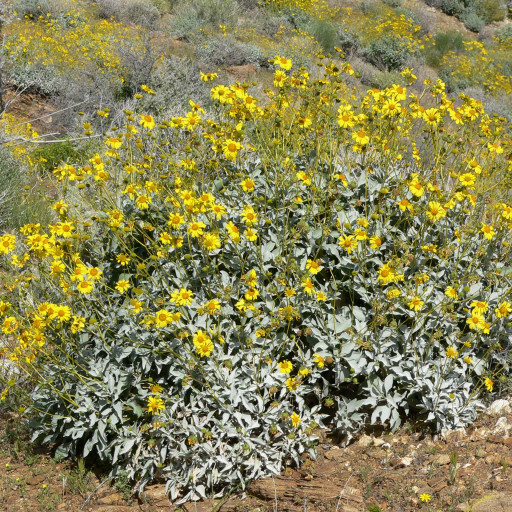
Known as the Brittlebush or Incienso, this desert jewel is famous for turning the parched hills of the Sonoran and Mojave deserts into a shimmering sea of gold. It acts like a living mirror, using its distinct silvery foliage to reflect harsh sunlight and conserve precious moisture. Beyond its beauty, it carries a deep history; early Spanish explorers were so captivated by its aromatic resin that they used it as a substitute for frankincense in mission ceremonies.
🔍 How to Identify
- 🌿 Silvery Foliage: The triangular leaves are coated in a thick layer of fine, velvety white hairs that give the plant a ghostly, frosted appearance.
- 🌼 Golden Blooms: Bright yellow, daisy-like flowers rise high above the main foliage on long, leafless stalks, creating a "floating" floral canopy.
- 🪴 Mounded Shape: It naturally grows into a tidy, rounded dome, often appearing as a compact silver ball in the landscape before the flowers emerge.
🏡 In Your Garden
- 🏜️ Heat Warrior: This plant is the ultimate "xeriscape" champion. It thrives in intense, direct sun and poor, gravelly soil. It is "drought-deciduous," meaning it may drop leaves during extreme dry spells to protect itself—don't panic, it’s just sleeping!
- ✂️ Brittle by Name: As the name suggests, its woody stems are famously fragile and snap with the slightest pressure. Avoid planting it directly next to high-traffic walkways where pets or children might accidentally break the branches.
⚠️ Safety & Toxicity
- 🐾 Safe for Pets: Brittlebush is generally considered non-toxic to dogs, cats, and horses, making it a safe choice for desert-themed backyard habitats.
- 🖐️ Sticky Resin: While not poisonous, the stems exude a yellowish, sticky resin. In rare cases, this sap can cause mild skin irritation for people with highly sensitive skin, so wearing gloves during heavy pruning is a good idea.
✨ Fun Fact
Native Americans discovered that the resin from the Brittlebush makes an excellent multipurpose tool; it was used as glue to fasten arrowheads to shafts, as a waterproof sealant for baskets, and even as a traditional treatment for toothaches!

Detailed Care Instructions
To grow Encelia Farinosa plants, also known as Brittlebush, follow these steps:
- Climate: Brittlebush is native to arid regions of California, Arizona, and northern Mexico. Ensure that you live in a similar climate or have the ability to replicate its growing conditions.
- Soil: Brittlebush prefers well-draining soil with good aeration. If your soil is compact or heavy, mix in sand or perlite to improve drainage.
- Sunlight: Provide your plant with full sun exposure. Brittlebush requires at least 6-8 hours of direct sunlight daily.
- Watering: Initially, water the plant regularly until it establishes roots. However, once it is established, Brittlebush is drought-tolerant and requires minimal watering. Water deeply but infrequently to encourage deep root growth.
- Mulching: Apply a layer of organic mulch around the base of the plant to help retain moisture and prevent weed growth.
- Pruning: Pruning is not usually necessary for Brittlebush. However, you can trim back any dead or damaged branches to maintain its shape and health.
- Fertilizer: Brittlebush is a low-maintenance plant that thrives in nutrient-poor soils. Use a balanced, slow-release fertilizer if desired, but it is not necessary.
- Pests and Diseases: Brittlebush is generally pest and disease-free. However, keep an eye out for common garden pests like aphids or whiteflies, and treat them accordingly.
- Propagation: Brittlebush can be propagated from seeds or stem cuttings. Collect the seeds after they turn brown and plant them in well-draining soil. For stem cuttings, take a 6-8 inch long cutting from a healthy plant, remove the lower leaves, and plant it in moist soil.
With proper care, water management, and suitable growing conditions, your Encelia Farinosa plant should thrive and grow into a beautiful addition to your garden.

Place in a bright room that is sun drenched almost all day. Or directly in a south-facing window.

Encelia Farinosa is a plant that requires moderate watering. The ideal way to water this plant is through a deep soak. This means that the water must be allowed to penetrate deep into the soil, reaching the plant roots. You must avoid overwatering the plant, as it may cause root rot. Ensure that the top layer of soil is dry before watering, and avoid watering if there is any moisture already present in the soil. When watering, ensure that you do not wet the leaves of the plant, as this may cause fungal infections. Additionally, you can water the plant early in the day to avoid water evaporation and ensure that the plant has enough water throughout the day.
To fertilize this plant, apply a balanced fertilizer with equal amounts of nitrogen, phosphorus, and potassium. Use a fertilizer with a slow-release formulation for a gradual nutrient supply. Apply the fertilizer every two to three months during the growing season, from spring to fall. Mix the fertilizer with water in a watering can or sprayer and apply it to the soil around the base of the plant, avoiding foliage. Water the plant after fertilizing to help the nutrients penetrate the soil. Avoid over-fertilizing as it can damage the plant and lead to excessive growth or salt buildup in the soil.
For Encelia Farinosa plant, it is recommended to use well-draining soil with a slightly acidic to neutral pH. The soil should be rich in organic matter, such as compost or aged manure, to support healthy growth. The plant prefers soil that is slightly sandy and loamy, which allows for proper root aeration and moisture retention. It is important to avoid heavy, clay soils as they can become waterlogged and cause root rot. A good quality potting mix that contains perlite or vermiculite can also be used for container planting. Overall, Encelia Farinosa plant requires soil that is nutrient-rich, well-draining, and has good texture to support its growth and health.
Encelia Farinosa can be propagated through various methods, including seed propagation and cuttings.
Seed propagation involves collecting healthy seeds from the plant and sowing them in a suitable growing medium. The seeds should be placed in a warm, well-lit area to germinate. Once they have sprouted and have a few true leaves, they can be transplanted into individual pots or directly into the garden.
Cuttings are another popular method of propagating Encelia Farinosa. To take cuttings, select a healthy stem with several leaves and make a clean cut just below a leaf node. Remove the lower leaves from the cutting and dip the cut end in rooting hormone. Place the cutting in a well-draining potting mix and keep it moist but not waterlogged. Enclose the pot and cutting in a clear plastic bag to increase humidity and reduce moisture loss. Roots should begin to form within a few weeks, and the cutting can be transplanted into a larger pot or the garden once it has established enough roots.
Both of these methods of propagation can be successful with Encelia Farinosa, but it's important to keep in mind that the plant may not produce the exact same characteristics as the parent plant, especially when grown from seed.
Common pests of the brittlebush include Spider mites, whiteflies. Make a habit of checking your brittlebush frequently for pests so that any infestations can be caught and managed early.








