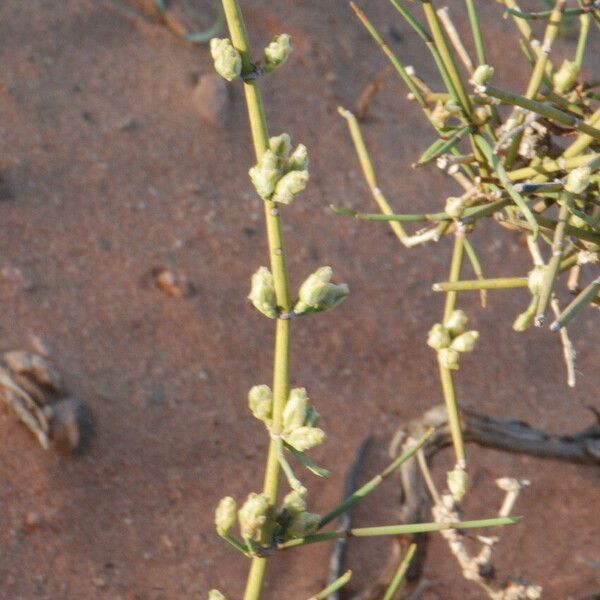
Plant Overview
Known as the "Winged Ephedra" or "Alanda" in Arabic-speaking regions, Ephedra alata is a resilient desert shrub that looks more like a bundle of green sticks than a traditional leafy plant. This "living fossil" belongs to an ancient group of plants that existed alongside the dinosaurs, perfectly adapted to the scorching sands of North Africa and the Middle East. It is famous for its medicinal history and its ability to anchor shifting sand dunes in the harshest environments.
🔍 How to Identify
- 🌵 The Stems: The plant is composed of stiff, cylindrical, and highly branched stems. They are bright green when young, turning a grayish-yellow as they age, and perform the photosynthesis that leaves usually do.
- 🍂 The Leaves: You might miss them! The leaves are reduced to tiny, brownish scales found at the joints (nodes) of the stems to prevent water loss.
- 🦋 The "Wings": During the reproductive season, female plants produce small cones surrounded by papery, transparent "wings" (bracts). these allow the seeds to be carried away by the desert wind.
🏡 In Your Garden
- ☀️ Sun Devotee: This plant is an obligate sun-lover. It requires full, unobstructed sunlight to maintain its structural integrity; in the shade, the stems become floppy and lose their vibrant green color.
- 🏜️ Drainage Specialist: Because it is a desert native, Ephedra alata has evolved to thrive in poor, sandy, or rocky soils. It is extremely sensitive to overwatering and will suffer from root rot if kept in standard, moisture-retaining potting soil.
- 🌬️ Erosion Control: In landscaping, it is often used as a "binder" for slopes or sandy patches, as its extensive root system is excellent at stabilizing loose earth.
⚠️ Safety & Toxicity
- 💊 Medicinal Potency: This species contains ephedrine and pseudoephedrine. While these compounds have been used in traditional medicine for respiratory issues, they are powerful stimulants.
- 🚫 Health Risk: Ingestion by pets or children can lead to serious heart palpitations, increased blood pressure, and tremors. It should never be consumed without expert medical supervision, as the line between a "dose" and "danger" is very thin.
✨ Fun Fact
The genus Ephedra is the original source of the drug ephedrine. While modern medicine now synthesizes many of these compounds in labs, ancient cultures have been brewing "Mormon Tea" or "Ma Huang" from related species for thousands of years to treat asthma!

Detailed Care Instructions








