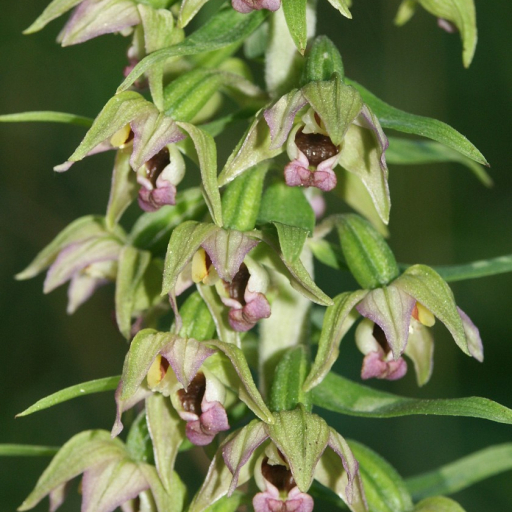
Plant Overview
The Broad-leaved Helleborine is often called the "Stealth Orchid" or the "Weedy Orchid." While most orchids are famous for being fussy and delicate, this resilient traveler has managed to colonize urban gardens, cracks in sidewalks, and dense forests alike. Originally from Europe and Asia, it is one of the few orchid species that has successfully naturalized across North America, often surprising homeowners who find a wild orchid growing right next to their compost bin.
🔍 How to Identify
- 🍃 The Foliage: Look for broad, oval-shaped leaves that clasp the stem. They feature prominent parallel veins and are arranged in a distinct spiral pattern as they move up the stalk.
- 🌸 The Flowers: The plant produces a long spike of 15 to 50 drooping flowers. Each bloom is a subtle mix of greenish-yellow with splashes of dusky purple or rose-pink.
- 📏 Growth Habit: It typically grows as a single, sturdy upright stem that can reach up to 3 feet in height. The upper part of the stem is often covered in fine, downy hairs.
🏡 In Your Garden
- 🌱 The Urban Survivor: Unlike its tropical cousins, the Helleborine thrives in limestone-rich soils and shaded areas. It is incredibly hardy and can survive in poor soil where other flowers might fail, making it a "volunteer" plant in many backyard gardens.
- 🍄 Fungal Friendships: This plant is a master of networking. It relies on a symbiotic relationship with underground mycorrhizal fungi to help it gather nutrients. This is why it often pops up near the base of old trees like Oaks or Beeches.
- ⛏️ Tough Roots: If you find one where you don't want it, be aware that it grows from a thick horizontal rhizome. Simply pulling the top off won't work; you must remove the entire root system to prevent it from returning next year.
⚠️ Safety & Toxicity
- 🟢 General Status: The Broad-leaved Helleborine is not considered highly toxic to humans or pets, but it is not edible.
- 🐾 Pet Caution: While not listed on major "poisonous plant" databases for dogs and cats, consuming wild orchids can cause mild stomach upset or vomiting in curious pets. It is best enjoyed visually rather than as a snack.
✨ Fun Fact
The nectar of the Broad-leaved Helleborine actually contains naturally occurring ethanol and narcotic compounds. When wasps drink from the flowers, they become slightly intoxicated or "tipsy," which makes them sluggish and ensures they stay on the flower long enough to get covered in pollen!

Detailed Care Instructions
| Humidity | Normal |
| Lighting | Shade |
| Toxicity | Poisonous |
| Difficulty | Medium |
| Hibernation | Cold Period |
| Hardiness Zones | 3 - 6 |
To grow Epipactis helleborine plants, follow these tips:
- Soil and location: Epipactis helleborine prefers moist, well-draining soil. They thrive in shady to partially shady locations, such as woodland areas or under trees.
- Propagation: This plant can be propagated through division or from seed. Division is the most common method and should be done in early spring or fall when the plant is not actively growing. Dig up a clump of the plant and carefully separate the bulbs or pseudobulbs, ensuring each division has a good root system.
- Planting: Choose a suitable location with the right light conditions. Dig a hole slightly larger than the roots or pseudobulb and place it in the hole. Cover it with soil, leaving the top of the pseudobulb exposed.
- Watering: Epipactis helleborine prefers moist soil. Water regularly, especially during dry spells, to keep the soil consistently moist but not waterlogged.
- Mulching: Apply a layer of organic mulch, like bark chips or compost, around the plant to help retain moisture in the soil and suppress weed growth.
- Fertilizing: Epipactis helleborine is not a heavy feeder and generally doesn't require fertilization. However, you can apply a balanced, slow-release fertilizer in the spring to provide some nutrients.
- Maintenance: Remove any competing weeds or vegetation around the plant, as they can hinder its growth. Also, remove spent flower stalks after blooming to encourage more blooms in the future.
- Winter care: Epipactis helleborine is hardy in USDA zones 4-9. In colder regions, provide some winter protection by mulching the plants with a thick layer of organic material, like straw or leaves.
By following these guidelines, you should successfully grow Epipactis helleborine plants in your garden.

Place in a window with dappled sun or a spot in the middle of a room. Or directly in a window facing west or east.

To water this plant, you should first check the moisture level of the soil by sticking your finger about an inch into the soil. If it feels dry, it's time to water. Fill a watering can or pitcher with room temperature water and slowly pour the water directly onto the soil around the base of the plant. Be careful not to get water on the leaves or flowers, as this can lead to rot or other damage. Allow the water to soak into the soil, and then discard any excess water that collects in the saucer or drainage tray. Repeat this process when the soil feels dry, but be sure not to overwater as this can also lead to root rot.
To fertilize this plant, use a balanced fertilizer with equal amounts of nitrogen, phosphorus, and potassium. Apply the fertilizer once a month during the growing season, which runs from early spring to late summer. Dilute the fertilizer to half strength and apply it directly to the soil around the base of the plant. Be careful not to allow the fertilizer to come into contact with the foliage or roots, as this can cause damage. Water the plant well after fertilizing to help the nutrients reach the roots.
Epipactis Helleborine plant prefers a well-draining and nutrient-rich soil that is slightly acidic to neutral in pH. The soil should be moist but not waterlogged as the plant does not tolerate waterlogging and root rot. It can be grown in a wide range of soils including loam, sandy loam, and clay loam soils. Soil rich in organic matter including compost and leaf mold is preferred. In addition, Epipactis Helleborine plant requires good air circulation and some shade, which can be provided by trees or shrubs.
Epipactis Helleborine plant can be propagated through division of root clusters. Firstly, select a mature and healthy plant, and carefully remove it from the soil. Next, clean the root system of old soil and debris, and then divide the root clusters into sections with at least three active growing points. Plant these sections individually in their own pots, with fresh potting soil. Keep the newly potted plants consistently moist and in shade until new growth has been established.








