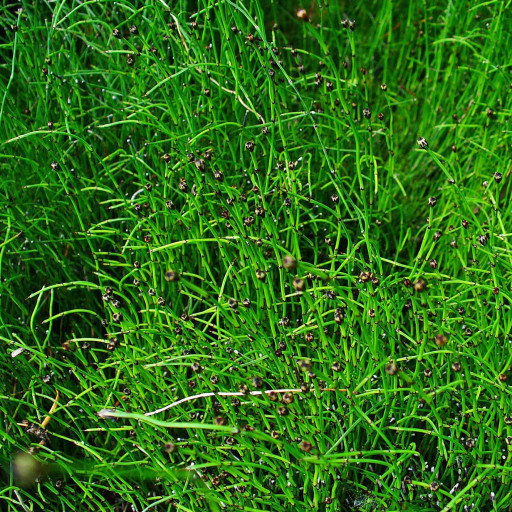
Plant Overview
Often called the Dwarf Scouring Rush, this miniature marvel is a living link to the prehistoric world, remaining largely unchanged for over 100 million years. While its Carboniferous ancestors grew as tall as skyscrapers, Equisetum scirpoides has evolved into a delicate, moss-like carpet of wiry stems. It is a favorite for Zen gardens and container enthusiasts who love its architectural, "mini-bamboo" aesthetic.
🔍 How to Identify
- 🌿 Wiry Stems: The stems are very fine, deep green, and uniquely twisted or "kinked," unlike the perfectly straight stems of its larger relatives.
- 🖤 Dark Sheaths: If you look closely at the segmented joints, you’ll see tiny, tooth-like black sheaths. These are actually the plant's highly reduced leaves.
- 🍦 Tiny Cones: Since it doesn't produce flowers or seeds, look for small, pointed, yellowish-black cones (strobili) at the tips of the stems in summer; these release spores to reproduce.
🏡 In Your Garden
- 💧 The Bog Lover: This plant thrives in "wet feet." It is naturally found in bogs and damp forests, making it the perfect choice for pond edges, water features, or soggy spots where other plants might rot.
- 🧊 Boreal Toughness: It is incredibly cold-hardy and stays evergreen throughout the winter, even in northern climates where it may spend months tucked under a blanket of snow.
- 🧱 Contained Growth: While much slower-growing than the invasive Field Horsetail, it still spreads via underground runners (rhizomes). If you want to keep it in a tidy tuft, consider planting it in a buried container to limit its reach.
⚠️ Safety & Toxicity
- 🐾 Pet & Livestock Caution: Contains thiaminase, an enzyme that can interfere with Vitamin B1 absorption. While a small nibble by a cat or dog is rarely an issue, it should never be ingested in large quantities.
- 🐎 Equine Alert: It is specifically toxic to horses if consumed in significant amounts (usually found in contaminated hay), leading to a condition known as "equisetosis."
- 🖐️ Abrasive Texture: The stems are impregnated with silica (the primary component of glass). This gives the plant a sandpaper-like texture that is fascinating to touch but can be mildly irritating to very sensitive skin.
✨ Fun Fact
Before the invention of synthetic sponges or steel wool, travelers and pioneers used bundles of horsetail stems to scrub their cooking pots and polish pewter. The high silica content makes it nature’s very own "scouring pad," which is how it earned the nickname Scouring Rush!

Detailed Care Instructions
| Humidity | Normal |
| Lighting | Shade |
| Difficulty | Medium |
| Hardiness Zones | Max 3A |
To grow Equisetum scirpoides, also known as dwarf scouring rush or horsetail rush, follow these steps:
- Obtain the plant: Look for Equisetum scirpoides at a local nursery, garden center, or search online for a reputable seller. You can acquire a potted plant or buy rhizomes (underground stems) for propagation.
- Container and soil: Choose a container that is at least 12 inches deep and has drainage holes. Equisetum scirpoides prefers moist soil, so ensure the potting mix has good water retention. A mix of peat moss, loam, and sand will work well. Avoid using regular potting soil, as it may retain too much water.
- Planting: Plant the rhizomes horizontally just below the surface of the soil. Alternatively, if planting from a potted plant, carefully remove it from its original container and replant it at the same depth in the new container.
- Watering: Keep the soil consistently moist but avoid waterlogging. Ensure your container has good drainage to prevent water accumulation. Mist the plant occasionally to maintain humidity.
- Light: Equisetum scirpoides prefers partial shade but can tolerate full sun. Place your plant in an area that receives indirect sunlight for a few hours a day. If growing indoors, keep it near a window with filtered light.
- Temperature and humidity: Equisetum scirpoides thrives in cool temperatures between 60-75°F (15-24°C). Provide moderate humidity by misting the plant or placing a tray filled with water near the container to increase humidity levels.
- Fertilization: Equisetum scirpoides doesn't require much fertilization. Use a balanced liquid fertilizer monthly during the growing season, following the package instructions for proper dilution.
- Maintenance: Trim any dead or brown stems regularly. You can also divide the plant to propagate once it has established. Dividing can be done by carefully separating the rhizomes and repotting them in new containers.
Remember that horsetail rush can be invasive if planted in the ground, as it spreads through rhizomes. Growing it in containers helps control its growth and prevents it from taking over your garden.

Place in a window with dappled sun or a spot in the middle of a room. Or directly in a window facing west or east.

Equisetum Scirpoides is a plant that belongs to the Equisetaceae family. This plant is aquatic in nature and thus requires a lot of water to grow properly. It is important to keep the soil of this plant consistently moist and saturated. This can be achieved by watering the plant regularly, usually once every two to three days. It is important not to let the soil dry out completely, as this can cause damage to the plant. Additionally, the plant should be kept in a partially submerged container to provide adequate water levels. It is important to avoid overwatering the plant as this can lead to root rot and other plant diseases. To ensure optimal growth and development, it is recommended to use a high-quality aquatic plant fertiliser every two weeks.
To fertilize this plant, use a balanced fertilizer with equal amounts of nitrogen, phosphorus, and potassium. Apply the fertilizer once a month during the growing season, from spring to summer. Dilute the fertilizer to half strength and water the plant with it. Avoid over-fertilizing as it can cause the plant to grow too quickly and become weak.
When growing this particular plant, it is important to choose a soil that offers good drainage and contains a high level of organic matter. The preferred soil pH range is slightly acidic to neutral, typically around 6.0-7.0. It is recommended to use a mixture of peat moss, sand and well-draining soil, as this will provide a balanced growing environment for the plant. It is also important to ensure that the soil is kept moist, but not overly saturated, as this can lead to root rot and other issues. To maintain optimal soil health, it is recommended to fertilize the plant with a balanced, slow-release fertilizer before the growing season begins.
Equisetum Scirpoides is a plant that can be propagated through both vegetative and sexual methods. Vegetative propagation involves taking a cutting from the plant and growing it into a new plant. Sexual propagation involves collecting spores from mature plants and growing them into new plants.
To propagate Equisetum Scirpoides through vegetative propagation, first identify a healthy stem with several nodes. Using sterile cutting shears or a sharp knife, carefully cut the stem at a sharp angle just below a node. Remove any leaves or side shoots from the lower half of the stem. Place the stem cutting in a glass of water or moist soil. Keep the soil moist and provide bright, indirect light. New roots should begin to form within a few weeks and the cutting can be transplanted into a well-draining potting mix.
To propagate Equisetum Scirpoides through sexual propagation, collect spores from mature plants in the early morning when the air is calm. Using a sterile paper bag or envelope, gently shake or tap the ripe spores onto the paper. Store the spores in a cool, dry place until they are ready to be planted. Prepare a well-draining potting mix and sprinkle the spores on top of the soil. Do not cover the spores with soil as they need light to germinate. Keep the soil moist and provide bright, indirect light. New plants should begin to grow within a few weeks.








