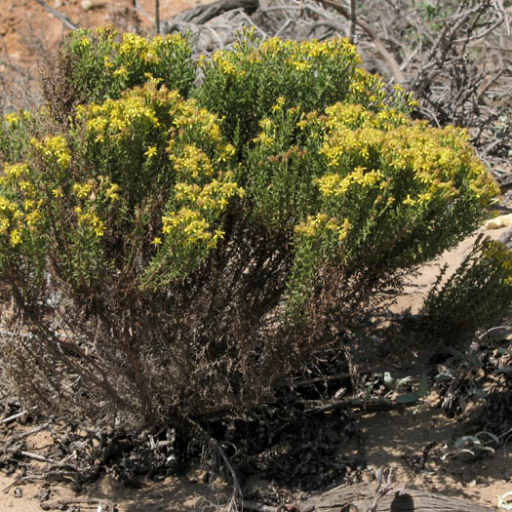
Plant Overview
Often called "Mock Heather" because of its tiny, needle-like foliage, Ericameria ericoides is a resilient California native that thrives where other plants struggle. It paints the coastal dunes in a brilliant yellow glow late in the season, acting as a beacon for migrating butterflies. This hardy shrub is a master of survival in salt-sprayed, wind-swept landscapes, proving that beauty can be tough as nails.
🔍 How to Identify
- 🌿 The "Heather" Look: The leaves are tiny, narrow, and clustered together in small bundles. They look remarkably like true Mediterranean heather (Erica), which is how the plant earned its name.
- 🌼 Late-Season Blooms: It produces dense clusters of bright yellow, daisy-like flower heads that erupt at the tips of the branches from late summer through autumn.
- 🪵 Mounded Habit: It typically grows as a low, rounded, evergreen shrub, usually reaching 1 to 3 feet in height, with woody stems that become gnarled with age.
🏡 In Your Garden
- 🏖️ Coastal Warrior: This plant is incredibly salt-tolerant and thrives in sandy, fast-draining soil. It is a top choice for "ocean-front" gardening where salt spray would wither most other species.
- 🦋 The Autumn Buffet: Because it blooms when many other plants have finished, it serves as a vital nectar source for migrating butterflies and native bees during the lean months of October and November.
- ✂️ Pruning Nuance: While it is low-maintenance, it can become "leggy" over time. A light shearing after the flowers fade helps maintain its tidy, pincushion shape, but be careful not to cut back into the old, leafless wood.
⚠️ Safety & Toxicity
- ✅ General Safety: Ericameria ericoides is generally considered non-toxic to humans and common household pets.
- 🧴 Sticky Resins: The foliage and flower heads can be somewhat resinous or "sticky" to the touch. While not dangerous, the resin may cause mild skin irritation for people with highly sensitive skin or those with specific allergies to the Sunflower family.
✨ Fun Fact
Despite its name and appearance, this plant isn't related to Heather at all! It is actually a member of the Asteraceae (Sunflower) family. It is a prime example of "convergent evolution," where two unrelated plants evolve similar physical traits to survive in similar harsh environments.

Detailed Care Instructions
To grow an Ericameria Ericoides plant, commonly known as Goldenbush, you can follow these steps:
- Climate and location: Goldenbush is native to arid regions of North America, so it thrives in dry and sunny areas. Ensure that the climate in your region is suitable for this plant, as it requires full sun.
- Soil: Prepare well-draining soil for the plant. Goldenbush prefers sandy or loamy soil with a slightly acidic to neutral pH level. If your soil is heavy and clay-like, consider adding organic matter or sand to improve drainage.
- Planting: Goldenbush can be grown from seeds or cuttings. If using seeds, plant them in the spring or fall when the soil is warm. Lightly cover the seeds with soil and keep them moist until they germinate. If using cuttings, take 4-6 inch (10-15 cm) cuttings from a healthy plant and plant them directly in well-drained soil.
- Watering: Initially, water the newly planted Goldenbush regularly until it establishes its root system. Once established, Goldenbush is drought-tolerant and does not require frequent watering. Water sparingly, only when the soil becomes dry.
- Pruning: Goldenbush benefits from regular pruning to maintain its shape and stimulate growth. Prune in early spring before new growth appears, removing any dead or damaged branches and shaping the plant as desired.
- Fertilizer: Goldenbush typically does not require heavy fertilization. However, if your soil is poor, you can apply a slow-release, balanced fertilizer in early spring.
- Pest and disease control: Goldenbush is generally resistant to pests and diseases. However, occasional checks for common garden pests like aphids, spider mites, or leaf-mining flies are still recommended. If necessary, use appropriate organic insecticides or insecticidal soaps to control pests.
- Mulching: Applying a layer of organic mulch around the base of the Goldenbush can help conserve soil moisture and suppress weeds. However, ensure that the mulch is not in contact with the stem to prevent rotting.
Remember to consult local nurseries or gardening experts for specific advice tailored to your region and conditions.

Place in a bright room that is sun drenched almost all day. Or directly in a south-facing window.

To properly water this plant, it is important to take into consideration the soil moisture level and local weather conditions. The Ericameria Ericoides plant prefers well-draining soil that is slightly moist but never soggy. Water should be given moderately and only when the soil has dried out between watering sessions.
If the plant is in a container, it is important to ensure drainage holes are functioning properly to allow excess water to escape to avoid water-logging the roots. During hot, dry spells, the plant may require more frequent watering. However, avoid over-watering as this can cause root rot or fungal infections which can eventually lead to the plant’s death.
When watering, it is recommended to apply water directly to the soil around the plant's roots, avoiding getting water on the leaves or stem. This helps prevent disease, pest infestation, and moisture loss. In winter, water should be reduced, as the plant enters its dormant phase and requires minimal moisture.
Overall, proper watering of the Ericameria Ericoides plant minimizes stress, encourages healthy growth, and ensures long-term plant survival.
For optimal growth, apply a balanced fertilizer with equal amounts of nitrogen, phosphorus, and potassium during the early spring months. Use a slow-release fertilizer to avoid over-fertilization. Apply fertilizer at half the recommended rate for young plants and gradually increase to the full rate as the plant matures. Avoid applying fertilizer during droughts or hot weather, as this can stress the plant. Water the fertilizer in thoroughly and maintain consistent moisture levels to promote healthy growth.
Ericameria ericoides, commonly known as the "mock goldenrod plant," prefers well-draining soils that are slightly acidic and have a sandy texture. The ideal soil for this plant typically contains a mixture of organic matter, sand, and loam. It's important to select a soil that holds moisture but doesn't become waterlogged, as Ericameria ericoides generally does not tolerate water-saturated soils. Incorporating compost or other organic matter into the soil can help improve soil fertility and structure, but it's essential to avoid using soils that are too rich in nutrients, as this can cause excessive growth that may negatively impact the plant's overall health. The ideal soil pH for this plant ranges from 6.0 to 7.5, with a pH closer to 6.5 being ideal. Maintaining proper soil conditions is essential to ensure that the plant can thrive and produce beautiful clusters of yellow flowers.
Ericameria Ericoides can be propagated through stem cuttings. To do this, select a healthy stem from the plant and cut a section that is approximately 4 to 6 inches long. Remove any leaves or buds from the bottom of the stem, leaving only the top leaves intact. Dip the cut end of the stem in rooting hormone and plant it in a well-draining potting mix. Water the cutting and keep it in a warm, bright location with indirect sunlight. Mist the cutting regularly to keep the soil moist. Within a few weeks, roots should begin to form, and once they are fully developed, the new plant can be transplanted into its permanent location.








