Plant Overview
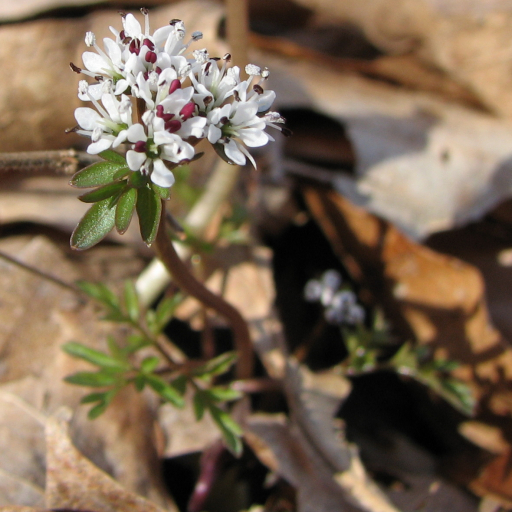
Often called the "Harbinger-of-spring" or "Pepper-and-salt," Erigenia bulbosa is a tiny, delicate wildflower that acts as nature’s first alarm clock in the deciduous forests of eastern North America. It is one of the earliest native plants to bloom, often peeking through the leaf litter while the air is still crisp and other plants are still dormant. This "spring ephemeral" lives a fast-paced life, blooming and seeding before the trees above it even grow their leaves.
🔍 How to Identify
- 🌸 Peppered Blooms: The plant features small clusters of tiny white flowers. Its most striking feature is the dark reddish-purple to black anthers that stand out against the white petals, giving it its "pepper-and-salt" nickname.
- 🌿 Lacy Foliage: The leaves are highly divided and fern-like, resembling parsley. They often have a slightly purplish tint when they first emerge from the soil.
- 📏 Low Profile: This is a true "belly plant"—you’ll need to get close to the ground to appreciate it, as it rarely grows taller than 3 to 6 inches.
🏡 In Your Garden
- 🍂 Woodland Mimicry: To keep this plant happy, you must mimic the forest floor. It requires rich, moist, undisturbed soil and the specific cycle of a hardwood forest: bright sun in the very early spring and deep shade provided by a leaf canopy in the summer.
- ⏳ Dormancy Strategy: Because it is an ephemeral, the entire above-ground portion of the plant will wither and vanish by early summer. It survives the rest of the year as a small, round underground tuber, which stores all the energy it needs to "wake up" the following February or March.
⚠️ Safety & Toxicity
- ✅ Status: Erigenia bulbosa is generally considered non-toxic to humans and common household pets.
- ⚠️ The Family Risk: While this specific plant is safe, it belongs to the Apiaceae (Carrot) family, which includes some of the most "deadly" look-alikes in nature, such as Poison Hemlock. Always exercise extreme caution when identifying wild plants with lace-like leaves.
✨ Fun Fact
❄️ Natural Antifreeze: The Harbinger-of-spring is so determined to be first that it has evolved a high concentration of dissolved salts and sugars in its cell sap. This acts as a biological antifreeze, allowing the delicate flowers to survive being buried under a sudden late-winter snowfall without the cells bursting.

Detailed Care Instructions
To grow Erigenia bulbosa, follow these steps:
- Obtain seeds or bulbs: Erigenia bulbosa is also known as the harbinger-of-spring or salt and pepper, and it is primarily propagated through seeds or bulbs. Look for a reputable plant nursery or online seed supplier to obtain the seeds or bulbs.
- Determine the planting time: Erigenia bulbosa is a spring ephemeral plant that emerges in early spring and goes dormant by early summer. Plant the seeds or bulbs in late winter or early spring, ideally when the soil temperature is still cool.
- Choose a suitable location: Erigenia bulbosa thrives in partial to full shade environments. Select a spot that receives dappled sunlight or is shaded for a significant portion of the day. Ensure that the soil is well-draining and rich in organic matter.
- Prepare the soil: Prior to planting, loosen the soil in the designated area using a garden fork or a tiller. Remove any weeds or debris and amend the soil with compost or well-rotted manure to improve its fertility and drainage.
- Plant the seeds or bulbs: If using seeds, scatter them on the prepared soil and gently press them into the ground. If using bulbs, plant them 2-3 inches deep with the pointed end facing upwards. Space the plants approximately 4-6 inches apart to allow for their spreading growth habit.
- Water regularly: Keep the planted area consistently moist, especially during the germination period and the plant's active growth stage. Avoid overwatering to prevent waterlogged soil, which can lead to bulb rot.
- Mulch the area: Apply a layer of organic mulch, like shredded bark or straw, around the plants. Mulch helps to retain moisture, suppress weed growth, and maintain a cool soil temperature.
- Provide care and maintenance: Continue watering the plants throughout the growing season, especially during dry spells. Erigenia bulbosa is a low-maintenance plant and does not require frequent fertilization. However, you can apply a balanced slow-release fertilizer once a year in early spring.
- Enjoy the flowers: Erigenia bulbosa typically blooms in early spring, producing white flowers with delicate pinkish-red accents. Enjoy the beauty of the blooms while they last, as the plant will gradually go dormant by summer. Allow the foliage to die back naturally, as it provides nutrients for the bulb's growth.
By following these steps, you can successfully grow Erigenia bulbosa and enjoy its lovely spring display in your garden.

Place in a window with dappled sun or a spot in the middle of a room. Or directly in a window facing west or east.

Erigenia Bulbosa is a plant that requires regular watering, especially during its growing season. It is important to ensure that the soil is consistently moist, but not overly saturated, as excessive water retention can cause root rot.
To water Erigenia Bulbosa, you should begin by checking the soil moisture level regularly. This can be done by inserting your finger about an inch into the soil and feeling if it feels dry or moist. If the soil feels dry, it is time to water the plant.
When watering Erigenia Bulbosa, you should use a watering can or a hose with a nozzle to gently water the soil around the plant. Make sure to water all areas of the soil around the plant evenly, and avoid getting water on the foliage or bulbs.
It is recommended to water Erigenia Bulbosa once per week, and increase watering frequency during particularly hot or dry weather. Additionally, you should reduce watering frequency during the dormant season.
Overall, it is important to monitor the soil moisture level and adjust watering frequency accordingly to ensure that Erigenia Bulbosa receives the appropriate amount of water for its optimal growth and development.
To properly fertilize this plant, it is recommended to apply a balanced fertilizer with equal amounts of nitrogen, phosphorus, and potassium. This should be done once a year, preferably in the spring before new growth begins. Be sure not to over-fertilize, as this plant prefers a more natural and low-nutrient soil environment.
Erigenia Bulbosa plant requires a specific type of soil that is rich in nutrients and well-draining. It prefers a soil that is slightly acidic with a pH range of 5.5-6.5. The soil should also be loamy, which means it should have a mixture of sand, silt, and clay with a good amount of organic matter. This type of soil allows for proper aeration and drainage while retaining enough moisture for the plant's root system. A mixture of peat moss, perlite, and vermiculite is a great option for this plant. Additionally, it is essential to ensure that the soil is not compacted or waterlogged as it can lead to root rot and damage.
Erigenia bulbosa can be propagated through several methods. The most common and effective way is through division of the plant's rhizomes. This can be done either during the fall, when the leaves of the plant have died off, or early in the spring before the plant's foliage emerges.
To propagate the plant through division, first dig up the entire plant and gently shake off any excess soil. Carefully separate the individual rhizomes, making sure that each one has at least one healthy shoot and root system. Replant the divisions in a suitable location with well-drained soil, ensuring that each are planted at the same depth as they were previously.
Another way to propagate Erigenia bulbosa is through sowing of its seeds. Collect ripe seeds from the plant during the fall and sow them immediately, as they have a short viability period and may not germinate if stored for too long. Sow the seeds in a well-drained soil mix and keep them moist until they germinate. Once the seedlings have emerged, thin them out and transplant them to their permanent location in the garden.
Propagation through cutting is also possible, although this method is less reliable. Cuttings should be taken in the spring from healthy shoots that have not yet flowered. Dip the cut ends in rooting hormone and plant them in a well-drained soil mix. Keep the soil moist and provide adequate light until the cuttings have rooted and are established enough to transplant to their permanent location.








