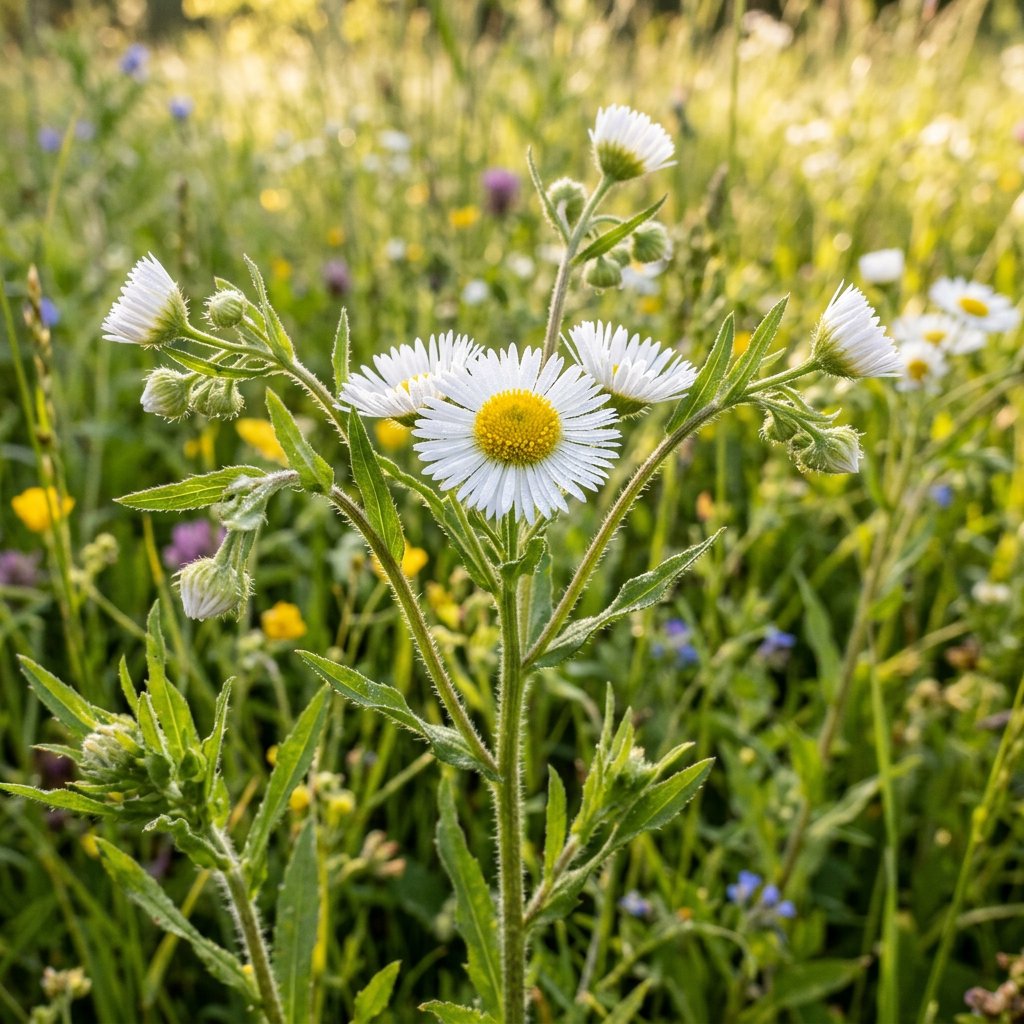
Plant Overview
Often called the Eastern Daisy Fleabane or the "Annual Fleabane," this wildflower is a master of the summer meadow. While many gardeners initially mistake it for a common daisy, its delicate, fringe-like petals give it a softer, almost ethereal appearance. In the language of flowers, it represents a "pioneer spirit," as it is one of the first plants to bloom in disturbed soils or forgotten garden corners.
🔍 How to Identify
- 🌼 The Flower Head: Each bloom is small (about 1/2 to 3/4 inch) with a bright golden-yellow center surrounded by 40–100+ very thin, thread-like white or pale lavender ray petals.
- 🌿 The Foliage: The leaves are alternate, lance-shaped, and usually have coarse teeth along the edges. The lower leaves are larger and broader than those near the top.
- 🖋️ The Stem: The main stem is upright, slightly hairy, and branches out significantly at the top to form a flat-topped cluster of numerous flowers.
🏡 In Your Garden
- 🐝 Pollinator Buffet: This plant is a superstar for biodiversity. It attracts a massive variety of small beneficial insects, including hoverflies, soldier beetles, and tiny carpenter bees that larger garden flowers might ignore.
- 🌱 Soil Health: It thrives in "tired" or compacted soil. If you find it growing in your yard, it is likely working to stabilize the ground and prevent erosion with its fibrous root system. It is very easy to pull if it spreads too far, but many keep it for its meadow-like charm.
⚠️ Safety & Toxicity
- ✅ Generally Safe: Erigeron annuus is considered non-toxic to humans, cats, dogs, and horses. It is a frequent inhabitant of pastures where livestock graze without issue.
- 🧤 Skin Sensitivity: While not poisonous, the tiny hairs on the stems can cause mild skin irritation or "contact dermatitis" in people with sensitive skin. It’s best to wear gloves if you are weeding large patches of it.
✨ Fun Fact
The name "Fleabane" comes from an ancient (but mistaken) belief that the dried flowers of this plant could be burned or stuffed into mattresses to drive away fleas. While it doesn't actually kill pests, the name has stuck for centuries!

Detailed Care Instructions
To grow Erigeron annuus, also known as Common Fleabane or daisy fleabane, you can follow these steps:
- Choose the right location: Erigeron annuus prefers full sun to part shade, so select a spot in your garden that receives at least six hours of direct sunlight each day.
- Prepare the soil: Fleabane enjoys well-draining soil, so make sure to prepare the soil by removing any weeds, rocks, and debris. Amend the soil with organic matter, such as compost or well-rotted manure, to improve its fertility and drainage.
- Sow the seeds: Erigeron annuus can be grown from seeds. Sow the seeds directly into the prepared soil in early spring after the last frost has passed. Scatter the seeds over the soil surface and lightly press them down. Keep a spacing of about 12-18 inches between each seed to allow for adequate growth.
- Watering: Keep the soil moist but not waterlogged during the germination period. Once the plants are established, they are quite drought-tolerant and only require occasional watering during prolonged dry spells.
- Thin the seedlings: Once the seedlings reach a height of a few inches, thin them out to provide sufficient space for growth. Remove the weaker seedlings, leaving about 12-18 inches between the remaining plants.
- Mulching: Apply a layer of organic mulch, such as straw or wood chips, around the plants to help conserve moisture, suppress weeds, and provide insulation for the roots during extreme temperatures.
- Maintenance: Fleabane is relatively low-maintenance. Remove any weeds that may compete with the plants for nutrients and sunlight. Deadhead the flowers regularly to encourage continuous blooming and prevent self-seeding.
- Pests and diseases: Erigeron annuus is generally resistant to most pests and diseases. However, keep an eye out for common garden pests like aphids or snails, and take appropriate measures to control them if necessary.
- Propagation: If you wish to propagate Erigeron annuus, you can collect the seeds after the flowers have faded and dried on the plant. Store the seeds in a cool, dry place until you are ready to sow them in the following season.
By following these guidelines, you can successfully grow Erigeron annuus and enjoy its lovely daisy-like flowers in your garden.

Place in a bright room that is sun drenched almost all day. Or directly in a south-facing window.

To water this plant, fill a watering can with room temperature water and gently pour it over the soil at the base of the plant until the soil is moist but not waterlogged. Avoid getting water on the leaves as this can promote disease. Check the soil regularly and only water when the top layer feels dry to the touch. Adjust the frequency of watering according to the weather, as the plant may need more water during hot and dry periods. It is important not to overwater this plant to prevent root rot.
- Start by choosing a well-draining soil for your plant to grow in. A mixture of organic matter and sand will help provide the necessary nutrients.
- Apply a balanced fertilizer that is rich in nitrogen, phosphorus, and potassium. Use a slow-release fertilizer or a liquid fertilizer every two weeks during the growing season.
- Water your plant deeply and regularly to ensure that it stays hydrated. Do not let the soil dry out completely between waterings.
- To promote healthy growth, remove any dead or yellowing foliage and spent flowers from the plant.
- In the fall, cut back the plant to a few inches above the soil line to encourage new growth in the spring.
- For best results, plant your Erigeron Annuus in a sunny area that receives at least six hours of direct sunlight per day.
Erigeron Annuus grows well in well-draining, loamy soil that is rich in organic matter. The soil should have a pH between 5.0 and 7.5. It prefers a slightly acidic to neutral soil. Avoid using heavy or clay soils, as they can hinder root development. The plant also requires good air circulation, so soil should not be tightly compacted or waterlogged. It is important to ensure that the soil remains moist but not waterlogged. Adding a layer of organic mulch around the base of the plant can help to retain moisture and regulate temperature fluctuations. Soil should be fertilized with a balanced, all-purpose fertilizer every two to three weeks during the growing season.
To propagate this plant, start by selecting a healthy stem and cut it just below a node. Remove any leaves from the lower 2/3 of the stem. Dip the cut end in rooting hormone powder and plant it in a well-draining potting mix. Cover the pot with a clear plastic bag or wrap to create humidity. Place the pot in a bright, indirect light and keep the soil moist. After a few weeks, roots should start to form. Once the plant has developed a strong root system, it can be transplanted into a larger container or into the garden.
Common pests of the annual fleabane include Spider mites, aphids, larvae. Make a habit of checking your annual fleabane frequently for pests so that any infestations can be caught and managed early.








