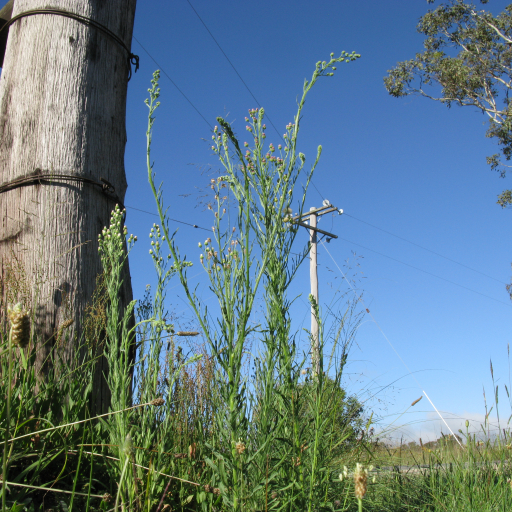
Plant Overview
Often called the Hairy Fleabane or Flax-leaf Fleabane, this South American native has traveled the globe as a hardy, uninvited guest. While many gardeners view it as a stubborn weed, it possesses a rugged, silvery beauty and an incredible ability to thrive where other plants fail. It is a master of colonization, often seen standing tall in sidewalk cracks and neglected urban spaces.
🔍 How to Identify
- 🌿 Silvery Foliage: The entire plant has a distinct grayish-green hue caused by a dense coating of fine, stiff hairs that protect it from drying out.
- 📏 Stiff, Upright Stature: It grows remarkably straight and tall, often reaching up to three feet, with narrow, lance-shaped leaves that give it a "flax-like" appearance.
- ☁️ "Shaving Brush" Blooms: Unlike its showy daisy cousins, its flowers are tiny and lack large petals. They look like miniature, cream-colored shaving brushes or fuzzy cotton balls once they go to seed.
🏡 In Your Garden
- 🌱 The Ultimate Opportunist: This plant thrives in "disturbed" soil. If you have recently tilled a garden bed or left a patch of earth bare, the Fleabane will likely be the first to move in.
- 💪 The Taproot Strategy: It develops a deep, sturdy taproot very quickly. This makes it drought-tolerant but difficult to pull out once it matures; it is much easier to remove when the soil is damp.
- 🪁 Wind-Borne Travelers: A single plant can produce tens of thousands of seeds equipped with tiny "parachutes." If you don't want it spreading, it is vital to remove the flower heads before they turn into white fluff.
⚠️ Safety & Toxicity
- 🤧 Mild Irritant: The bristly hairs on the leaves and stems can cause "mechanical irritation" (itchiness) on sensitive skin. It’s a good idea to wear gloves when weeding.
- 🐾 Pet Watch: While not listed as highly toxic, the plant is not palatable. Ingesting large amounts of wild weeds can cause minor stomach upset in curious dogs or cats.
- 💨 Allergy Note: Like many members of the Aster family, its pollen can be a trigger for those who suffer from seasonal hay fever.
✨ Fun Fact
- 🧬 A Botanical Rebel: Erigeron bonariensis is famous among scientists for its "super-weed" status; it was one of the first species globally to develop a natural resistance to several common chemical herbicides!

Detailed Care Instructions
To grow Erigeron bonariensis, also known as Argentine Fleabane or Purpletop Vervain, follow these steps:
- Choose a suitable location: Erigeron bonariensis thrives in full sunlight, so select a location where the plant will receive at least 6 hours of direct sunlight daily.
- Soil preparation: This plant prefers well-draining soil. Before planting, ensure that the soil is amended with compost or organic matter to improve its fertility and drainage.
- Planting: Dig a hole twice the size of the plant's root ball. Place the Erigeron bonariensis in the hole, ensuring that the top of the root ball is level with the soil surface. Backfill the hole with soil, gently firming it around the plant.
- Watering: Water the plant thoroughly after planting to help settle the soil. Afterward, water when the top few inches of soil are dry. Avoid overwatering, as Erigeron bonariensis prefers slightly drier conditions.
- Mulching: Apply a layer of mulch around the plant to retain moisture, suppress weed growth, and maintain consistent soil temperatures. It also helps protect the plant during winter.
- Fertilization: This plant generally does not require frequent fertilization. In early spring, apply a balanced, slow-release fertilizer according to the product's instructions.
- Pruning: Erigeron bonariensis benefits from occasional pruning to encourage bushier and more compact growth. Cut back the plant by about one-third of its height after the flowering season to stimulate new growth and prevent it from becoming leggy.
- Propagation: Erigeron bonariensis can be propagated through division or seed. Divide mature plants in early spring or fall, ensuring each division has healthy roots. For seed propagation, collect seeds after the flowering season and sow them in well-draining soil in prepared seed trays. Keep the soil moist until germination occurs.
- Pest and disease control: This plant is generally resistant to pests and diseases. However, occasionally, aphids or spider mites may infest the plant. Keep an eye out for these pests and take appropriate measures if necessary, such as spraying with insecticidal soap or a strong stream of water.
By following these steps, you can successfully grow Erigeron bonariensis in your garden or landscape.

Place in a bright room that is sun drenched almost all day. Or directly in a south-facing window.

Erigeron Bonariensis plant requires a consistent watering schedule to ensure healthy growth. The soil should be kept consistently moist, but not waterlogged, as this can lead to root rot. It is important to water the plant from the base rather than from above the foliage to minimize the risk of developing plant diseases.
Water the plant deeply once or twice a week, depending on the climate and soil conditions. Pay attention to the soil surface to determine if it is dry or moist before watering. During prolonged droughts, watering may be increased to prevent the soil from becoming too dry.
To improve water retention in the soil, add a layer of mulch around the base of the plant or mix in organic matter such as compost into the soil. Additionally, consider planting the Erigeron Bonariensis plant in an area with well-draining soil to prevent standing water.
Regularly check the soil moisture levels and adjust the watering schedule as needed to ensure the plant receives enough moisture without becoming overwatered.
To best fertilize this plant, it is recommended to use a balanced fertilizer with equal amounts of nitrogen, phosphorus, and potassium. This should be applied once a month during the growing season, starting in early spring and ending in late summer. Be sure to apply the fertilizer evenly to the soil around the base of the plant and water thoroughly after application. Avoid over-fertilizing as it can lead to excessive growth and reduced overall health of the plant.
Erigeron Bonariensis plant prefers well-draining soil with good air circulation. Sandy loam, clay loam, and rocky soils are all suitable for this plant. The soil pH should be between slightly acidic to neutral (pH 6.0-7.0) for optimal growth. It does not tolerate waterlogged soils, and therefore, you should avoid using heavy clay soils. Organic-rich soil, with a mixture of compost or well-rotted manure, can help in retaining moisture and providing the plant with necessary nutrients. Adding sand or perlite to the soil mix can also improve drainage. Before planting, amend the soil with the appropriate fertilizer or nutrients your plant requires.
Erigeron Bonariensis can be propagated through stem cuttings. To do this, select a healthy stem with no diseases or damages. Cut a 4-6 inch section of the stem from the main plant using a sharp, sterile pair of scissors or garden pruners. Strip the lower leaves, leaving only two to three pairs of leaves at the top of the cutting.
Next, dip the bottom end of the stem cutting in rooting hormone powder. This will help the cutting develop roots faster. Insert the cutting into a well-draining soil mix or a mixture of sand and peat moss. Water the soil lightly and cover the pot or tray with a plastic bag to create a humid environment. Place the cutting in a bright but indirect light area.
After 4-6 weeks, the cutting should start developing roots. To check, gently tug on the stem to see if it is anchored in the soil. Once roots have developed, slowly acclimate the cutting to more sunlight and eventually transplant it to its permanent location when it has grown sufficiently and is ready.








