Plant Overview
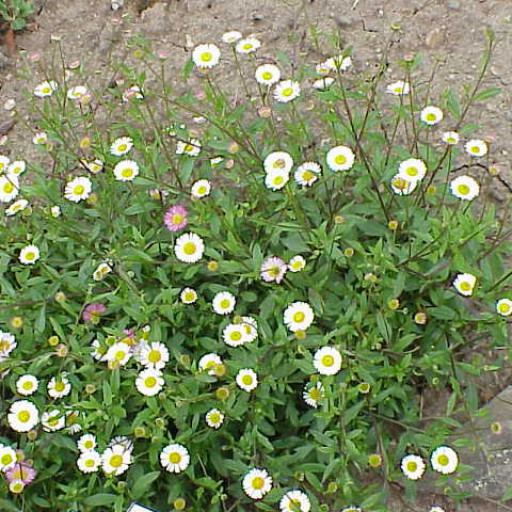
Often called the Mexican Fleabane or the "Santa Barbara Daisy," this charming perennial is the ultimate master of the cottage garden aesthetic. It is famous for its "unstoppable" nature, often found spilling over stone walls or sprouting cheerfully from tiny cracks in old brickwork. Originally hailing from Mexico and Central America, it has become a global favorite for gardeners who want a romantic, "wild" look with almost zero effort.
🔍 How to Identify
- 🌼 Color-Changing Blooms: The most striking feature is that the flowers change color as they age. A single clump will simultaneously show pure white, soft pink, and deep lavender-purple daisies.
- 🍳 Golden Centers: Each tiny flower (about 1cm wide) features a bright yellow central disc, giving it the appearance of a miniature fried egg.
- 🌿 Wiry Growth: It grows on thin, prostrate stems that form a dense, cascading mound. The stems are tough and flexible, allowing them to trail down vertical surfaces.
- 🍃 Narrow Foliage: The leaves are small, hairy, and lance-shaped. They are a muted grayish-green, providing a soft backdrop that lets the colorful flowers pop.
🏡 In Your Garden
- 🧗 The Crevice Specialist: Unlike many plants that demand deep, rich soil, this daisy thrives in "liminal spaces." It loves the lime in mortar and the heat of stone, making it the perfect choice for softening garden steps or filling gaps in rockeries.
- ☀️ Drought Resilience: This plant is a sun-worshiper. Once its roots are tucked into a cool crack between stones, it can survive long periods of drought, making it an excellent "set it and forget it" addition to Mediterranean-style gardens.
- 🌱 Gentle Wanderer: It spreads primarily through self-seeding. While it is prolific, it isn't usually considered aggressive; it simply "finds" the spots where other plants refuse to grow.
⚠️ Safety & Toxicity
- ✅ General Safety: Erigeron karvinskianus is not known to be toxic to humans or common household pets.
- 🐾 Mild Irritant: While safe, the hairy texture of the leaves can occasionally cause very mild skin irritation for people with highly sensitive skin or cause a bit of a "scratchy" throat if a curious pet decides to chew on a large amount.
✨ Fun Fact
This humble "weed" is actually a high-fashion icon in the horticulture world. It has received the prestigious Award of Garden Merit from the Royal Horticultural Society and is a staple at the Chelsea Flower Show, where designers use it to make brand-new gardens look instantly established and historic.

Detailed Care Instructions
To grow Erigeron karvinskianus (also known as Santa Barbara daisy or Mexican fleabane), follow these steps:
- Choose a suitable location: Erigeron karvinskianus prefers full sun, but it can tolerate partial shade. Ensure the soil is well-draining to prevent root rot.
- Prepare the soil: Amend the soil with organic matter like compost or aged manure to improve its fertility and drainage. Erigeron karvinskianus can grow in various soil types, including sandy, loamy, or rocky soils.
- Sow seeds or plant seedlings: Erigeron karvinskianus can be grown from seeds or nursery-bought seedlings. If starting from seeds, sow them in a seed tray filled with potting mix and lightly cover them with a thin layer of soil. Keep the soil consistently moist until germination occurs. Transplant seedlings into the garden when they are about 2-3 inches (5-8 cm) tall. Alternatively, directly sow seeds in the garden, 6-8 inches (15-20 cm) apart.
- Watering: Water the plant regularly, especially during dry spells. Allow the soil to dry out slightly between watering to prevent overwatering, as excessive moisture can cause root rot.
- Fertilization: Apply a balanced, slow-release fertilizer according to the manufacturer's instructions during the growing season. Alternatively, you can apply a liquid fertilizer diluted to half strength every 2-3 weeks during the active growth period.
- Pruning: Erigeron karvinskianus is a low-growing, spreading perennial, but it can become leggy and overgrown if not pruned. Regularly trim back the plant to maintain a compact shape and encourage bushier growth. Remove dried flowers to encourage continuous blooming.
- Mulching: Apply a layer of organic mulch, like wood chips or straw, around the plant to help conserve moisture, suppress weed growth, and regulate soil temperature.
- Propagation: Erigeron karvinskianus can be propagated by dividing established clumps in early spring or by taking softwood cuttings in early summer. Ensure the new divisions or cuttings are planted in suitable soil conditions and kept moist until they establish roots.
By following these guidelines, you should be able to successfully grow Erigeron karvinskianus and enjoy its beautiful daisy-like flowers.

Place in a window with dappled sun or a spot in the middle of a room. Or directly in a window facing west or east.

To water this plant, ensure that the soil has thoroughly dried out before watering. This can be determined using a moisture meter or by sticking your finger into the soil up to your knuckle and feeling for any moisture. When watering, pour water directly onto the soil around the plant's base and avoid getting water on the leaves. Steer clear of overwatering as this plant prefers dry to moderately moist soil. Given that it is a drought-tolerant plant, it is important to not leave it sitting in standing water as it can cause root rot.
To fertilize this plant, apply a slow-release fertilizer once in early spring when new growth begins, and then again in mid-summer. Water the plant deeply before applying fertilizer, and then scatter the granules evenly around the base of the plant. Avoid getting fertilizer on the foliage or flowers. Water deeply after applying fertilizer to help it work into the soil.
To grow this plant, it is recommended to use well-draining soil with good water retention capacity. The soil pH should be slightly acidic to neutral (pH 6.0-7.0). The plant prefers a soil that is rich in organic matter and nutrients. Avoid using heavy soils with high clay content as they can become waterlogged and lead to root rot. A mixture of 1 part loam, 1 part sand, and 1 part compost is a good recipe for Erigeron Karvinskianus. Adding perlite or vermiculite to increase drainage can also be helpful. It is important to keep the soil moist but not waterlogged to prevent any fungal diseases. Regular fertilizing with a balanced, slow-release fertilizer can help promote healthy growth and flowering.
To propagate this particular plant, you will need to take stem cuttings. First, locate a healthy and mature plant with numerous stems. Using a clean and sharp pair of scissors or pruning shears, cut a few stem pieces that are at least 6 inches long each.
Remove any lower leaves from the stems, leaving only the top few leaves intact. Dip the cut end of each stem into a rooting hormone powder to encourage root growth.
Next, fill a small pot or container with moistened potting soil. Create a small hole in the soil and insert the cut end of the stem into the hole, burying it about an inch deep.
Water the newly planted cuttings gently, being careful not to overwater and cause waterlogged soil. Keep the soil consistently moist and cover the container with a plastic bag to create a mini greenhouse and retain moisture.
Place the container in an area with bright, indirect light and moderate temperatures. Check on the cuttings every few days and mist them with water if the soil feels dry. After a few weeks, new growth and roots should begin to appear.
Once the new plants are established with healthy root systems, they can be transplanted into larger pots or directly into the ground.
Common pests of the mexican fleabane include Spider mites, aphids, larvae. Make a habit of checking your mexican fleabane frequently for pests so that any infestations can be caught and managed early.








